Short Communication - (2025) Volume 15, Issue 4
Received: 03-Aug-2025, Manuscript No. jprm-25-174463;
Editor assigned: 06-Aug-2025, Pre QC No. P-174463;
Reviewed: 19-Aug-2025, QC No. Q-174463;
Revised: 25-Aug-2025, Manuscript No. R-174463;
Published:
30-Aug-2025
, DOI: 10.37421/2161-105X.2025.15.756
Citation: Kowalski, Peter. ”PE: Diagnosis, Acute and Chronic Management.” J Pulm Respir Med 15 (2025):756.
Copyright: © 2025 Kowalski P. This is an open-access article distributed under the terms of the Creative Commons Attribution License, which permits unrestricted use, distribution and reproduction in any medium, provided the original author and source are credited.
Pulmonary embolism (PE) remains a critical cardiovascular emergency with significant global impact. This review provides insights into the current understanding of acute pulmonary embolism, encompassing its worldwide prevalence, the intricate biological mechanisms underlying clot formation and migration, and the diverse ways patients typically present with symptoms. Emphasizing the recognition of varied clinical manifestations is crucial for timely diagnosis and effective management [1].
Managing acute pulmonary embolism requires a comprehensive approach, guiding clinicians through initial risk stratification, appropriate diagnostic pathways, and a spectrum of therapeutic strategies. Tailoring treatment based on individual patient risk profiles, ranging from standard anticoagulation to more advanced interventions, is a cornerstone of effective care [2].
Beyond the acute phase, the emerging concept of post-pulmonary embolism syndrome is increasingly recognized. This syndrome encompasses various manifestations, including persistent dyspnea, exercise intolerance, and chronic thromboembolic pulmonary hypertension. The need for long-term follow-up and dedicated management strategies for patients after an acute PE event cannot be overstated [3].
The complex interplay between COVID-19 and pulmonary embolism has also garnered significant attention. This area investigates unique pathophysiological mechanisms that contribute to heightened thrombotic risk in infected patients. It also highlights diagnostic challenges specific to this context and explores tailored treatment considerations for COVID-19 associated PE [4].
Accurate diagnosis of pulmonary embolism heavily relies on sophisticated imaging modalities. An overview of these techniques, such as CT pulmonary angiography, ventilation-perfusion scans, and ultrasound, critically compares their strengths and limitations. Understanding their appropriate application across different clinical scenarios is vital for optimizing diagnostic accuracy [5].
Risk stratification is a crucial element in guiding patient care for pulmonary embolism. This involves assessing the severity and prognosis of acute PE by utilizing various scoring systems and clinical parameters. Such assessments are fundamental for informed decision-making, influencing management plans from outpatient treatment to advanced interventions for high-risk individuals [6].
Chronic Thromboembolic Pulmonary Hypertension (CTEPH) stands as a severe long-term complication following pulmonary embolism. This contemporary review elucidates its diagnostic pathway, which heavily relies on multimodal imaging, and outlines current therapeutic approaches. These include surgical pulmonary endarterectomy and targeted medical therapies, all aimed at enhancing patient outcomes [7].
For specific cases, catheter-directed therapy (CDT) offers a targeted interventional approach for acute pulmonary embolism. This involves various percutaneous techniques, with discussions revolving around their indications, procedural specifics, and the clinical outcomes, particularly for patients with intermediate-to-high-risk PE who stand to benefit from rapid clot burden reduction [8].
Anticoagulation remains a cornerstone of treatment for venous thromboembolism, including pulmonary embolism. Updated understanding of anticoagulation strategies reviews the efficacy and safety profiles of direct oral anticoagulants (DOACs) in comparison to traditional therapies. This provides practical guidance on agent selection, appropriate dosing, and optimal duration of therapy, carefully considering patient characteristics and the risk of recurrence [9].
Finally, addressing pulmonary embolism during pregnancy presents unique complexities due to the increased thrombotic risk in this population. This involves navigating the inherent challenges of imaging and anticoagulant selection to ensure safety for both the mother and the fetus. Outlining tailored treatment strategies is crucial for this particularly vulnerable population [10].
Pulmonary embolism (PE) is a critical condition demanding a comprehensive understanding, from its initial presentation to long-term sequelae. Research highlights the significant global prevalence of acute PE, detailing the intricate biological mechanisms that lead to clot formation and subsequent migration within the pulmonary vasculature. It strongly emphasizes the importance of recognizing the varied and often subtle clinical manifestations patients exhibit for prompt diagnosis and effective intervention. These studies provide foundational knowledge necessary for clinicians to accurately identify and manage this life-threatening condition, improving patient outcomes worldwide [1].
Accurate and timely diagnosis of PE is paramount for initiating appropriate treatment. This process relies heavily on a suite of advanced imaging modalities, each offering unique insights. These include CT pulmonary angiography (CTPA), ventilation-perfusion (V/Q) scans, and ultrasound, among others. Each technique presents distinct advantages and limitations, making their appropriate application in diverse clinical scenarios a key decision point for medical professionals. A thorough understanding of how to best utilize these diagnostic tools ensures that patients receive the most precise and efficient assessment possible, thereby guiding subsequent treatment plans and minimizing diagnostic delays [5].
Once PE is suspected or definitively confirmed, effective management critically hinges on robust risk stratification and a highly tailored approach to treatment. Clinicians are guided through initial risk assessment, which involves utilizing various established scoring systems and comprehensive clinical parameters to accurately gauge the severity and prognosis of acute PE. This meticulous stratification process is fundamental for informed clinical decision-making, significantly influencing whether a patient can be safely managed with outpatient care or necessitates advanced, often invasive, interventions due to high-risk profiles and hemodynamic instability. The overarching goal is always to optimize patient management from the very outset, preventing adverse events and promoting recovery [2, 6].
Therapeutic strategies for PE are diverse and continuously evolving to improve patient care. Anticoagulation remains the cornerstone of treatment, with recent updates providing crucial insights into the efficacy and safety profiles of direct oral anticoagulants (DOACs) in comparison to traditional therapies like vitamin K antagonists. These guidelines offer practical guidance on agent selection, appropriate dosing regimens, and the optimal duration of therapy, all carefully customized to individual patient characteristics and their specific risk of recurrence [9]. For patients presenting with intermediate-to-high-risk PE, catheter-directed therapy (CDT) offers a valuable, minimally invasive interventional option. This involves various percutaneous techniques specifically aimed at achieving rapid clot burden reduction, with detailed discussions covering their precise indications, procedural specifics, and the anticipated clinical outcomes, particularly in scenarios where systemic thrombolysis might be contraindicated or carry high risks [8].
The impact of pulmonary embolism extends significantly beyond the acute event, with substantial long-term implications for patient quality of life. The emerging concept of post-pulmonary embolism syndrome describes a constellation of persistent symptoms such as chronic dyspnea, debilitating exercise intolerance, and impaired functional capacity, underscoring the critical necessity for extended follow-up and specific management strategies after an acute PE [3]. A more severe and potentially life-threatening long-term complication is Chronic Thromboembolic Pulmonary Hypertension (CTEPH). This debilitating condition requires a dedicated and complex diagnostic pathway, often involving multimodal imaging, and a range of highly specialized therapeutic options. These treatments include surgical pulmonary endarterectomy, which is curative in selected patients, and targeted medical therapies, all meticulously aimed at improving long-term patient outcomes and functional status [7].
Specialized considerations are also profoundly crucial for particular patient populations, where standard approaches may need modification. The intricate relationship between COVID-19 and pulmonary embolism highlights unique pathophysiological mechanisms that contribute to significantly increased thrombotic risk in infected individuals. This scenario presents specific diagnostic challenges due to overlapping symptoms and necessitates tailored treatment considerations for COVID-19 associated PE [4]. Similarly, diagnosing and managing PE during pregnancy poses distinct complexities due to the inherent heightened thrombotic risk in this physiological state. Navigating imaging choices and anticoagulant selection is exceptionally critical to ensure the safety of both the mother and the fetus, making tailored treatment strategies for this vulnerable group an absolute imperative [10].
Pulmonary embolism (PE) represents a significant global health concern, with research actively exploring its epidemiology, underlying pathophysiology of clot formation, and the diverse ways patients present clinically. Understanding these initial aspects is vital for timely diagnosis and effective management. The diagnostic process is comprehensive, leveraging various imaging modalities such as CT pulmonary angiography, ventilation-perfusion scans, and ultrasound, each with specific strengths for different clinical scenarios. Once diagnosed, managing acute PE involves careful risk stratification using established scoring systems and clinical parameters to guide treatment decisions. Therapeutic strategies span a range from systemic anticoagulation, with a focus on the efficacy and safety of direct oral anticoagulants (DOACs) compared to traditional therapies, to advanced interventions like catheter-directed therapy for higher-risk cases. Beyond acute management, there's growing recognition of long-term complications. Post-pulmonary embolism syndrome, characterized by persistent symptoms like dyspnea and exercise intolerance, requires dedicated follow-up. A particularly severe sequela, Chronic Thromboembolic Pulmonary Hypertension (CTEPH), necessitates specialized diagnostic pathways, including multimodal imaging, and specific treatments such as pulmonary endarterectomy or targeted medical therapies. Research also addresses PE in specific contexts, such as the increased thrombotic risk observed in COVID-19 patients, which presents unique diagnostic and treatment considerations, and the challenges of PE during pregnancy, where careful selection of imaging and anticoagulation is paramount for maternal and fetal safety. Collectively, this body of research underscores the multifaceted nature of PE, from initial presentation and diagnosis to acute intervention and chronic management.
None
None
1. Konstantinos PT, Sofia AX, Michael EK. "Acute Pulmonary Embolism: Epidemiology, Pathophysiology, and Clinical Presentation".Curr Cardiol Rep 25 (2023):11-24.
Indexed at, Google Scholar, Crossref
2. Kevin LO, Justin AV, Andrew DC. "Management of Acute Pulmonary Embolism: A Clinical Review".JAMA 326 (2021):1946-1955.
Indexed at, Google Scholar, Crossref
3. Daniel MG, Michael WM, David SB. "Post-Pulmonary Embolism Syndrome: A Narrative Review".Chest 161 (2022):440-447.
Indexed at, Google Scholar, Crossref
4. Junaid K, Firas AD, Muhammad W. "Pulmonary embolism in COVID-19: A review of pathophysiology, diagnosis, and treatment".Clin Med (Lond) 21 (2021):e606â??e611.
Indexed at, Google Scholar, Crossref
5. Lorenzo FR, Riccardo MI, Valentina LDT. "Imaging in Pulmonary Embolism: An Overview".Diagnostics (Basel) 12 (2022):1941.
Indexed at, Google Scholar, Crossref
6. Nicolas V, Janine CvdH, Anne MVS. "Risk Stratification and Clinical Decision Making in Pulmonary Embolism".Semin Thromb Hemost 46 (2020):147-156.
Indexed at, Google Scholar, Crossref
7. Daniel MG, Michael WM, David SB. "Chronic Thromboembolic Pulmonary Hypertension: A Contemporary Review".J Am Heart Assoc 12 (2023):e030491.
Indexed at, Google Scholar, Crossref
8. Andrew PK, William RF, Arash B. "Catheter-Directed Therapy for Acute Pulmonary Embolism".JACC Cardiovasc Interv 13 (2020):1-13.
Indexed at, Google Scholar, Crossref
9. Daniel DK, Gregory SC, Jeffrey SS. "Anticoagulation for the Treatment of Venous Thromboembolism: An Update".Am J Med 134 (2021):44-54.
Indexed at, Google Scholar, Crossref
10. Catherine LYA, Joanna RG, Clare RW. "Pulmonary Embolism in Pregnancy: Diagnosis and Management".Chest 164 (2023):1475-1487.
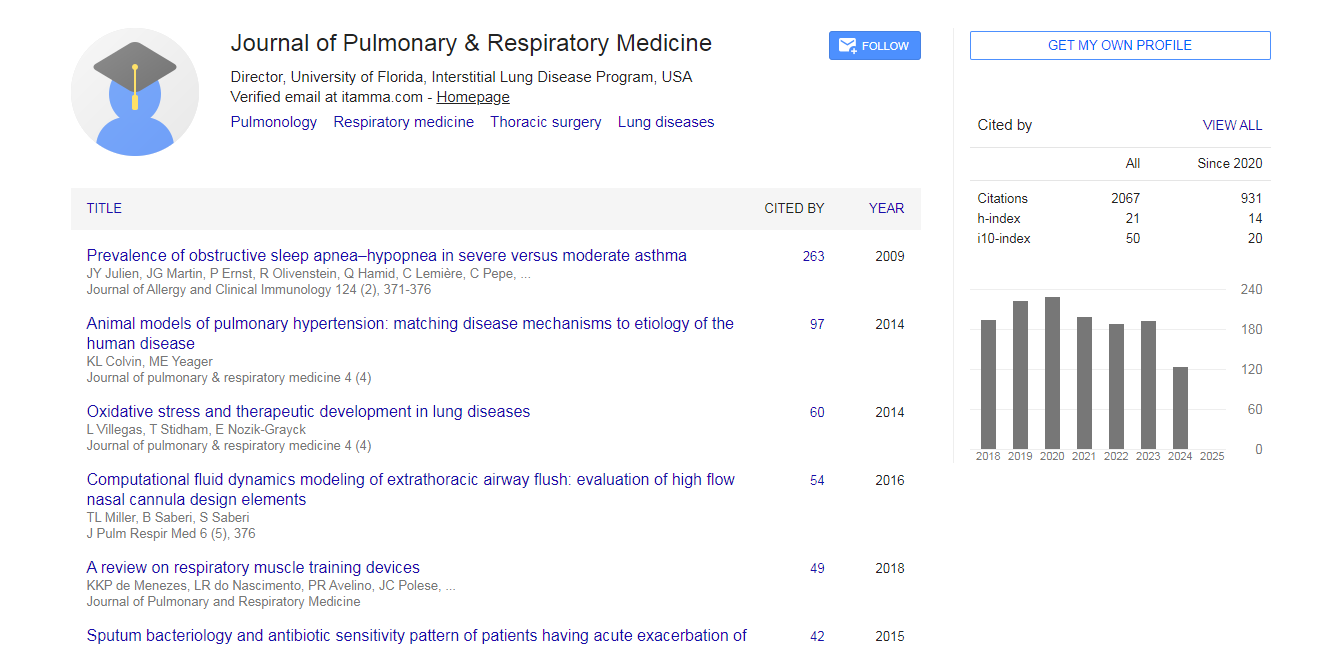
Pulmonary & Respiratory Medicine received 1690 citations as per Google Scholar report