Perspective - (2025) Volume 11, Issue 6
Received: 01-Nov-2025, Manuscript No. ldt-25-178464;
Editor assigned: 03-Nov-2025, Pre QC No. P-178464;
Reviewed: 17-Nov-2025, QC No. Q-178464;
Revised: 24-Nov-2025, Manuscript No. R-178464;
Published:
29-Nov-2025
, DOI: 10.37421/2472-1018.2025.11.338
Citation: Svensson, Helena. ”Patient-Centered Lung Disease Care: A Holistic Approach.” J Lung Dis Treat 11 (2025):338.
Copyright: © 2025 Svensson H. This is an open-access article distributed under the terms of the Creative Commons Attribution License, which permits unrestricted use, distribution and reproduction in any medium, provided the original author and source are credited.
The evolving landscape of respiratory medicine is increasingly prioritizing patient-centered care, recognizing that optimal management of lung diseases hinges on actively involving individuals in their health journey. This approach moves beyond a purely clinical perspective to encompass the unique needs, preferences, and values of each patient. A cornerstone of this paradigm is the emphasis on shared decision-making, where healthcare professionals and patients collaborate to establish treatment plans tailored to individual circumstances. This collaborative model fosters a deeper understanding of the disease and its implications, empowering patients to become active participants in their care, which is crucial for chronic conditions requiring long-term management [1].
In recent years, the integration of digital health technologies has presented novel avenues for enhancing patient engagement and support in chronic lung disease management. Telehealth platforms, mobile applications, and wearable sensors offer unprecedented opportunities for remote monitoring, real-time feedback, and personalized interventions. These tools facilitate continuous communication between patients and their healthcare providers, enabling timely adjustments to treatment and providing a sense of connection and support that can be vital for individuals managing long-term illnesses [2].
Qualitative research has shed light on the lived experiences of patients with specific conditions like interstitial lung disease (ILD), underscoring the profound importance of shared decision-making from their perspective. These studies reveal that patients desire comprehensive information, trust in their healthcare providers, and a personalized care approach that aligns with their life goals and values. Understanding these patient perspectives is critical for developing effective and compassionate care strategies that genuinely meet their needs [3].
Personalization is also a key theme in the rehabilitation of patients with chronic obstructive pulmonary disease (COPD). Tailored pulmonary rehabilitation programs, which consider individual exercise capacity, comorbidities, and personal goals, have demonstrated superior outcomes compared to generic approaches. This individualized approach optimizes improvements in symptoms like dyspnea, enhances exercise tolerance, and positively impacts health-related quality of life, highlighting the effectiveness of custom-fit interventions [4].
For individuals with advanced lung diseases, advance care planning (ACP) plays a critical role in ensuring that future care decisions align with their deeply held values and preferences. Engaging patients in open discussions about their wishes for end-of-life care, symptom management, and treatment goals can significantly reduce distress for both patients and their families. The timely and thoughtful initiation of ACP is essential for providing care that truly reflects an individual's desires during challenging times [5].
Patient-reported outcome measures (PROMs) are indispensable tools for capturing the subjective experience of living with a chronic condition. For diseases like cystic fibrosis, the development and validation of PROMs are crucial for understanding how patients perceive their disease and the impact of treatments. These measures provide invaluable, patient-generated data that informs personalized care strategies and allows for a more accurate evaluation of treatment effectiveness from the patient's viewpoint [6].
Beyond the physical aspects of lung disease, addressing the behavioral and psychological well-being of patients is paramount. Conditions like anxiety, depression, and social isolation are frequently encountered and can significantly impede treatment adherence and overall quality of life. Integrating comprehensive behavioral and psychological support, often through multidisciplinary teams, is essential for holistic patient care [7].
Effective patient education and robust self-management support are vital for empowering individuals with chronic respiratory conditions, such as asthma. Tailored educational programs that accommodate diverse learning styles equip patients with the knowledge to understand their illness, manage medications, identify triggers, and handle exacerbations effectively. This leads to improved symptom control and a reduction in healthcare utilization, such as hospitalizations [8].
Implementing patient-centered care models in clinical settings, particularly in respiratory clinics, presents both challenges and opportunities. Barriers like time constraints, resource limitations, and the need for specialized training for healthcare professionals must be addressed. However, strategies such as integrated care teams, technological advancements, and strong patient advocacy can facilitate systemic changes necessary for truly patient-centered management [9].
The field of idiopathic pulmonary fibrosis (IPF) is also benefiting from the advancements in precision medicine. By understanding the underlying genetic and molecular variations within the IPF patient population, clinicians can develop targeted therapies and personalized treatment strategies. Integrating patient-specific data into clinical decision-making holds significant promise for improving outcomes and enhancing the quality of life for individuals with this complex disease [10].
The foundational principle of patient-centered care in lung disease management underscores the critical importance of shared decision-making. This involves empowering patients by providing them with comprehensive information about their condition and treatment options, enabling them to actively participate in setting goals and making choices that align with their personal values and lifestyle. Personalized treatment plans, moving away from a one-size-fits-all approach, are essential for improving adherence and overall quality of life [1].
Digital health technologies have emerged as transformative tools in supporting patient-centered chronic lung disease management. Telehealth, mobile health applications, and wearable sensors facilitate enhanced patient engagement through continuous remote monitoring and real-time feedback. These technologies foster stronger communication channels between patients and healthcare providers, allowing for more dynamic and personalized care interventions, particularly for conditions like COPD and asthma [2].
Patient perspectives are central to understanding and improving care delivery. Qualitative studies investigating the experiences of individuals with interstitial lung disease (ILD) reveal a strong desire for involvement in treatment decisions. Their input highlights the necessity of clear information, trusting relationships with clinicians, and care plans that are sensitive to their individual life circumstances and aspirations, guiding the development of more responsive care models [3].
In pulmonary rehabilitation for COPD, personalization is key to maximizing patient benefits. Rehabilitation programs that are specifically designed to address individual factors such as exercise capacity, coexisting medical conditions, and patient-defined goals have shown greater efficacy in improving symptoms like breathlessness and enhancing exercise tolerance. This tailored approach ensures that interventions are maximally effective for each individual [4].
Advance care planning (ACP) represents a vital component of patient-centered care for individuals with advanced lung diseases. By facilitating open dialogues about future care preferences, values, and end-of-life goals, ACP ensures that medical interventions are aligned with the patient's wishes. This process not only promotes autonomy but also helps to alleviate distress for patients and their families, ensuring compassionate care throughout the illness trajectory [5].
Patient-reported outcome measures (PROMs) serve as a crucial mechanism for capturing the patient's subjective experience of their health status and the impact of treatments. In conditions such as cystic fibrosis, the creation and validation of PROMs are essential for gathering reliable data on how patients perceive their disease progression and treatment effectiveness, thereby enabling more informed and personalized care decisions [6].
Addressing the psychological and behavioral dimensions of chronic lung diseases is integral to comprehensive patient care. Patients often grapple with issues such as anxiety, depression, and social isolation, which can significantly affect their ability to adhere to treatment plans and maintain a good quality of life. A multidisciplinary approach that incorporates behavioral and psychological support is therefore indispensable [7].
Effective patient education and robust self-management support are critical for empowering individuals with asthma. Educational initiatives tailored to individual learning needs equip patients with the knowledge and skills to manage their condition effectively, including understanding medication use, recognizing triggers, and managing exacerbations. This self-efficacy translates into better symptom control and reduced reliance on emergency care [8].
The successful implementation of patient-centered care in respiratory clinics requires a systematic approach to overcome identified barriers. These challenges, including time constraints and resource limitations, can be mitigated through strategies such as team-based care, leveraging technology, and actively engaging patient advocates. Such systemic improvements are vital for the widespread adoption of patient-centered principles [9].
Precision medicine is revolutionizing the management of complex lung conditions like idiopathic pulmonary fibrosis (IPF). By characterizing the molecular and genetic heterogeneity of the disease, it becomes possible to develop targeted therapies that are more effective for specific patient subgroups. This personalized approach, driven by individual patient data, holds significant promise for improving treatment outcomes and enhancing quality of life [10].
This collection of research highlights the growing emphasis on patient-centered care in managing lung diseases. It underscores the importance of shared decision-making, personalized treatment plans, and the integration of patient-reported outcomes to improve patient quality of life and adherence. Digital health technologies offer new ways to engage patients and monitor their conditions remotely. Patient perspectives are crucial, informing the development of tailored rehabilitation programs and advance care planning. Addressing psychological well-being and providing robust patient education are also key components. While challenges exist in implementing these models, precision medicine is offering new avenues for targeted therapies. Ultimately, a holistic and individualized approach is essential for optimizing care for individuals with lung diseases.
None
None
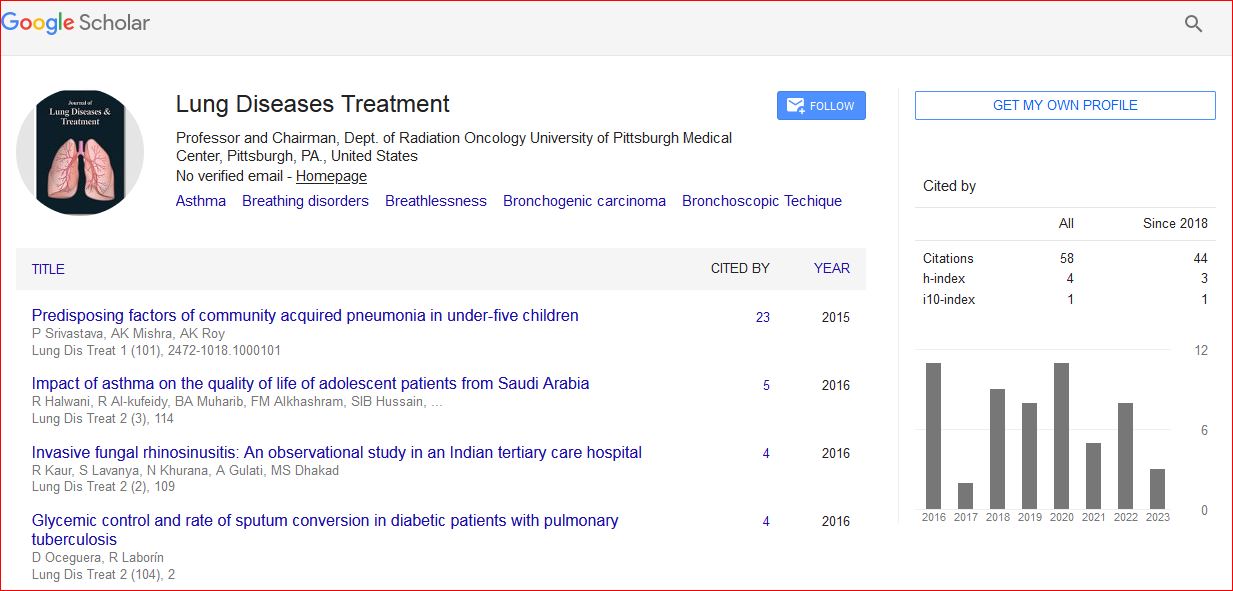
Journal of Lung Diseases & Treatment received 247 citations as per Google Scholar report