Commentary - (2025) Volume 9, Issue 3
Received: 02-Jun-2025, Manuscript No. ahbs-26-182414;
Editor assigned: 04-Jun-2025, Pre QC No. P-182414;
Reviewed: 18-Jun-2025, QC No. Q-182414;
Revised: 23-Jun-2025, Manuscript No. R-182414;
Published:
30-Jun-2025
, DOI: 10.37421/2952-8097.2025.9.314
Citation: Walker, Thomas J.. ”Pain And Behavior: A Crucial
Link.” J Anim Health Behav Sci 09 (2025):314.
Copyright: © 2025 Walker J. Thomas This is an open-access article distributed under the terms of the Creative Commons Attribution License, which permits unrestricted use,
distribution and reproduction in any medium, provided the original author and source are credited.
Recognizing and managing pain in companion animals is paramount in veterinary behavioral science, as subtle behavioral changes can signify underlying discomfort that is frequently overlooked. Effective pain management is thus fundamental to addressing behavioral issues, significantly improving animal welfare, and reinforcing the human-animal bond. A multimodal approach, integrating both pharmacological and non-pharmacological strategies, is strongly emphasized as the most effective method for comprehensive pain relief [1].
Furthermore, the intricate link between chronic pain and the subsequent development of anxiety and aggression in dogs has been a subject of significant exploration. Persistent pain can profoundly alter a dog's perception of their environment and social interactions, often leading to the manifestation of defensive behaviors. Early identification of pain-related behavioral changes, coupled with timely veterinary intervention, is advocated to mitigate these negative outcomes and enhance the animal's overall quality of life [2].
In parallel, the critical need for non-pharmacological pain management strategies, particularly for cats suffering from chronic pain associated with conditions such as arthritis, has been highlighted. Techniques encompassing environmental enrichment, physical therapy, diligent weight management, and various complementary therapies are discussed. These methods are shown to considerably improve a cat's comfort and mobility, thereby reducing reliance on medication and enhancing their overall welfare [3].
Moreover, the complexities associated with pain assessment in animals exhibiting cognitive dysfunction present unique challenges. In these cases, where verbal communication is absent and behavioral changes can be inherently ambiguous, a systematic approach to identifying pain is crucial. This involves careful consideration of factors like altered activity levels, increased vocalizations, and the presence of protective behaviors. A thorough history, comprehensive physical examination, and detailed behavioral observation are essential to guide effective pain relief strategies [4].
Specifically regarding osteoarthritis in dogs, owner-reported behavioral changes serve as invaluable indicators of pain. Certain behaviors, including a reduced enthusiasm for walks, observable difficulty in rising, and increased vocalization, are commonly associated with the discomfort experienced by these animals. The critical value of owner perception in detecting subtle signs of pain, which might otherwise be missed during routine veterinary visits, is underscored, emphasizing a collaborative approach to pain management [5].
On the pharmacological front, current approaches to pain management in veterinary patients, with a particular focus on analgesics utilized in behavioral medicine, have been reviewed. This includes a discussion of the mechanisms of action, efficacy, and potential side effects of various classes of analgesics, such as opioids, NSAIDs, and adjuvant agents. The importance of individualized treatment plans and vigilant monitoring for adverse reactions is stressed to ensure optimal pain relief while minimizing behavioral disruptions [6].
The significant role of environmental enrichment in effectively managing pain and substantially improving the well-being of laboratory animals has also been examined. Providing stimulating environments can demonstrably reduce stress, anxiety, and pain-associated behaviors, ultimately contributing to more reliable and ethical research outcomes. The ethical imperative to implement robust enrichment strategies for all animals within research settings is strongly highlighted [7].
In the context of post-operative care, the efficacy of multimodal analgesia in managing pain and facilitating recovery in dogs undergoing orthopedic surgery has been investigated. Comparisons between combining different analgesic modalities, such as local anesthetics, opioids, and NSAIDs, reveal their superior capability in reducing pain scores and improving mobility. These findings consistently indicate that a multimodal approach offers significant advantages over single-modality treatments for optimal pain control and accelerated recovery [8].
Investigating the physiological and behavioral responses to pain in cats experiencing urinary tract disease reveals how discomfort associated with conditions like cystitis can manifest in noticeable changes. These often include alterations in litter box habits, social withdrawal, and increased vocalization. Veterinary professionals are urged to be highly attuned to these subtle signs to ensure timely and effective pain management [9].
Finally, the application of complementary therapies, such as acupuncture, for managing chronic pain in horses offers a promising avenue. These techniques can synergistically complement conventional treatments, leading to reduced pain, improved mobility, and an enhanced overall quality of life for equine patients. Evidence-based insights into the benefits and limitations of integrating these therapies into comprehensive pain management plans are provided [10].
The critical role of recognizing and managing pain in veterinary behavioral science is underscored, emphasizing that subtle behavioral shifts can indicate underlying pain, often going unnoticed. Consequently, effective pain management is established as a cornerstone for resolving behavioral issues, advancing animal welfare, and strengthening the human-animal bond. A definitive recommendation is made for a multimodal approach, integrating both pharmacological and non-pharmacological strategies for comprehensive care [1].
The profound impact of chronic pain on the development of anxiety and aggression in dogs is a significant area of study. It details how persistent pain can distort a dog's perception of their environment and social interactions, thereby precipitating defensive behaviors. The article strongly advocates for the early detection of pain-related behavioral alterations and prompt veterinary intervention to mitigate these adverse effects and improve the animal's quality of life [2].
In the feline context, a thorough review of non-pharmacological pain management strategies for cats, particularly for chronic pain associated with conditions like arthritis, has been presented. The discussion includes a range of techniques such as environmental enrichment, physical therapy, essential weight management, and various complementary therapies. These non-pharmacological methods are crucial for significantly enhancing a cat's comfort and mobility, thereby decreasing reliance on medication and boosting overall welfare [3].
Assessing and managing pain in animals with cognitive dysfunction presents a complex challenge due to the absence of verbal communication and the ambiguity of behavioral changes. A systematic approach is outlined for identifying pain in these patients, involving careful consideration of factors like changes in activity levels, vocalizations, and protective behaviors. The authors stress the importance of a detailed history, thorough physical examination, and diligent behavioral observation to inform effective pain relief strategies [4].
Owner-reported behavioral changes are highlighted as vital indicators of pain in dogs suffering from osteoarthritis. Specific behaviors, such as a diminished enthusiasm for walks, noticeable difficulty when rising, and increased vocalizations, are identified as common manifestations of pain. The research emphasizes the indispensable value of owner perception in detecting subtle pain signals that might be overlooked during routine veterinary assessments, advocating for a collaborative approach to pain management [5].
Regarding pharmacological interventions, current practices for pain management in veterinary patients are reviewed, with a focus on analgesics commonly employed in behavioral medicine. The review elaborates on the mechanisms of action, efficacy, and potential side effects of opioids, NSAIDs, and adjuvant analgesics. It strongly emphasizes the necessity of individualized treatment plans and close monitoring for adverse reactions to ensure optimal pain relief and minimize any behavioral disruptions [6].
The role of environmental enrichment in managing pain and enhancing the welfare of laboratory animals is explored. Providing stimulating environments is shown to effectively reduce stress, anxiety, and behaviors indicative of pain, which contributes to more reliable research outcomes. The authors underscore the ethical obligation to implement effective enrichment strategies for all animals involved in research settings [7].
The efficacy of multimodal analgesia in managing post-operative pain and promoting recovery in dogs undergoing orthopedic surgery is examined. The study compares the effectiveness of combining various analgesic modalities, including local anesthetics, opioids, and NSAIDs, in reducing pain scores and improving mobility. The results convincingly demonstrate that a multimodal approach is superior to single-modality treatments for achieving optimal pain control and facilitating a faster recovery [8].
Investigating the physiological and behavioral manifestations of pain in cats with lower urinary tract disease reveals how the discomfort associated with conditions like cystitis can lead to significant changes. These changes commonly include alterations in litter box habits, social withdrawal, and increased vocalization. The authors highlight the imperative for veterinary professionals to be highly sensitive to these subtle signs for the implementation of timely and effective pain management [9].
Finally, the application of complementary therapies, such as acupuncture, for chronic pain management in horses is discussed. These techniques have the potential to work synergistically with conventional treatments to alleviate pain, enhance mobility, and improve the overall quality of life for equine patients. The authors present evidence-based insights into the advantages and limitations of incorporating these therapies into a comprehensive pain management strategy [10].
This compilation of research underscores the critical link between pain and behavior in animals. It highlights the importance of recognizing subtle behavioral cues as indicators of pain, especially in cases of chronic pain or cognitive dysfunction. A multimodal approach, combining pharmacological and non-pharmacological strategies like environmental enrichment and physical therapy, is consistently recommended for effective pain management. Owner observations play a vital role in identifying pain, particularly in conditions like osteoarthritis. The review also covers pharmacological options and complementary therapies such as acupuncture, emphasizing individualized treatment plans and the ethical imperative to prioritize animal welfare and quality of life.
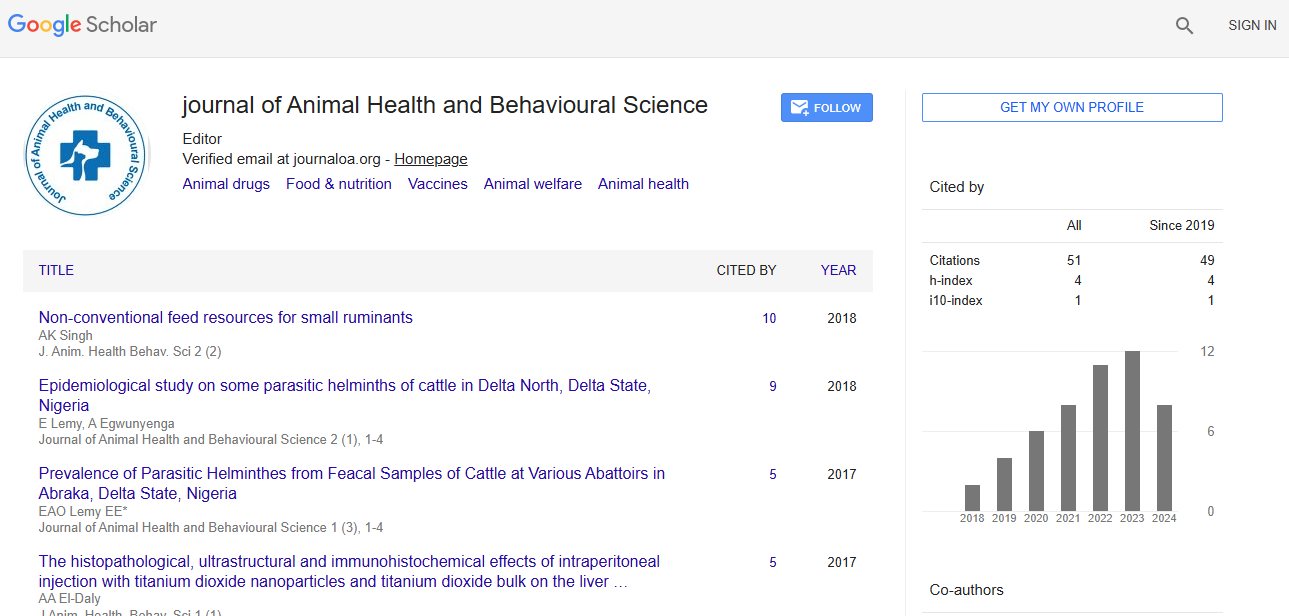
Journal of Animal Health and Behavioural Science received 38 citations as per Google Scholar report