Short Communication - (2025) Volume 15, Issue 3
Received: 02-Jun-2025, Manuscript No. jprm-25-174452;
Editor assigned: 04-Jun-2025, Pre QC No. P-174452;
Reviewed: 18-Jun-2025, QC No. Q-174452;
Revised: 23-Jun-2025, Manuscript No. R-174452;
Published:
30-Jun-2025
, DOI: 10.37421/2161-105X.2025.15.745
Citation: Dimitriou, Elena. ”OSA: Systemic Challenges, Personalized Management Strategies.” J Pulm Respir Med 15 (2025):745.
Copyright: © 2025 Dimitriou E. This is an open-access article distributed under the terms of the Creative Commons Attribution License, which permits unrestricted use, distribution and reproduction in any medium, provided the original author and source are credited.
Obstructive Sleep Apnea (OSA) is widely recognized for its profound implications on overall health, significantly increasing the risk of various cardiovascular diseases, a critical area of concern for patient management [3].
These cardiovascular morbidities encompass serious conditions such as hypertension, coronary artery disease, and heart failure, underscoring the broad systemic impact of OSA on the circulatory system [3].
Here's the thing: the underlying mechanisms contributing to these adverse outcomes involve intermittent hypoxia, chronic sympathetic activation, and persistent systemic inflammation [3].
Consequently, there's a clear and pressing need for early OSA diagnosis and effective treatment to substantially mitigate these well-documented cardiovascular risks and improve patient prognosis [3].
Beyond cardiovascular complications, this data also illuminates a complex and clinically significant bidirectional relationship existing between obstructive sleep apnea and diabetes [4].
What this really means is that OSA can directly exacerbate glycemic control, primarily through the mechanisms of intermittent hypoxia and fragmented sleep patterns [4].
Simultaneously, the presence of diabetes can, in turn, worsen the overall severity of OSA, creating a challenging cycle for affected individuals [4].
The importance of integrated care cannot be overstated here, as evidence suggests that the effective management of one condition can exert a positive influence on the other, leading to improved health outcomes for patients with both disorders [4].
Moreover, a strong association has been consistently highlighted between obstructive sleep apnea and various forms of renal disease, a factor often overlooked in broader discussions [10].
This includes the development and progression of chronic kidney disease and, in severe cases, end-stage renal disease, indicating a systemic reach that extends to vital organ function [10].
The authors describe how intermittent hypoxia, increased oxidative stress, and sympathetic overactivity, all characteristic features of OSA, collectively contribute to this renal dysfunction [10].
Therefore, there's a compelling argument for advocating the screening and subsequent treatment of OSA in all patients diagnosed with existing kidney conditions, aiming to prevent further deterioration [10].
Recent reviews have updated the evidence firmly linking obstructive sleep apnea to an increased risk of stroke and demonstrably worse outcomes following such cerebrovascular events [6].
It's clear that OSA's signature intermittent hypoxia and persistent sleep fragmentation are significant contributors to cerebrovascular damage and heightened inflammation within the brain [6].
This underscores a crucial point: the importance of routine screening for and prompt treatment of OSA as an integral component of both stroke prevention strategies and effective rehabilitation protocols [6].
The profound impact of obstructive sleep apnea extends to neurocognitive function, affecting numerous critical areas of mental processing [9].
Patients often experience impaired attention, executive function, memory recall, and diminished psychomotor speed, collectively affecting daily functioning and quality of life [9].
The mechanism behind this involves intermittent hypoxia and sleep fragmentation, which lead to identifiable structural and functional changes within the brain over time [9].
What this means for care is that effective OSA treatment has a clear potential to improve these cognitive outcomes, offering hope for cognitive recovery and enhanced brain health [9].
This area of research also critically highlights significant sex differences in the prevalence, typical presentation, and overall consequences of obstructive sleep apnea [8].
Here's the problem: women often present with atypical symptoms, leading to a concerning rate of underdiagnosis and subsequent delays in receiving appropriate treatment [8].
Understanding these fundamental sex-based differences is absolutely critical for improving diagnostic accuracy for all patients and tailoring management strategies effectively for both men and women affected by OSA [8].
Turning to management, Continuous Positive Airway Pressure (CPAP) therapy adherence in OSA patients remains a central focus, with various factors acting as crucial determinants of its success [1].
Key influencing factors include the level of patient education regarding their condition, discomfort experienced with the device, and their perceived benefits of the treatment [1].
Here's the thing: improving CPAP adherence isn't a one-size-fits-all solution; it specifically requires personalized strategies that directly address these identified barriers for each individual [1].
Beyond conventional approaches, emerging pharmacological interventions are being explored for OSA, with a focus on agents that target key physiological mechanisms [2].
These agents aim to influence upper airway muscle activity, optimize ventilatory control, and improve sleep architecture, offering new avenues for treatment [2].
While Continuous Positive Airway Pressure (CPAP) therapy largely remains the first-line treatment, these pharmacological interventions could provide valuable alternative or adjunctive treatments [2].
This is particularly relevant for patients who find themselves intolerant to, or derive insufficient benefit from, more conventional therapies [2].
An overview of surgical options for obstructive sleep apnea reveals a spectrum of procedures available, each designed to address different anatomical levels of upper airway obstruction [7].
The authors emphasize that surgery represents a viable alternative treatment pathway for patients who are either intolerant to or unsuccessful with CPAP therapy [7].
Selection of the most appropriate surgical approach is highly individualized, depending significantly on the patient's specific anatomical factors and the overall severity of their disease [7].
Finally, a significant paradigm shift towards personalized medicine approaches in OSA is strongly advocated, moving decidedly beyond traditional one-size-fits-all treatments [5].
This approach involves phenotyping patients based on their distinct underlying pathophysiological mechanisms, such as anatomical narrowness or inherent ventilatory control instability [5].
Such detailed phenotyping can effectively guide the selection of more effective and precisely tailored therapies, which in turn leads to improved patient outcomes and better adherence to treatment regimens [5].
Obstructive Sleep Apnea (OSA) is a chronic and complex sleep-related breathing disorder that carries widespread health implications, affecting numerous organ systems. The condition is characterized by recurrent episodes of upper airway collapse during sleep, leading to intermittent hypoxia and sleep fragmentation. These physiological disturbances initiate a cascade of adverse effects throughout the body. Notably, OSA significantly elevates the risk of various cardiovascular diseases, including hypertension, coronary artery disease, and heart failure [3]. The intricate interplay of intermittent hypoxia, heightened sympathetic nervous system activity, and systemic inflammation collectively contributes to these serious cardiovascular consequences. Early diagnosis and aggressive treatment of OSA are therefore crucial in mitigating these risks and improving cardiac health outcomes [3].
Beyond cardiovascular health, OSA exhibits a complex and bidirectional relationship with metabolic disorders such as diabetes. Obstructive Sleep Apnea can exacerbate glycemic control through its characteristic intermittent hypoxia and sleep fragmentation, while, conversely, diabetes can worsen the severity of OSA [4]. This emphasizes the critical need for integrated care strategies, as effectively managing one condition often yields positive impacts on the other [4]. Furthermore, there is a strong and concerning association between OSA and various forms of renal disease, including chronic kidney disease and end-stage renal disease. Intermittent hypoxia, oxidative stress, and sympathetic overactivity stemming from OSA are key contributors to renal dysfunction, highlighting the importance of screening for and treating OSA in individuals with kidney conditions [10]. The cerebrovascular system is also vulnerable, with OSA increasing the risk and worsening the prognosis of stroke. The intermittent hypoxia and sleep fragmentation inherent in OSA lead to cerebrovascular damage and inflammation, making OSA screening and treatment vital components of stroke prevention and rehabilitation strategies [6].
The impact of obstructive sleep apnea extends significantly to neurocognitive function, presenting as impaired attention, executive function, memory, and psychomotor speed [9]. These cognitive deficits are not merely transient; rather, they are linked to structural and functional brain changes induced by chronic intermittent hypoxia and sleep fragmentation. Encouragingly, effective treatment of OSA has been shown to improve these cognitive outcomes, offering a pathway to better brain health and daily functioning [9]. It is also imperative to recognize the significant sex differences evident in the prevalence, clinical presentation, and overall consequences of obstructive sleep apnea. Women, for example, frequently present with atypical symptoms, which unfortunately contributes to a higher rate of underdiagnosis and subsequent delays in receiving timely and appropriate treatment [8]. A deeper understanding of these sex-specific variations is fundamental for enhancing diagnostic accuracy and tailoring management strategies to optimize outcomes for all patients [8].
In terms of management, Continuous Positive Airway Pressure (CPAP) therapy remains the primary and most effective treatment for many OSA patients. However, adherence to CPAP therapy remains a substantial challenge, influenced by factors such as patient education, discomfort with the device, and their perceived benefits of the treatment [1]. Successful management necessitates personalized strategies that directly address these specific barriers to adherence [1]. For patients who struggle with CPAP, alternative therapeutic avenues are being explored. Emerging pharmacological approaches aim to target upper airway muscle activity, ventilatory control, and sleep architecture, offering promising alternative or adjunctive treatments, especially for individuals who are intolerant to conventional therapies [2]. Surgical options also represent a viable alternative, encompassing a range of procedures designed to address anatomical obstructions in the upper airway. The choice of surgical intervention is highly individualized, depending on specific anatomical factors and the severity of the disease [7].
A progressive shift towards personalized medicine is advocated for optimizing OSA management, moving away from a uniform approach to more tailored interventions. This involves phenotyping patients based on their unique underlying pathophysiological mechanisms, such as anatomical narrowness or ventilatory control instability [5]. By categorizing patients in this manner, clinicians can guide more effective, customized therapies, ultimately leading to improved patient outcomes and enhanced adherence to treatment regimens [5]. This holistic and individualized approach represents the future of effective obstructive sleep apnea care, aiming to maximize therapeutic benefit and minimize the burden of the disease across diverse patient populations.
Obstructive Sleep Apnea (OSA) poses significant health challenges, influencing various physiological systems and necessitating diverse management approaches. A primary hurdle in OSA treatment revolves around Continuous Positive Airway Pressure (CPAP) adherence, which is often compromised by patient education gaps, discomfort with the device, and a lack of perceived benefits. Overcoming these barriers requires personalized strategies. Beyond CPAP, emerging pharmacological treatments offer alternative or supplementary options by targeting mechanisms like upper airway muscle activity and ventilatory control, particularly beneficial for those unable to tolerate standard therapies. Surgical interventions are also available for patients for whom CPAP is unsuitable or ineffective, with procedures customized based on individual anatomical considerations and disease severity. The systemic repercussions of OSA are extensive. It substantially escalates the risk of cardiovascular diseases, including hypertension, coronary artery disease, and heart failure, primarily driven by intermittent hypoxia, heightened sympathetic activity, and systemic inflammation. There is also a complex, bidirectional relationship with diabetes, where OSA worsens glycemic control through hypoxia and sleep disruption, while diabetes can, in turn, intensify OSA. Integrated care is vital, as improvements in one condition often positively impact the other. Furthermore, OSA is strongly associated with various renal conditions, such as chronic kidney disease, due to factors like intermittent hypoxia and oxidative stress. Neurologically, OSA significantly impairs cognitive functions like attention, memory, and executive abilities; these deficits are linked to structural brain changes induced by intermittent hypoxia and sleep fragmentation, with treatment often leading to cognitive improvements. The disorder also increases the risk and severity of stroke, as intermittent hypoxia contributes to cerebrovascular damage. Critically, recognizing and addressing sex differences in OSA is important, as women frequently present with less typical symptoms and face underdiagnosis, underscoring the necessity for tailored diagnostic and therapeutic strategies. Ultimately, a personalized medicine approach, where patient phenotypes guide treatment choices, is advocated to enhance overall outcomes and adherence in OSA management.
None
None
1. Hussain A, Sami A, Bander A. "Continuous positive airway pressure (CPAP) therapy adherence and factors affecting it in obstructive sleep apnea patients.".Saudi Med J 44 (2023):284-290.
Indexed at, Google Scholar, Crossref
2. Afif K, Isabel A, Ramon F. "Pharmacological Management of Obstructive Sleep Apnea.".Am J Respir Crit Care Med 201 (2020):1052-1064.
Indexed at, Google Scholar, Crossref
3. Gianfranco P, Gabriele B, Giuseppe B. "Cardiovascular Consequences of Obstructive Sleep Apnea.".Hypertension 77 (2021):1122-1133.
Indexed at, Google Scholar, Crossref
4. Atul M, Amrinder SG, Alan RS. "Obstructive Sleep Apnea and Diabetes: The Bidirectional Relationship.".Sleep 44 (2021):zsaa280.
Indexed at, Google Scholar, Crossref
5. Marta C, Nico dV, Marc JLR. "Role of Personalized Medicine in Obstructive Sleep Apnea Management.".Adv Otorhinolaryngol 86 (2022):163-172.
Indexed at, Google Scholar, Crossref
6. Osama OZ, Shadi Y, Ahmed MK. "Obstructive Sleep Apnea and Stroke: An Updated Review.".Curr Treat Options Neurol 25 (2023):93-107.
Indexed at, Google Scholar, Crossref
7. Andrea DV, Carlo DV, Nicola R. "Surgical Management of Obstructive Sleep Apnea.".Acta Otorhinolaryngol Ital 43 (2023):107-115.
Indexed at, Google Scholar, Crossref
8. Emily M, Zacharias K, Grace WP. "Sex differences in obstructive sleep apnea: a narrative review.".J Clin Sleep Med 20 (2024):471-480.
Indexed at, Google Scholar, Crossref
9. Mark SA, Clete AK, Fang H. "Neurocognitive Consequences of Obstructive Sleep Apnea.".Sleep Med Clin 15 (2020):363-372.
Indexed at, Google Scholar, Crossref
10. Vishal S, Ankur S, Siddharth K. "Obstructive Sleep Apnea and Renal Disease: A Comprehensive Review.".Cureus 13 (2021):e13936.
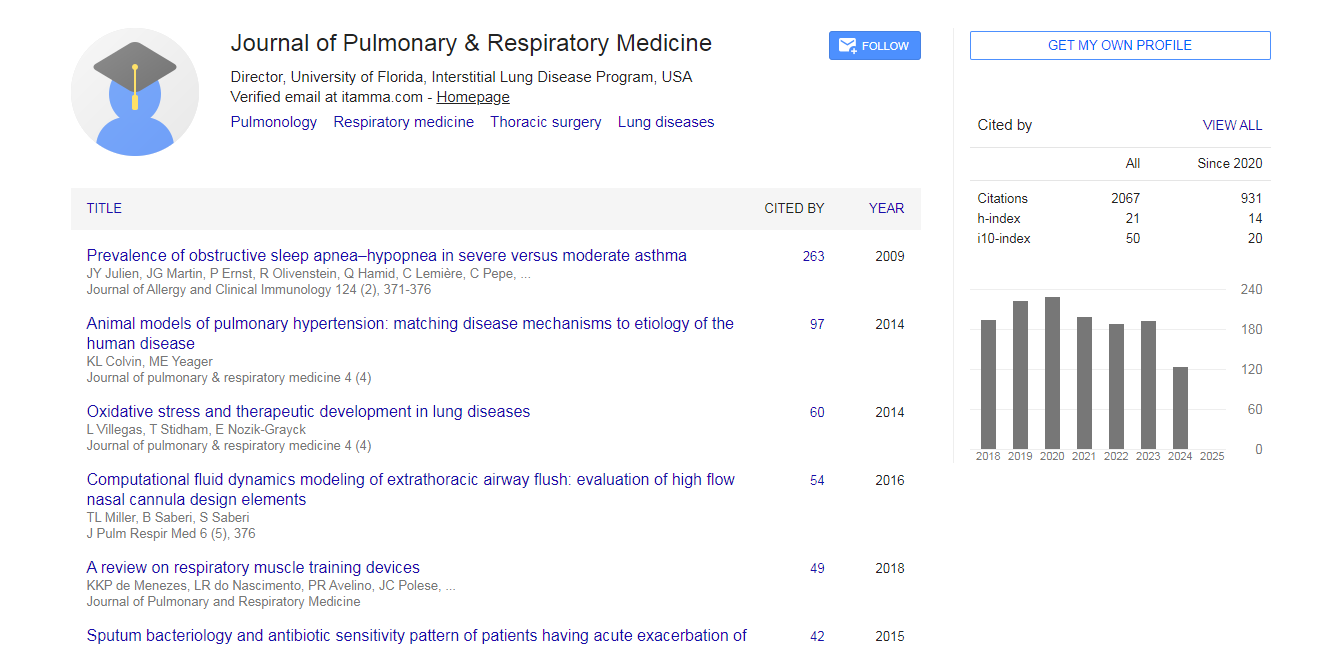
Pulmonary & Respiratory Medicine received 1690 citations as per Google Scholar report