Brief Report - (127) Volume 9, Issue 2
Received: 01-Apr-2025, Manuscript No. jcao-26-187123;
Editor assigned: 03-Apr-2025, Pre QC No. P-187123;
Reviewed: 17-Apr-2025, QC No. Q-187123;
Revised: 22-Apr-2025, Manuscript No. R-187123;
Published:
29-Apr-2025
, DOI: 10.37421/2684-6004.2025.9.273
Citation: Ferreira, Luciana. ”Optimizing Postoperative Pain Management: A Multimodal Approach.” J Clin Anesthesiol 09 (2025):283.
Copyright: © 2025 Ferreira L. This is an open-access article distributed under the terms of the Creative Commons Attribution License, which permits unrestricted use, distribution and reproduction in any medium, provided the original author and source are credited.
The management of postoperative pain and the optimization of patient recovery are critical aspects of surgical care, significantly influencing patient outcomes and hospital resource utilization. Advances in anesthetic and analgesic techniques continue to emerge, aiming to provide superior pain relief while minimizing adverse effects and facilitating a faster return to normal function. This review synthesizes current research to explore various strategies employed in enhancing perioperative pain management and recovery across different surgical specialties. Intraoperative anesthetic choices play a pivotal role in shaping the postoperative experience. For instance, the use of remifentanil infusions during abdominal surgery has been investigated for its potential to reduce postoperative pain and opioid consumption, thereby contributing to early recovery pathways [1].
Regional anesthesia techniques are increasingly recognized for their efficacy in providing targeted pain relief and reducing the need for systemic opioids. In orthopedic surgery, the integration of regional blocks with judicious systemic medication is emphasized as a cornerstone of multimodal analgesia to improve recovery trajectories [2].
Adjuncts to general anesthesia are also being explored to attenuate the physiological stress response to surgery and improve postoperative outcomes. Dexmedetomidine, for example, has shown promise in major abdominal surgery by reducing intraoperative anesthetic requirements and mitigating postoperative nausea and vomiting [3].
For specific surgical contexts, localized regional techniques are highly effective. Ultrasound-guided transversus abdominis plane (TAP) blocks have demonstrated substantial benefits in reducing opioid requirements and improving pain scores following cesarean delivery, a common obstetric procedure [4].
In the realm of abdominal surgery, patient-controlled epidural analgesia (PCEA) has been evaluated for its capacity to enhance recovery. Studies suggest PCEA offers superior pain control, reduced side effects like nausea and vomiting, and promotes earlier mobilization [5].
For spinal procedures, multimodal analgesia incorporating gabapentinoids has emerged as a valuable strategy. These agents have been shown to significantly decrease opioid consumption and improve pain scores following spinal fusion surgery [6].
Beyond pain management, the prevention of postoperative complications like delirium is a significant concern, particularly in elderly patients. Anesthetic management, including lighter depths and early discontinuation of volatile agents, is associated with a lower incidence of postoperative delirium [7].
In orthopedic surgery, alternative opioid-sparing strategies are being explored. Ketamine infusions have shown efficacy in reducing opioid consumption and improving pain scores without increasing adverse events, offering a promising avenue for enhanced recovery [8].
Peripheral nerve blocks are also crucial for localized pain control, particularly in upper extremity surgery. They offer improved pain management, reduced opioid use, and faster functional recovery, with ultrasound guidance enhancing their precision [9].
Finally, a comprehensive approach to optimizing surgical recovery involves standardized protocols. Enhanced recovery after surgery (ERAS) protocols have demonstrated significant reductions in hospital stay, fewer complications, and improved patient satisfaction in patients undergoing elective colorectal surgery [10].
The impact of intraoperative remifentanil infusion on postoperative pain and opioid consumption following abdominal surgery has been investigated, revealing a notable decrease in pain scores and overall opioid requirements. This suggests its potential utility in expediting early recovery and underscores the importance of balancing intraoperative anesthetic depth with postoperative pain management strategies [1].
Regional anesthesia techniques are vital for optimizing perioperative pain management in orthopedic procedures, leading to improved patient satisfaction and reduced systemic opioid use. The integration of regional blocks with judicious systemic medication is crucial for enhancing recovery trajectories through multimodal analgesia [2].
The effectiveness of dexmedetomidine as an adjunct in general anesthesia for major abdominal surgery has been explored. This adjunct has been associated with a significant reduction in intraoperative anesthetic needs and a notable improvement in postoperative nausea and vomiting, indicating its role in attenuating the stress response and enhancing recovery [3].
Ultrasound-guided transversus abdominis plane (TAP) blocks have been evaluated for their impact on postoperative pain control and opioid consumption in patients undergoing cesarean delivery. These blocks have shown a substantial reduction in opioid requirements and improved pain scores, highlighting their efficacy in this common obstetric procedure [4].
Patient-controlled epidural analgesia (PCEA) has been studied for its role in enhancing postoperative recovery after major abdominal surgery. The findings indicate that PCEA is linked to better pain control, diminished nausea and vomiting, and earlier mobilization, all of which contribute to a quicker return to normal activities [5].
The efficacy of multimodal analgesia, including the use of gabapentinoids, in managing postoperative pain after spinal fusion surgery has been examined. Gabapentinoids have been found to significantly reduce opioid consumption and improve pain scores, serving as a valuable addition to standard anesthetic practices for spinal procedures [6].
Research into the impact of anesthetic techniques on postoperative delirium in elderly patients undergoing elective surgery highlights that lighter anesthetic depths and earlier cessation of volatile anesthetics correlate with a lower incidence of this complication. This emphasizes the significance of careful anesthetic management in this vulnerable demographic [7].
The effectiveness of perioperative ketamine infusion for opioid-sparing analgesia in patients undergoing major orthopedic surgery has been studied. The results indicate that ketamine infusion significantly decreases opioid consumption and enhances pain scores without an increase in adverse events, presenting a promising approach for improved recovery [8].
Current evidence on the use of peripheral nerve blocks for postoperative pain management in patients undergoing upper extremity surgery points to their benefits. These include improved pain control, reduced opioid requirements, and faster functional recovery, with ultrasound guidance playing a key role in ensuring precision [9].
The implementation of a standardized enhanced recovery after surgery (ERAS) protocol has been investigated for its effect on perioperative outcomes in elective colorectal surgery. This approach has resulted in a significant reduction in the length of hospital stay, decreased complication rates, and improved patient satisfaction, underscoring the value of comprehensive ERAS strategies [10].
This collection of studies explores various strategies for improving postoperative pain management and patient recovery across different surgical procedures. Research highlights the benefits of intraoperative remifentanil infusions in abdominal surgery, regional anesthesia techniques in orthopedics, and adjuncts like dexmedetomidine. Specific regional blocks such as ultrasound-guided TAP blocks are effective for cesarean deliveries, while PCEA aids recovery in major abdominal surgeries. Multimodal analgesia, incorporating gabapentinoids for spinal surgery and ketamine infusions for orthopedic procedures, demonstrates significant reductions in opioid consumption. The importance of anesthetic depth in preventing delirium in elderly patients is noted. Finally, standardized ERAS protocols show significant improvements in perioperative outcomes for colorectal surgery. Collectively, these findings emphasize a shift towards multimodal, patient-centered approaches to enhance surgical recovery and minimize opioid reliance.
None
None
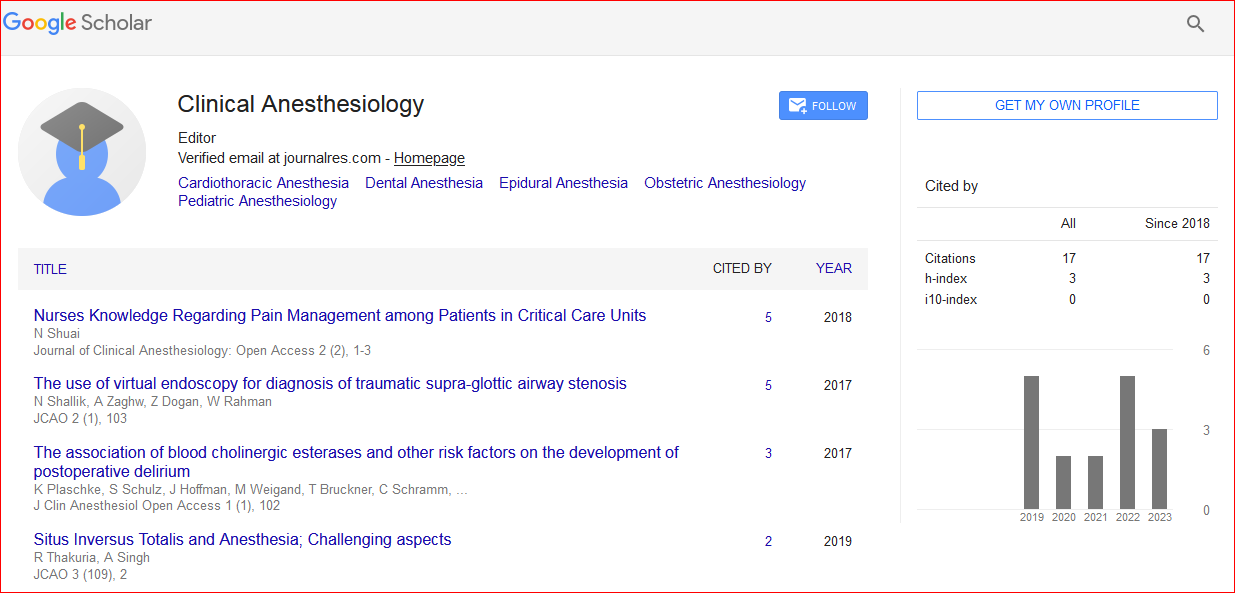
Journal of Clinical Anesthesiology: Open Access received 31 citations as per Google Scholar report