Perspective - (2025) Volume 14, Issue 4
Received: 01-Jul-2025, Manuscript No. iem-26-179817;
Editor assigned: 03-Jul-2025, Pre QC No. P-179817;
Reviewed: 14-Jul-2025, QC No. Q-179817;
Revised: 22-Jul-2025, Manuscript No. R-179817;
Published:
29-Jul-2025
, DOI: 10.37421/2169- 0316.2025.14.312
Citation: Fernandez, Carlos. âÂÂOptimizing Manufacturing Workflow: Strategies for Efficiency.â J Ind Eng Manag 14 (2025):312.
Copyright: © 2025 Fernandez C. This is an open-access article distributed under the terms of the Creative Commons Attribution License, which permits unrestricted use,
distribution and reproduction in any medium, provided the original author and source are credited.
The optimization of manufacturing workflows is a critical area of focus for enhancing overall efficiency and productivity within industrial operations. Various methodologies and technologies have been developed and explored to achieve these improvements, addressing different facets of the production process. This article aims to synthesize the current understanding and research surrounding these optimization strategies, drawing from a breadth of literature to provide a comprehensive overview. One significant approach involves the application of lean manufacturing principles and Six Sigma methodologies, often integrated with advanced technologies like Artificial Intelligence (AI) and the Internet of Things (IoT) to drive substantial gains in operational performance. These strategies are instrumental in identifying and rectifying inefficiencies, reducing waste, and ultimately boosting output [1].
The transformative potential of digital technologies, particularly the convergence of IoT and AI, is a central theme in modern manufacturing workflow optimization. These technologies enable real-time data acquisition and sophisticated predictive analytics, facilitating proactive issue resolution, optimized resource allocation, and enhanced agility in production [2].
Simulation modeling emerges as a powerful tool for meticulously analyzing and refining manufacturing processes. By employing techniques such as discrete-event simulation, organizations can effectively pinpoint bottlenecks, assess alternative workflow designs, and forecast the consequences of proposed changes prior to their implementation, thereby informing critical decisions and mitigating associated risks [3].
Automation and robotics play a pivotal role in streamlining manufacturing workflows, contributing to increased speed, precision, and consistency. Intelligent automation systems not only enhance operational efficiency and safety but also empower human workers to concentrate on more complex and strategic tasks, further elevating overall productivity [4].
The implementation of a Kanban system offers a structured approach to managing manufacturing workflows, emphasizing visual cues and just-in-time inventory principles. This methodology is effective in reducing lead times, minimizing work-in-progress inventory, and ensuring a smoother flow of materials, resulting in a more responsive and efficient production system [5].
Theory of Constraints (TOC) provides a framework for optimizing manufacturing workflows by identifying and managing the most significant constraint within a production system. This focused approach aims to maximize throughput and enhance the efficiency of the entire system by systematically addressing its primary limiting factor [6].
Digital twins are increasingly being utilized for the optimization of manufacturing workflows. These virtual replicas of physical assets facilitate real-time monitoring, sophisticated simulations, and predictive maintenance, leading to enhanced operational control and a significant reduction in costly downtime [7].
The human element remains indispensable in the pursuit of workflow optimization. Investing in employee training and skill development, particularly in areas like problem-solving and the adoption of new technologies, is a crucial factor in achieving successful and sustainable workflow improvements within manufacturing environments [8].
Artificial intelligence is also driving advancements in manufacturing through AI-driven scheduling and control systems. These systems dynamically adapt production schedules based on real-time data, fluctuating demand, and resource availability, thereby improving efficiency and reducing lead times in complex production scenarios [9].
Value stream mapping (VSM) is a widely adopted tool for identifying and eliminating waste within manufacturing workflows. This technique visually maps the flow of materials and information, enabling the clear identification of non-value-adding activities and guiding targeted process improvement initiatives [10].
The optimization of manufacturing workflows is a multifaceted endeavor, drawing upon a diverse array of principles and technologies to achieve heightened levels of efficiency and productivity. The integration of lean manufacturing and Six Sigma methodologies, bolstered by cutting-edge advancements such as AI and IoT, represents a powerful synergy for elevating operational performance. These integrated strategies are pivotal in identifying and addressing inefficiencies, minimizing waste, and ultimately enhancing overall output and throughput in production environments [1].
The contemporary manufacturing landscape is being profoundly reshaped by the integration of digital technologies, with IoT and AI at the forefront of workflow optimization. The capability of these technologies to collect and analyze real-time data enables predictive analytics, which in turn supports proactive problem-solving, more judicious resource allocation, and the creation of more adaptable and agile production lines [2].
Simulation modeling stands out as an indispensable tool for the comprehensive analysis and optimization of manufacturing processes. Methodologies like discrete-event simulation offer the capacity to precisely identify operational bottlenecks, thoroughly evaluate the efficacy of various workflow designs, and accurately predict the impact of proposed alterations before their actual implementation, thereby facilitating informed decision-making and significantly reducing operational risks [3].
Automation and the deployment of robotics are instrumental in refining and accelerating manufacturing workflows. Intelligent automation systems are adept at improving operational speed, enhancing precision, and ensuring consistency, while simultaneously liberating human personnel to engage in higher-level problem-solving and more complex tasks, thereby augmenting overall operational efficiency and workplace safety [4].
The strategic implementation of a Kanban system provides a robust framework for the effective management of manufacturing workflows. By leveraging visual signals and adhering to just-in-time inventory management principles, this system is proven to reduce lead times, minimize work-in-progress inventory, and facilitate a smoother, more consistent flow of materials, leading to a more responsive and highly efficient production system [5].
Theory of Constraints (TOC) offers a targeted methodology for optimizing manufacturing workflows by concentrating on the identification and diligent management of the single most significant constraint within any given production system. This focused approach is designed to maximize throughput and elevate the overall efficiency and effectiveness of the entire operational system [6].
The application of digital twins presents a sophisticated avenue for optimizing manufacturing workflows through advanced simulation and monitoring. These virtual counterparts of physical assets enable real-time oversight, detailed simulation scenarios, and predictive maintenance strategies, ultimately resulting in improved control over operations and a notable reduction in instances of unexpected downtime [7].
Investing in the human capital within manufacturing is paramount for achieving effective workflow optimization. Comprehensive employee training and continuous skill development, particularly in critical areas such as advanced problem-solving techniques and the proficient use of emerging technologies, are vital for the successful implementation and sustained impact of workflow improvements [8].
Artificial intelligence is increasingly being harnessed to develop intelligent scheduling and control systems that significantly optimize manufacturing operations. These AI-powered systems possess the ability to dynamically adjust production schedules in response to real-time operational data, shifting market demands, and the availability of resources, thereby enhancing overall efficiency and substantially reducing production lead times [9].
Value Stream Mapping (VSM) serves as a cornerstone tool for the systematic identification and elimination of waste within manufacturing workflows. This technique offers a visual representation of the material and information flow, which is crucial for identifying non-value-adding activities and guiding targeted process improvement initiatives aimed at enhancing efficiency and reducing waste [10].
Manufacturing workflow optimization is addressed through various strategies including lean manufacturing, Six Sigma, and Industry 4.0 technologies like AI and IoT. These approaches aim to enhance efficiency and productivity by identifying bottlenecks and reducing waste. Digital technologies enable real-time data analysis for proactive problem-solving and agility. Simulation modeling helps in evaluating workflow designs and predicting impacts before implementation. Automation and robotics improve speed and precision, while Kanban systems streamline material flow. Theory of Constraints focuses on managing system bottlenecks, and digital twins offer advanced monitoring and simulation capabilities. Human capital development through training is crucial for adopting new technologies and improving processes. AI-driven systems dynamically adjust schedules for better efficiency, and Value Stream Mapping visually identifies and eliminates waste. Collectively, these methods provide a comprehensive framework for achieving optimized manufacturing operations.
None
None
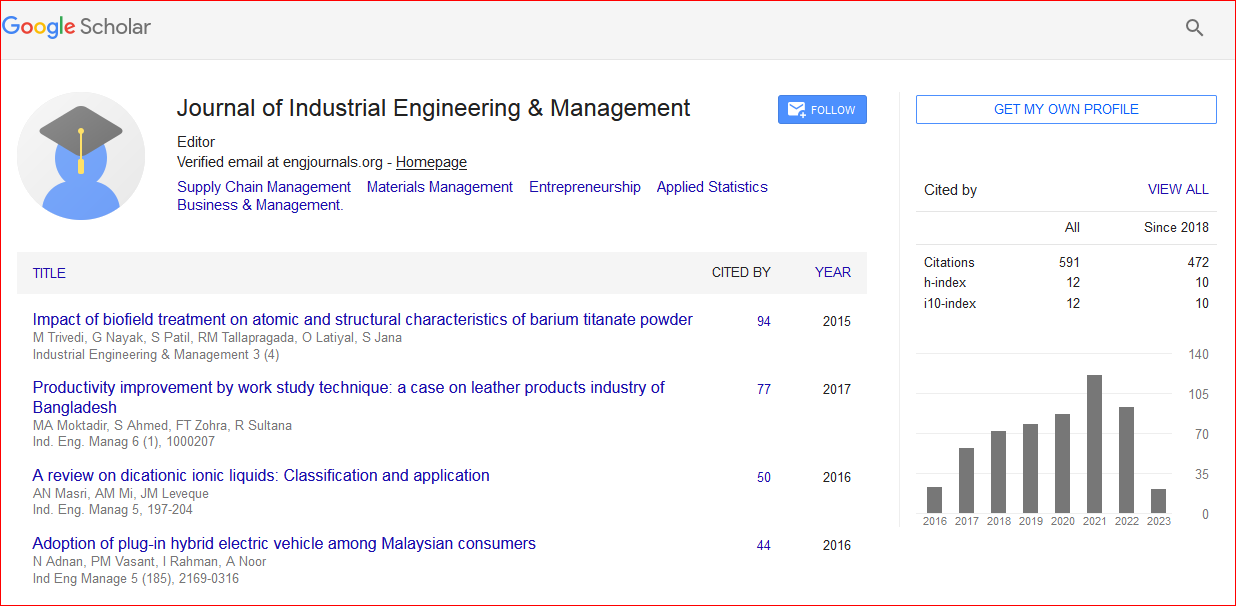
Industrial Engineering & Management received 739 citations as per Google Scholar report