Opinion - (2025) Volume 14, Issue 3
Received: 01-May-2025, Manuscript No. iem-26-179786;
Editor assigned: 04-May-2025, Pre QC No. P-179786;
Reviewed: 14-May-2025, QC No. Q-179786;
Revised: 21-May-2025, Manuscript No. R-179786;
Published:
29-May-2025
, DOI: 10.37421/2169- 0316.2025.14.303
Citation: Smith, James. Optimizing Manufacturing Operations: Advanced Scheduling for Resilience. J Ind Eng Manag 14 (2025):303.
Copyright: © 2025 Smith J. This is an open-access article distributed under the terms of the Creative Commons Attribution License, which permits unrestricted use, distribution
and reproduction in any medium, provided the original author and source are credited.
The optimization of production planning and scheduling is a cornerstone of efficient manufacturing operations, a field that has seen continuous evolution driven by technological advancements and the pursuit of greater operational agility. Early approaches focused on systematic methodologies to map out production timelines and resource allocations, laying the groundwork for more sophisticated techniques. These traditional methods provided a foundational understanding of project management principles within manufacturing settings. The integration of advanced algorithms has become increasingly vital for tackling the inherent complexities of modern production environments. By leveraging computational power, researchers and practitioners are developing solutions that can handle dynamic changes and optimize multiple production objectives simultaneously. This shift reflects a growing need for adaptive systems capable of responding to market fluctuations and internal operational variations. The application of metaheuristic algorithms, such as Genetic Algorithms and Ant Colony Optimization, has shown particular promise in addressing these intricate scheduling challenges. These approaches excel in exploring vast solution spaces to find near-optimal results for complex problems, offering significant improvements over conventional methods. The continuous drive for efficiency and cost reduction has also led to a focus on integrated planning systems. These systems aim to harmonize production schedules with inventory management, ensuring that resources are aligned with demand while minimizing holding costs and preventing stockouts. Such integration is crucial for a holistic view of the supply chain and overall operational performance. The advent of Industry 4.0 has further revolutionized production scheduling by enabling real-time data exchange and intelligent decision-making. The use of digital twins and cloud-based platforms allows for unprecedented visibility and control over the production floor, facilitating dynamic rescheduling and predictive maintenance.
This interconnectedness is key to achieving greater agility and responsiveness in the face of unexpected events. The unpredictable nature of manufacturing operations, characterized by potential machine breakdowns and unforeseen delays, necessitates robust scheduling strategies. These strategies must incorporate contingency planning and dynamic re-optimization to mitigate the impact of uncertainties and maintain production timelines. The exploration of resilient planning frameworks is essential for ensuring business continuity and operational stability. Furthermore, the principles of lean manufacturing, which emphasize waste reduction and continuous flow, can be synergistically combined with advanced scheduling techniques. This fusion allows for the minimization of work-in-progress inventory and lead times, leading to enhanced overall efficiency and productivity. The growing interconnectedness of global supply chains has also highlighted the need for production planning frameworks that can withstand disruptions. Developing resilient strategies to mitigate the effects of unexpected events, such as supplier failures or logistical issues, is paramount for maintaining operational integrity. The inherent complexity of many manufacturing processes, often involving intricate resource dependencies, demands specialized optimization tools. Constraint Programming, for instance, offers a powerful approach to model and solve these combinatorial challenges, yielding more feasible and optimized schedules. The dynamic nature of flexible manufacturing systems (FMS) presents unique scheduling challenges, often requiring the evaluation of numerous operational scenarios. Simulation-based optimization techniques provide a valuable means to explore these scenarios and identify optimal production configurations that maximize throughput and minimize idle time. The transformative potential of artificial intelligence (AI) and machine learning (ML) in production scheduling is a rapidly evolving area of research. These technologies enable systems to learn from historical data, predict demand, optimize resource allocation, and adapt schedules dynamically, leading to substantial gains in efficiency and adaptability. The ongoing quest for optimized manufacturing processes underscores the critical importance of effective production planning and scheduling, integrating diverse methodologies to address contemporary industrial challenges [1].
The sophistication of modern scheduling algorithms, particularly metaheuristics, offers powerful solutions for complex production environments [2]. The seamless integration of production and inventory planning is vital for cost-effective operations and meeting fluctuating demands [3]. Industry 4.0 technologies are fundamentally reshaping production scheduling through real-time connectivity and intelligent systems [4]. Developing robust scheduling approaches that can accommodate unforeseen disruptions is a key focus for maintaining operational stability [5]. The synergy between lean manufacturing principles and advanced scheduling enhances production flow and reduces operational waste [6]. Building resilience into production planning is crucial for navigating the complexities of supply chain disruptions [7]. Constraint programming provides a robust framework for tackling intricate scheduling problems with numerous dependencies [8]. Simulation-based optimization offers a powerful method for fine-tuning schedules in flexible manufacturing systems [9]. The application of AI and ML promises to revolutionize production scheduling through intelligent, adaptive systems [10].
The fundamental principles of effective production planning and scheduling have been meticulously examined, revealing a spectrum of methodologies designed to enhance manufacturing operations. Traditional techniques, such as Gantt charts and the Critical Path Method (CPM), continue to form the bedrock of project management in manufacturing, offering structured ways to visualize and manage production timelines and resource allocation. These foundational methods provide a clear roadmap for project execution and oversight [1].
Moving beyond these established approaches, contemporary research has delved into advanced algorithmic solutions for complex scheduling tasks. Metaheuristic techniques, specifically Genetic Algorithms (GAs) and Ant Colony Optimization (ACO), have demonstrated significant efficacy in optimizing job shop scheduling problems. These algorithms are adept at navigating dynamic production environments and concurrently addressing multiple objectives, such as minimizing makespan and total tardiness, thereby offering substantial improvements in scheduling efficiency compared to conventional methods [2].
The intricate interplay between production activities and inventory levels is a critical consideration for operational efficiency. Integrated planning frameworks that harmonize production schedules with inventory management are essential for minimizing costs and ensuring that demand is met without excess stock. Such integrated models, often employing a combination of mathematical programming and simulation, provide practical solutions for optimizing overall supply chain performance [3].
The paradigm shift towards Industry 4.0 has introduced novel dimensions to production scheduling, with a pronounced emphasis on real-time data processing and the utilization of advanced digital technologies. The implementation of digital twins and cloud-based platforms facilitates dynamic rescheduling, enables the integration of predictive maintenance, and provides enhanced visibility across the entire production floor, thereby boosting agility and responsiveness to operational disruptions [4].
The inherent unpredictability of manufacturing processes, including the possibility of machine breakdowns and unexpected delays, necessitates the development of robust scheduling strategies. These strategies must be capable of incorporating contingency planning and dynamic re-optimization mechanisms to effectively mitigate the impact of uncertainties and ensure that production timelines are maintained [5].
The integration of lean manufacturing principles with advanced scheduling techniques offers a potent combination for optimizing production flow. Methodologies like Kanban and Just-In-Time (JIT), when synergistically applied with sophisticated scheduling software, can significantly reduce work-in-progress inventory and lead times, leading to enhanced overall operational efficiency [6].
In an increasingly interconnected global economy, supply chain disruptions pose a significant threat to manufacturing operations. The development of resilient production planning frameworks that incorporate strategies for mitigating the effects of unexpected events, such as supplier failures or transportation issues, is crucial for maintaining operational stability [7].
For industries characterized by intricate resource dependencies and complex production sequences, Constraint Programming (CP) emerges as a powerful tool. CP models can effectively capture and resolve combinatorial challenges, leading to more optimized and feasible production schedules than traditional approaches, particularly in environments with numerous constraints [8].
Flexible manufacturing systems (FMS) often require the evaluation of a multitude of scheduling scenarios to identify optimal operational configurations. Simulation-based optimization, by combining discrete-event simulation with optimization algorithms, allows for the thorough exploration of these scenarios to maximize throughput and minimize idle time, providing valuable insights into system dynamics [9].
The application of artificial intelligence (AI) and machine learning (ML) is rapidly transforming the landscape of production scheduling. Intelligent scheduling systems leverage these technologies to learn from historical data, predict demand, optimize resource allocation, and dynamically adjust schedules in response to real-time changes, promising substantial improvements in efficiency and adaptability [10].
This collection of research highlights advancements in production planning and scheduling, focusing on optimizing manufacturing operations. It covers a range of techniques from traditional methods like Gantt charts to advanced algorithms such as Genetic Algorithms and Ant Colony Optimization for job shop scheduling. The importance of integrated production and inventory planning is emphasized for cost minimization and demand fulfillment. The impact of Industry 4.0, digital twins, and cloud platforms on real-time scheduling and agility is discussed. Robust scheduling approaches for handling machine breakdowns and uncertainties are presented, alongside the synergy between lean manufacturing and advanced scheduling for improved production flow. The need for resilient planning frameworks to address supply chain disruptions is explored, as is the application of Constraint Programming for complex scheduling problems. Simulation-based optimization for flexible manufacturing systems and the role of AI and machine learning in creating intelligent, adaptive scheduling systems are also key themes. These studies collectively point towards a future of more efficient, adaptable, and resilient manufacturing operations.
None
None
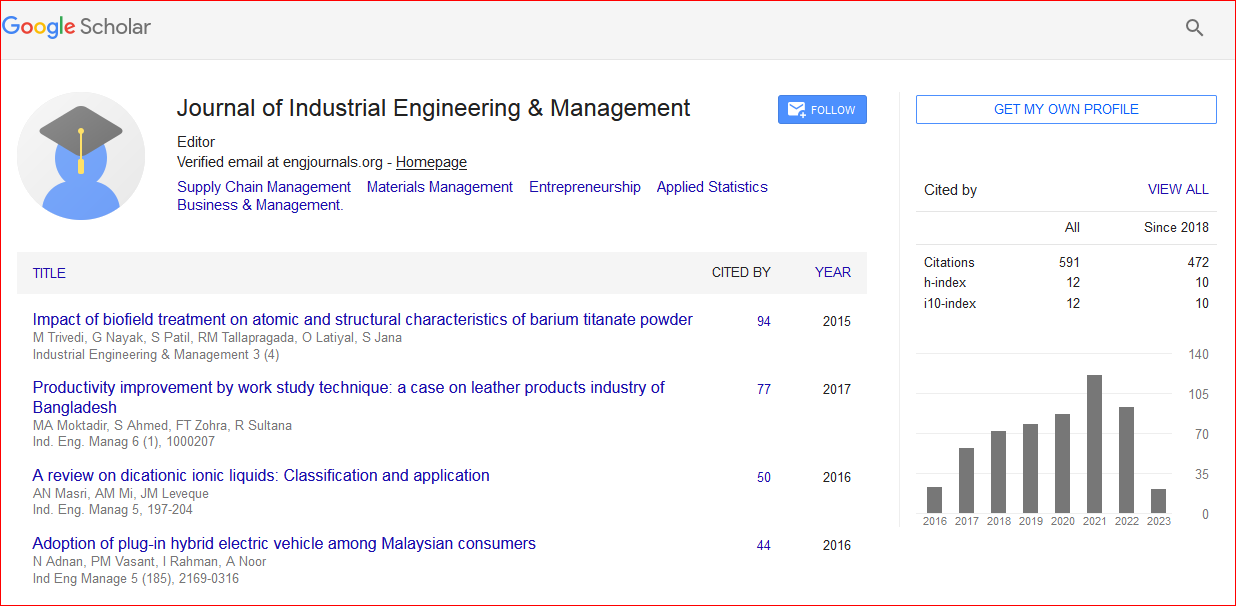
Industrial Engineering & Management received 739 citations as per Google Scholar report