Perspective - (2025) Volume 14, Issue 5
Received: 01-Sep-2025, Manuscript No. iem-26-179834;
Editor assigned: 03-Sep-2025, Pre QC No. P-179834;
Reviewed: 14-Sep-2025, QC No. Q-179834;
Revised: 22-Sep-2025, Manuscript No. R-179834;
Published:
29-Sep-2025
, DOI: 10.37421/2169- 0316.2025.14.323
Citation: Ali, Leila Ben. âOptimizing Manufacturing Logistics: Advanced Techniques for Efficiency.â J Ind Eng Manag 14 (2025):323.
Copyright: © 2025 Ali B. Leila This is an open-access article distributed under the terms of the Creative Commons Attribution License, which permits unrestricted use, distribution and reproduction in any medium, provided the original author and source are credited.
The intricate field of manufacturing logistics is undergoing a profound transformation, driven by the necessity for enhanced efficiency, reduced costs, and improved resilience in global supply chains. Optimization techniques are central to achieving these goals, encompassing a wide array of methodologies and technologies aimed at streamlining operations from procurement to final delivery. This introduction will explore the foundational concepts and recent advancements in manufacturing logistics optimization, drawing upon key research to establish a comprehensive understanding of the current landscape and future directions. The application of logistics optimization techniques within manufacturing environments is crucial for maintaining competitiveness. Sophisticated modeling and simulation, coupled with advanced inventory management strategies, are instrumental in achieving significant reductions in operational costs, improving delivery times, and bolstering overall supply chain resilience. The emphasis is on practical implementation for tangible efficiency gains, a concept explored in detail by Hammami et al. [1].
The integration of digital technologies, particularly those associated with Industry 4.0, is revolutionizing logistics in manufacturing. Concepts such as the Internet of Things (IoT) and Artificial Intelligence (AI) are enabling enhanced real-time tracking, predictive maintenance for logistics assets, and automated decision-making processes. These advancements streamline operations and facilitate adaptation to dynamic market demands, as highlighted by Ghorbel et al. [2].
Lean principles offer a powerful framework for optimizing manufacturing logistics. The application of lean methodologies focuses on waste reduction, improvement of process flow, and the implementation of just-in-time (JIT) delivery systems. A lean approach is demonstrated to create more efficient and cost-effective logistics networks within manufacturing settings, a subject addressed by Bouaziz et al. [3].
The strategic design of logistics networks plays a pivotal role in manufacturing competitiveness. This involves optimizing facility locations, selecting appropriate transportation modes, and defining efficient flow paths to minimize costs and lead times. The long-term benefits of a well-structured logistics network are a significant consideration for strategic planning, as investigated by Ben Yahia et al. [4].
Simulation and modeling techniques are indispensable tools for optimizing warehouse operations within manufacturing. Discrete-event simulation, in particular, can be employed to test various layouts, staffing levels, and material handling systems. This allows for the identification of bottlenecks and the subsequent improvement of operational efficiency, a valuable approach discussed by Bouzaiene et al. [5].
Advanced analytics and big data are increasingly leveraged to enhance manufacturing logistics. Data-driven insights derived from these technologies can significantly improve demand forecasting accuracy, optimize inventory levels, and enable proactive management of potential supply chain disruptions. The power of data in this domain is examined by Elloumi et al. [6].
The optimization of transportation logistics is a critical component of manufacturing operations. Various routing algorithms, fleet management strategies, and the utilization of real-time tracking technologies are employed to reduce transportation costs, minimize delivery times, and enhance overall operational efficiency. This specific area of optimization is explored by Khlifi et al. [7].
Inventory management optimization is another cornerstone of efficient manufacturing logistics. Techniques for safety stock calculation, order quantity optimization, and the integration of advanced inventory tracking systems are vital for reducing holding costs and preventing stockouts. Research in this area by Jemni et al. [8] underscores its importance. Operations research techniques, including linear programming and heuristic algorithms, offer a robust foundation for optimizing various aspects of manufacturing logistics. These techniques are applied to critical decisions related to routing, scheduling, and facility location, providing systematic approaches to complex problems, as presented by Gzara et al. [9].
Furthermore, the integration of sustainable practices into manufacturing logistics optimization is gaining prominence. Green logistics initiatives, such as optimizing routes for reduced emissions, employing eco-friendly packaging, and implementing reverse logistics, are crucial for enhancing environmental performance, a topic addressed by Ghedira et al. [10].
The optimization of logistics and supply chain management within manufacturing enterprises is a multifaceted endeavor that requires a comprehensive application of advanced techniques. Hammami et al. [1] emphasize that sophisticated modeling and simulation, alongside advanced inventory management strategies, are pivotal for significantly reducing operational costs, improving delivery times, and enhancing overall supply chain resilience. The practical implementation of these methods is underscored for achieving tangible efficiency gains in manufacturing settings. This foundational approach sets the stage for a deeper exploration of how logistics can be optimized. The advent of Industry 4.0 has ushered in a new era for manufacturing logistics, characterized by the integration of digital technologies like the Internet of Things (IoT) and Artificial Intelligence (AI). Ghorbel et al. [2] explore how these concepts revolutionize logistics by enabling enhanced real-time tracking, predictive maintenance for logistics assets, and automated decision-making processes. This allows for streamlined operations and greater adaptability to dynamic market demands, marking a significant technological leap forward. Lean principles provide a systematic approach to waste reduction and process improvement in manufacturing logistics. Bouaziz et al. [3] detail how methods for waste reduction, process flow enhancement, and the implementation of just-in-time delivery systems can create more efficient and cost-effective logistics networks. The focus on eliminating non-value-adding activities is central to achieving lean logistics optimization. Strategic logistics network design is a critical factor influencing manufacturing competitiveness. Ben Yahia et al. [4] investigate the optimization of facility locations, transportation modes, and flow paths to achieve cost minimization and lead time reduction. This strategic perspective highlights the long-term benefits derived from a well-structured and thoughtfully designed logistics network. Simulation modeling, particularly discrete-event simulation, offers a powerful tool for optimizing warehouse operations in manufacturing. Bouzaiene et al. [5] discuss how this technique can be used to evaluate different warehouse layouts, staffing levels, and material handling systems. The ability to identify bottlenecks and test improvement scenarios before implementation is a key advantage. Leveraging big data analytics is increasingly recognized as essential for enhancing manufacturing logistics. Elloumi et al. [6] examine how data-driven insights derived from advanced analytics can significantly improve demand forecasting, optimize inventory levels, and facilitate proactive management of potential supply chain disruptions. This data-centric approach enables more informed and agile decision-making. The optimization of transportation logistics within manufacturing operations is paramount for efficiency and cost control. Khlifi et al. [7] explore the application of various routing algorithms, sophisticated fleet management strategies, and the use of real-time tracking technologies. These efforts collectively aim to reduce transportation costs and minimize delivery times. Effective inventory management is a core component of manufacturing logistics optimization. Jemni et al. [8] focus on techniques for calculating safety stock, optimizing order quantities, and integrating advanced inventory tracking systems. The goal is to reduce holding costs, prevent stockouts, and maintain optimal inventory levels throughout the supply chain. Operations research (OR) techniques provide a robust mathematical framework for addressing complex optimization challenges in manufacturing logistics. Gzara et al. [9] highlight the application of methods such as linear programming and heuristic algorithms to optimize routing, scheduling, and facility location decisions, offering systematic solutions. Finally, the integration of sustainable practices into manufacturing logistics optimization is becoming increasingly critical. Ghedira et al. [10] focus on green logistics initiatives, including route optimization for emission reduction, the use of eco-friendly packaging, and the implementation of reverse logistics strategies. These practices contribute to enhanced environmental performance and corporate responsibility.
This compilation of research explores various facets of manufacturing logistics optimization. Key areas of focus include the application of advanced modeling, simulation, and inventory management techniques to reduce costs and improve efficiency. The integration of Industry 4.0 technologies such as IoT and AI is highlighted for its role in real-time tracking and automated decision-making. Lean principles are presented as a method for waste reduction and process flow improvement. Strategic network design, encompassing facility location and transportation optimization, is examined for its impact on competitiveness. Simulation modeling is utilized for enhancing warehouse operations [5], while big data analytics improve demand forecasting and inventory management. Transportation logistics are optimized through routing algorithms and fleet management, and inventory management techniques aim to reduce holding costs and prevent stockouts. Operations research techniques provide a framework for routing, scheduling, and facility location decisions. Lastly, sustainable practices and green logistics initiatives are integrated to improve environmental performance.
None
None
None
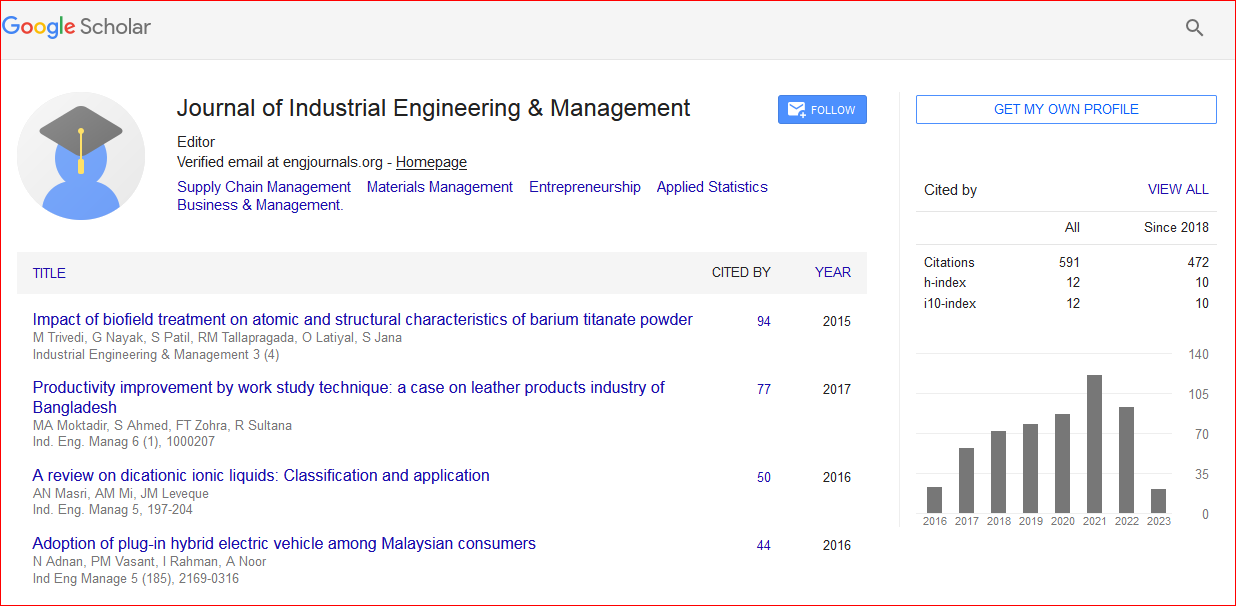
Industrial Engineering & Management received 739 citations as per Google Scholar report