Short Communication - (2025) Volume 14, Issue 3
Received: 01-May-2025, Manuscript No. iem-26-179788;
Editor assigned: 04-May-2025, Pre QC No. P-179788;
Reviewed: 14-May-2025, QC No. Q-179788;
Revised: 21-May-2025, Manuscript No. R-179788;
Published:
29-May-2025
, DOI: 10.37421/2169- 0316.2025.14.305
Citation: Rossi, Isabella. Optimizing Inventory: Strategies for Cost Reduction. J Ind Eng Manag 14 (2025):305.
Copyright: © 2025 Rossi I. This is an open-access article distributed under the terms of the Creative Commons Attribution License, which permits unrestricted use, distribution and reproduction in any medium, provided the original author and source are credited.
Effective inventory management is a cornerstone of operational efficiency and profitability within manufacturing enterprises. Organizations continuously seek robust strategies to mitigate costs associated with holding, ordering, and stockouts. This article delves into various approaches, beginning with the foundational elements of strategic inventory management aimed at significant cost reductions. Key insights emphasize the critical role of accurate demand forecasting, the strategic application of inventory control models such as the Economic Order Quantity (EOQ) and reorder points, and the imperative adoption of modern technologies like real-time tracking and Warehouse Management Systems (WMS). A data-driven methodology, coupled with enhanced supply chain collaboration, is highlighted as crucial for minimizing holding costs, obsolescence, and stockouts, thereby directly influencing profitability [1].
The evolution of inventory optimization has been significantly shaped by advancements in analytical techniques and artificial intelligence. Research explores the integration of these powerful tools to enhance precision in demand prediction, which consequently leads to improved stock level management. The benefits extend to predictive maintenance for inventory-related equipment and the use of AI for identifying slow-moving or obsolete stock, enabling proactive cost-saving measures. This shift represents a move beyond traditional inventory control methods towards a more dynamic and intelligent system [2].
A crucial factor in achieving inventory cost reduction is the enhancement of supply chain visibility. Improved visibility, facilitated by real-time data sharing across the entire supply chain, empowers more informed decision-making regarding inventory levels, transportation logistics, and production schedules. The establishment of a comprehensive framework for end-to-end supply chain visibility demonstrably reduces the need for safety stock, improves responsiveness to disruptions, and ultimately lowers overall inventory-related expenses [3].
Furthermore, the principles of lean management offer a powerful framework for inventory optimization. This approach focuses on the systematic identification and elimination of waste within inventory processes, including overproduction, excess inventory, and unnecessary movement. Specific lean tools and techniques, such as Just-In-Time (JIT) inventory, Kanban systems, and value stream mapping, are presented as effective methodologies for streamlining inventory operations and driving down associated costs [4].
In parallel with process-oriented strategies, the role of technology in inventory management is paramount. Modern inventory optimization software plays a vital role in reducing operational costs. These solutions provide advanced forecasting capabilities, automate reorder processes, and offer real-time inventory visibility. The selection criteria for suitable software and the potential return on investment, achieved through improved efficiency, reduced stockouts, and minimized excess inventory, are key considerations [5].
Complementing software solutions, simulation modeling provides a powerful avenue for optimizing inventory policies and achieving cost reductions. By creating virtual representations of inventory systems, managers can rigorously test various scenarios and evaluate the efficacy of different inventory control strategies without impacting live operations. This methodology facilitates the identification of optimal order quantities, safety stock levels, and replenishment frequencies that minimize total inventory costs [6].
Understanding and effectively managing inventory holding costs is fundamental to overall operational expense reduction. A comprehensive breakdown of holding cost components, including storage, insurance, obsolescence, and the opportunity cost of capital, is essential. Accurate calculation of these costs, coupled with strategic reduction methods such as optimizing warehouse layout, implementing better inventory rotation, and enhancing demand forecasting to minimize excess stock, directly impacts profitability [7].
Minimizing stockouts is another critical aspect of inventory management that directly contributes to cost avoidance and enhanced profitability. The direct and indirect costs associated with stockouts, including lost sales, diminished customer loyalty, and production stoppages, are significant. Techniques for mitigating stockouts, such as robust safety stock policies, improved order fulfillment processes, and the utilization of demand sensing technologies for agile responses to market fluctuations, are discussed [8].
The strategic design of the supply chain network profoundly influences inventory costs. The configuration of warehouses, distribution centers, and transportation routes directly impacts the volume of inventory held and the associated expenses. Methodologies for optimizing network design are proposed to achieve a balance between service levels and inventory investment, thereby realizing overall cost reductions [9].
Finally, the management of inventory for perishable goods presents unique challenges and opportunities. Specialized inventory control strategies, such as First-Expired, First-Out (FEFO) systems, and accurate shelf-life management are crucial. Effective inventory planning for perishables minimizes spoilage and waste, leading to substantial cost savings and improved product availability [10].
Strategic inventory management forms a critical pillar for enhancing financial performance in manufacturing. The pursuit of cost reduction through optimized inventory practices is a continuous endeavor. This section details the strategic imperative of demand forecasting accuracy and the judicious application of inventory control models like EOQ and reorder points. The integration of advanced technologies, including real-time tracking and sophisticated Warehouse Management Systems (WMS), is also emphasized. A core tenet is the adoption of a data-driven approach, harmonized with efficient supply chain collaboration, to effectively minimize holding costs, mitigate obsolescence, and prevent stockouts, all of which have a direct and positive impact on overall profitability [1].
The landscape of inventory optimization has been dramatically reshaped by the advent of advanced analytics and artificial intelligence. These technologies are instrumental in elevating demand prediction precision, which in turn facilitates superior stock level management. The practical benefits include improved predictive maintenance for inventory-related infrastructure and the leveraging of AI for the proactive identification of slow-moving or obsolete inventory, thereby enabling timely cost-saving interventions. This sophisticated approach signifies a departure from conventional inventory control methodologies towards a more adaptive and intelligent paradigm [2].
Enhancing supply chain visibility emerges as a significant lever for inventory cost reduction. Through the establishment of real-time data sharing across all supply chain nodes, organizations gain the ability to make more informed decisions concerning inventory quantities, transportation strategies, and production planning. A well-defined framework for achieving comprehensive end-to-end supply chain visibility has been shown to effectively reduce the necessity for substantial safety stock, expedite responses to unforeseen disruptions, and consequently lower overall inventory-related expenditures [3].
Lean principles offer a proven pathway to inventory cost reduction by systematically targeting and eliminating waste within inventory processes. This methodology actively seeks to identify and remove inefficiencies such as overproduction, the accumulation of excess inventory, and unproductive material movement. The implementation of specific lean tools, including Just-In-Time (JIT) inventory, Kanban systems, and value stream mapping, provides a structured approach to streamlining inventory operations and achieving significant cost reductions [4].
Inventory optimization software represents a vital technological enabler for reducing operational costs within the supply chain. These modern software solutions empower businesses with advanced forecasting capabilities, automate routine reorder procedures, and deliver real-time insights into inventory status. The critical assessment of selection criteria for appropriate software and the projection of its return on investment through enhanced efficiency, minimized stockouts, and the reduction of excess stock are essential considerations [5].
Simulation modeling stands as a powerful analytical tool for refining inventory policies and achieving cost optimization. The creation of virtual environments that mirror actual inventory systems allows managers to explore diverse scenarios and meticulously assess the performance of different inventory control strategies without disrupting ongoing operations. This technique is invaluable for determining optimal order quantities, establishing appropriate safety stock levels, and defining replenishment frequencies that collectively minimize total inventory costs [6].
A thorough understanding and active management of inventory holding costs are indispensable for controlling overall operational expenditures. This involves a detailed enumeration of all holding cost components, encompassing storage expenses, insurance premiums, the costs associated with obsolescence, and the opportunity cost of capital. Implementing effective strategies for calculating these costs accurately and subsequently reducing them, through measures like optimizing warehouse layouts, improving inventory rotation practices, and refining demand forecasting, directly contributes to enhanced profitability [7].
The imperative to minimize stockouts translates directly into significant cost avoidance and improved financial outcomes. Stockouts incur both direct and indirect costs, including lost sales opportunities, erosion of customer loyalty, and detrimental production interruptions. Proactive strategies for stockout mitigation, such as the establishment of well-defined safety stock policies, the refinement of order fulfillment processes, and the deployment of demand sensing technologies, are crucial for agile responses to market dynamics [8].
The strategic design of the supply chain network has a profound and direct impact on overall inventory costs. The physical configuration of warehouses, distribution centers, and the associated transportation routes are critical determinants of the total inventory held and the accompanying expenses. Methodologies focused on optimizing this network design are essential for achieving an effective balance between desired service levels and the financial investment in inventory, thereby leading to comprehensive cost reductions [9].
Managing inventory for perishable goods necessitates specialized approaches to mitigate substantial costs arising from spoilage and waste. This involves the adoption of tailored inventory control strategies, such as First-Expired, First-Out (FEFO) systems, and a strong emphasis on accurate shelf-life management. The successful implementation of effective inventory planning for perishable items directly translates into minimized waste, significant cost savings, and an improved availability of products for consumers [10].
This compilation of research explores multifaceted strategies for optimizing inventory management and achieving significant cost reductions. Key themes include the strategic implementation of demand forecasting, inventory control models like EOQ, and modern technologies such as real-time tracking and Warehouse Management Systems. The integration of artificial intelligence and advanced analytics enhances demand prediction and stock management. Supply chain visibility is highlighted as crucial for informed decision-making and reduced safety stock. Lean principles and simulation modeling offer systematic approaches to waste elimination and policy optimization. Furthermore, understanding and managing inventory holding costs, minimizing stockouts, optimizing supply chain network design, and implementing specialized strategies for perishable goods are all identified as vital components for driving down operational expenses and improving profitability.
None
None
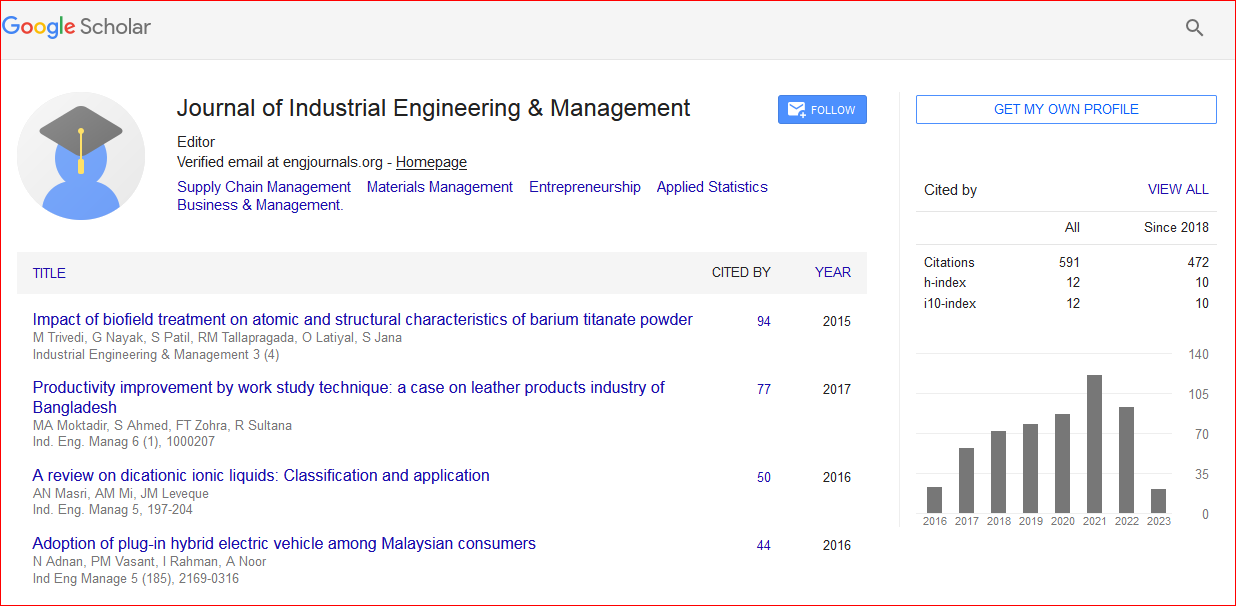
Industrial Engineering & Management received 739 citations as per Google Scholar report