Commentary - (2025) Volume 16, Issue 2
Received: 01-Mar-2025, Manuscript No. jhmi-26-178817;
Editor assigned: 03-Mar-2025, Pre QC No. P-178817;
Reviewed: 17-Mar-2025, QC No. Q-178817;
Revised: 24-Mar-2025, Manuscript No. R-178817;
Published:
31-Mar-2025
, DOI: 10.37421/2157-7420.2025.16.580
Citation: Markova, Elena R.. ”Optimizing EHRs: Integration, Usability and Future Potential.” J Health Med Informat 16 (2025):580.
Copyright: © 2025 Markova R. Elena This is an open-access article distributed under the terms of the Creative Commons Attribution License, which permits unrestricted use, distribution and reproduction in any medium, provided the original author and source are credited.
Electronic Health Records (EHRs) have become a cornerstone of contemporary healthcare systems, profoundly influencing the operational dynamics of clinical environments. They offer a streamlined approach to managing patient information, fostering enhanced communication among healthcare professionals, and supporting more informed decision-making through readily accessible data. The successful implementation of EHRs is paramount for achieving greater efficiency, minimizing medical errors, and ultimately elevating patient outcomes. This necessitates a deliberate integration into existing clinical practices, prioritizing user-friendliness, and providing comprehensive training for all users. The evolution of healthcare technology has seen EHRs emerge as critical tools for advancing patient care and operational effectiveness [1].
Optimizing clinical workflows through the adoption of EHRs demands a comprehensive strategy that addresses key areas such as system interoperability, the security of patient data, and overall user satisfaction. Many challenges encountered during the adoption phase can be attributed to inadequate system design, resistance to organizational change, and a lack of sufficient technical assistance. To overcome these obstacles, it is essential to establish continuous feedback mechanisms involving clinicians and to commit to iterative improvements in system functionality and design [2].
The impact of EHRs on patient safety is particularly noteworthy, with integrated features like drug interaction alerts and clinical decision support systems playing a vital role in the reduction of medical errors. However, the true effectiveness of these safety mechanisms is contingent upon their precise configuration and their application within the specific clinical context. Continuous assessment and evaluation are indispensable to guarantee that these features actively contribute to the provision of safe and high-quality patient care [3].
EHRs serve as a valuable resource for clinical research by providing structured data sets amenable to in-depth analysis. This structured data can unlock novel insights into disease progression, the efficacy of various treatments, and patterns in healthcare delivery. Nonetheless, the standardization and anonymization of this data are critical prerequisites for maintaining the integrity of research findings and ensuring the ethical utilization of sensitive patient information [4].
The usability of EHR systems exerts a direct influence on levels of physician burnout and the overall efficiency of clinical workflows. Cumbersome interfaces, excessive data entry requirements, and an overabundance of system-generated alerts can divert attention from direct patient care. Therefore, designing EHRs with active clinician input and a strong emphasis on intuitive user interfaces is fundamental to achieving successful adoption and optimizing workflow performance [5].
A persistent and significant challenge within the realm of EHRs is the lack of interoperability between disparate systems. The absence of seamless data exchange capabilities can result in redundant work, incomplete patient medical histories, and a fragmented approach to patient care. The adoption of standardized protocols, such as FHIR (Fast Healthcare Interoperability Resources), is crucial for facilitating improved data sharing and enhancing the continuity of care across different healthcare settings [6].
Mobile health applications, when integrated with EHR systems, offer a powerful avenue for increasing patient engagement and provider accessibility. These tools facilitate remote patient monitoring, enable secure communication channels, and provide patients with more convenient access to their health information, thereby optimizing patient management and empowering individuals to take a more active role in their healthcare journey [7].
The integration of Artificial Intelligence (AI) and machine learning within EHR systems presents substantial potential for enhancing predictive analytics and enabling truly personalized medicine. These advanced technologies can assist in identifying patients at high risk for certain conditions, recommending optimal treatment strategies, and automating various administrative tasks, all of which contribute to further optimizing clinical workflows [8].
Robust data governance frameworks and rigorous quality assurance measures are indispensable for the reliable and effective utilization of EHR data. Ensuring that patient data is accurate, complete, and consistent is not only vital for informed clinical decision-making but also fundamental to the validity of any research or analytical work conducted using this information [9].
Patient portals, frequently integrated with EHR functionalities, significantly empower patients by granting them access to their personal health records. These portals also facilitate essential administrative tasks such as appointment scheduling and streamline communication with healthcare providers. This heightened level of patient involvement is directly linked to improved adherence to treatment plans and consequently, better overall health outcomes [10].
Electronic Health Records (EHRs) are now an indispensable component of modern healthcare, significantly reshaping the way clinical activities are conducted. They serve to centralize and organize patient data, thereby improving the coordination of care among healthcare providers and enhancing diagnostic and treatment decision-making through readily available information. The successful implementation of EHRs is critical for achieving operational efficiencies, reducing the incidence of medical errors, and ultimately improving the quality of patient care. This involves careful integration into the established clinical workflows, ensuring that the systems are intuitive for users and that adequate training programs are in place. The evolution of healthcare technology has seen EHRs emerge as critical tools for advancing patient care and operational effectiveness [1].
To effectively optimize clinical workflows with the use of EHRs, a multifaceted strategy is required, with a primary focus on system interoperability, robust data security measures, and ensuring high levels of user satisfaction. Challenges that often impede the adoption of EHRs typically arise from poorly designed systems, resistance to the necessary changes in established routines, and insufficient technical support. Addressing these issues effectively requires the establishment of continuous feedback loops with healthcare professionals and a commitment to iterative improvements in system design and functionality [2].
The contribution of EHRs to improving patient safety is substantial, particularly through features designed to minimize medical errors, such as automated drug interaction alerts and sophisticated clinical decision support systems. Nevertheless, the effectiveness of these safety features is directly dependent on their correct configuration and their appropriate application within the specific clinical context. Ongoing evaluation and refinement are necessary to ensure that these systems consistently contribute positively to the provision of safe patient care [3].
EHR systems play a pivotal role in facilitating clinical research by offering structured and organized data that can be subjected to rigorous analysis. This capability can lead to the discovery of new insights into disease patterns, the evaluation of treatment efficacy, and a better understanding of healthcare delivery models. However, it is imperative that data standardization and robust anonymization protocols are strictly adhered to in order to maintain the integrity of the data and ensure its ethical use for research purposes [4].
The usability of EHR systems has a direct and significant impact on physician burnout and the overall efficiency of clinical workflows. Clunky user interfaces, overly demanding data entry requirements, and a barrage of frequent system alerts can detract from the time and attention that clinicians can dedicate to patient care. Therefore, designing EHRs with substantial input from clinicians and prioritizing an intuitive and user-friendly design are paramount for achieving successful adoption and optimizing the efficiency of clinical workflows [5].
Achieving seamless interoperability between different EHR systems remains a considerable challenge in the healthcare landscape. The absence of effective and consistent data exchange mechanisms can lead to duplicated efforts in data collection, incomplete patient medical histories, and ultimately, a fragmented approach to patient care. The widespread adoption of interoperability standards, such as FHIR, is essential for enabling better data sharing and significantly improving the continuity of care for patients [6].
Mobile health applications, when thoughtfully integrated with EHR systems, have the potential to significantly enhance patient engagement and improve provider accessibility. These mobile tools facilitate important functions such as remote patient monitoring, secure messaging between patients and providers, and easier access to personal health information, thereby optimizing patient management and empowering individuals to play a more active role in their healthcare journey [7].
The integration of advanced technologies like Artificial Intelligence (AI) and machine learning into EHR systems holds immense promise for the development of sophisticated predictive analytics and the realization of personalized medicine. These cutting-edge technologies can assist healthcare providers in identifying patients who are at higher risk for developing specific conditions, recommending the most effective treatment pathways, and automating numerous administrative tasks, all of which contribute to further optimizing clinical workflows [8].
Ensuring robust data governance and implementing stringent quality assurance measures are critical for the reliable and effective utilization of data within EHR systems. Maintaining the accuracy, completeness, and consistency of patient data is fundamental not only for informed clinical decision-making but also for ensuring the validity of any analytical studies or research conducted using this information [9].
Patient portals, which are increasingly integrated with EHR functionalities, offer a significant advantage by empowering patients with direct access to their health information. These portals also streamline essential administrative processes like appointment scheduling and facilitate effective communication with the care team. This increased patient involvement and access to information are directly correlated with better adherence to prescribed treatment plans and, consequently, improved health outcomes for patients [10].
Electronic Health Records (EHRs) are crucial for modern healthcare, streamlining patient data, improving communication, and enhancing decision-making. Effective implementation requires thoughtful integration, user-friendliness, and adequate training. Optimizing EHRs involves focusing on interoperability, data security, and user satisfaction, while addressing challenges like poor design and resistance to change through continuous feedback and iterative improvements. EHRs significantly enhance patient safety with features like alerts and decision support, but their effectiveness relies on proper configuration and context. They also facilitate clinical research by providing structured data, necessitating data standardization and anonymization for integrity. System usability directly impacts physician burnout and workflow efficiency, underscoring the need for user-centered design. Interoperability issues persist, hindering seamless data exchange and continuity of care, making standards like FHIR vital. Mobile health integrations boost patient engagement and accessibility through remote monitoring and secure messaging. AI and machine learning in EHRs offer potential for predictive analytics and personalized medicine, automating tasks and optimizing workflows. Strong data governance and quality assurance are essential for reliable EHR use. Patient portals integrated with EHRs empower patients with access to their health information, improving adherence and outcomes.
None
None
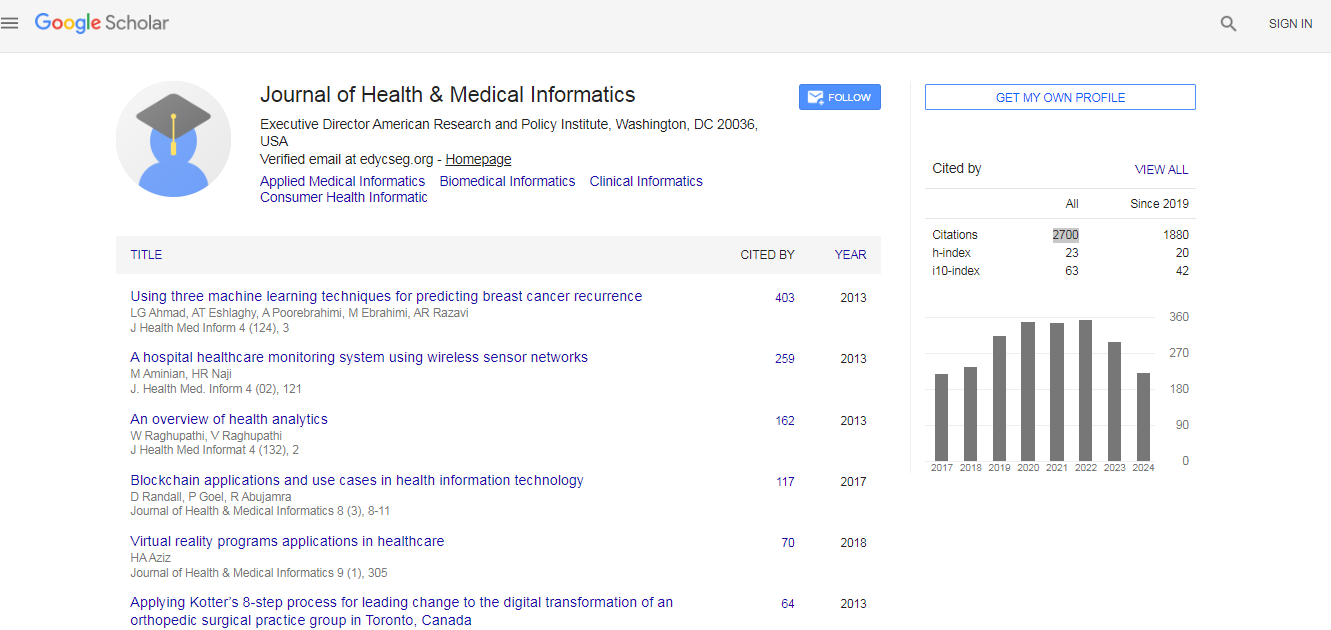
Journal of Health & Medical Informatics received 2700 citations as per Google Scholar report