Opinion - (2025) Volume 14, Issue 2
Received: 01-Apr-2025, Manuscript No. idse-26-182770;
Editor assigned: 03-Apr-2025, Pre QC No. P-182770;
Reviewed: 17-Apr-2025, QC No. Q-182770;
Revised: 22-Apr-2025, Manuscript No. R-182770;
Published:
29-Apr-2025
, DOI: 10.37421/2168-9768.2025.14.481
Citation: Wei, Liang. ”Optimizing Agricultural Water Management
For Sustainability.” Irrigat Drainage Sys Eng 14 (2025):481.
Copyright: © 2025 Wei L. This is an open-access article distributed under the terms of the Creative Commons Attribution License, which permits unrestricted use, distribution
and reproduction in any medium, provided the original author and source are credited.
The critical role of advanced irrigation and drainage engineering in optimizing agricultural water management is underscored by innovative techniques for efficient water application, improved soil moisture regulation, and enhanced water use efficiency across diverse agro-climatic conditions. The integration of smart technologies and data-driven approaches is vital for addressing water scarcity and promoting sustainable agricultural practices [1].
Significant challenges in agricultural lands, such as waterlogging and salinity, necessitate the exploration of effective drainage strategies. The design and implementation of subsurface drainage systems, with their impact on crop yields and soil health, are crucial. Assessment of the economic feasibility and environmental benefits of different drainage approaches in arid and semi-arid regions is therefore paramount [2].
The application of remote sensing and GIS technologies has opened new avenues for precision irrigation management. Real-time data on crop water needs and soil moisture levels, derived from satellite imagery and ground-based sensors, enable the development of site-specific irrigation recommendations, leading to substantial water savings and improved crop productivity [3].
A comparative analysis of irrigation scheduling methods reveals the effectiveness of various approaches, including fixed interval, soil moisture-based, and crop-based strategies. Quantifying water savings and yield responses under varying climatic conditions provides practical guidance for farmers to select optimal irrigation scheduling strategies [4].
The profound impact of climate change on agricultural water demand necessitates adaptation strategies for irrigation and drainage systems. Utilizing climate projection models to assess future water availability and crop water requirements is essential for proposing strategies that enhance the resilience of water management systems to climate variability [5].
Micro-irrigation systems, such as drip and sprinkler irrigation, are evaluated for their water-saving capabilities and impact on crop yield. Factors influencing their efficiency, including system design, maintenance, and water quality, highlight their suitability for high-value crops and water-scarce regions [6].
The use of treated wastewater for irrigation presents both challenges and opportunities, with potential risks to soil, crops, and human health balanced against the benefits of water reuse. Establishing guidelines and treatment technologies is crucial for ensuring the safe and effective application of treated wastewater in agricultural schemes [7].
The development and application of hydrological models offer a powerful tool for optimizing water resource management in agricultural catchments. Simulating rainfall-runoff processes, groundwater dynamics, and water demand aids in improving decision-making for water allocation and infrastructure planning [8].
In rainfed agriculture, the effectiveness of different mulching materials in conserving soil moisture and improving crop yield is a key area of research. Comparing the performance of various mulches provides insights into selecting appropriate techniques to enhance water productivity [9].
Furthermore, the integration of artificial intelligence and machine learning techniques is revolutionizing irrigation scheduling and water management. These technologies analyze complex environmental data, predict crop water needs, and automate irrigation decisions, thereby improving efficiency and sustainability in agriculture [10].
The advancement of irrigation and drainage engineering plays a pivotal role in optimizing agricultural water management by introducing innovative techniques for efficient water application and enhanced soil moisture regulation. This approach also focuses on improving water use efficiency across a spectrum of agro-climatic conditions. The research highlights the critical integration of smart technologies and data-driven methodologies to effectively address the growing concerns of water scarcity and to actively promote sustainable agricultural practices [1].
Addressing the persistent challenges of waterlogging and salinity within agricultural lands requires a thorough exploration of effective drainage strategies. The paper delves into the intricate design and practical implementation of subsurface drainage systems, critically assessing their profound impact on both crop yields and the overall health of the soil. Moreover, it undertakes an evaluation of the economic viability and the ecological advantages associated with employing different drainage methodologies, particularly in regions characterized by arid and semi-arid climates [2].
Precision irrigation management is being significantly advanced through the application of cutting-edge remote sensing and GIS technologies. This synergy allows for the acquisition of real-time data pertaining to crop water requirements and the dynamic levels of soil moisture. Such data is instrumental in formulating highly specific irrigation recommendations, ultimately leading to considerable water conservation and a marked improvement in crop productivity [3].
An in-depth comparative analysis of irrigation scheduling methods has been conducted, evaluating approaches such as fixed interval, soil moisture-based, and crop-based strategies. Through meticulous field experiments and sophisticated modeling, the study quantifies the water savings and the corresponding yield responses elicited by each method under a variety of climatic conditions. The resultant findings furnish practical directives for agricultural practitioners, enabling them to ascertain and implement the most suitable irrigation scheduling strategy for their specific needs [4].
The escalating impact of climate change on agricultural water demand necessitates the development and implementation of robust adaptation strategies within existing irrigation and drainage systems. Employing climate projection models to forecast future water availability and to ascertain evolving crop water requirements is a fundamental step in proposing adaptive measures. These strategies aim to bolster the resilience of water management systems against the backdrop of increasing climate variability [5].
The performance of micro-irrigation systems, encompassing drip and sprinkler irrigation techniques, is systematically evaluated with a focus on their water-saving potential and their contribution to crop yield enhancement. A detailed analysis identifies key factors that influence their operational efficiency, including the intricacies of system design, diligent maintenance practices, and the quality of the available water. The research substantiates the high suitability of micro-irrigation for cultivating high-value crops and its particular efficacy in regions confronting limited water resources [6].
The utilization of treated wastewater for agricultural irrigation presents a complex interplay of challenges and opportunities. This includes a careful examination of the potential risks posed to soil ecosystems, crop viability, and human health, juxtaposed against the significant benefits derived from water reuse in agriculture. The study consequently proposes a comprehensive set of guidelines and outlines advanced treatment technologies essential for ensuring the safe and effective deployment of treated wastewater within diverse irrigation schemes [7].
The paper meticulously explores the development and practical application of sophisticated hydrological models designed to optimize water resource management within agricultural catchments. It provides a detailed discussion on the utility of various modeling tools employed to accurately simulate crucial processes such as rainfall-runoff dynamics, groundwater fluctuations, and the multifaceted aspects of water demand. The overarching objective of this research is to enhance the quality of decision-making processes related to water allocation and the strategic planning of water infrastructure [8].
This particular study investigates the efficacy of a range of mulching materials specifically for their capacity to conserve soil moisture and, consequently, to improve crop yield within the context of rainfed agriculture. A detailed comparison of the performance characteristics of plastic mulch, organic mulch, and conventionally bare soil is undertaken across diverse environmental conditions. The research yields valuable insights, guiding the selection of appropriate mulching techniques to significantly bolster water productivity in rainfed farming systems [9].
Finally, the integration of artificial intelligence (AI) and machine learning (ML) techniques is explored as a transformative approach for optimizing irrigation scheduling and overall water management in the agricultural sector. The paper investigates the substantial potential of these advanced technologies to process and analyze intricate environmental datasets, to accurately predict crop water requirements, and to automate critical irrigation decisions, thereby fostering significant improvements in both agricultural efficiency and long-term sustainability [10].
This collection of research explores various facets of agricultural water management, focusing on optimizing irrigation and drainage systems for sustainability. Key areas of investigation include advanced engineering techniques, managing waterlogging and salinity, and the application of precision technologies like remote sensing and GIS. Studies also examine different irrigation scheduling methods, the impact of climate change, the performance of micro-irrigation, and the reuse of treated wastewater. Hydrological modeling and mulching practices are discussed for their roles in water conservation. Furthermore, the integration of artificial intelligence and machine learning is highlighted as a promising avenue for enhancing irrigation efficiency and decision-making in agriculture.
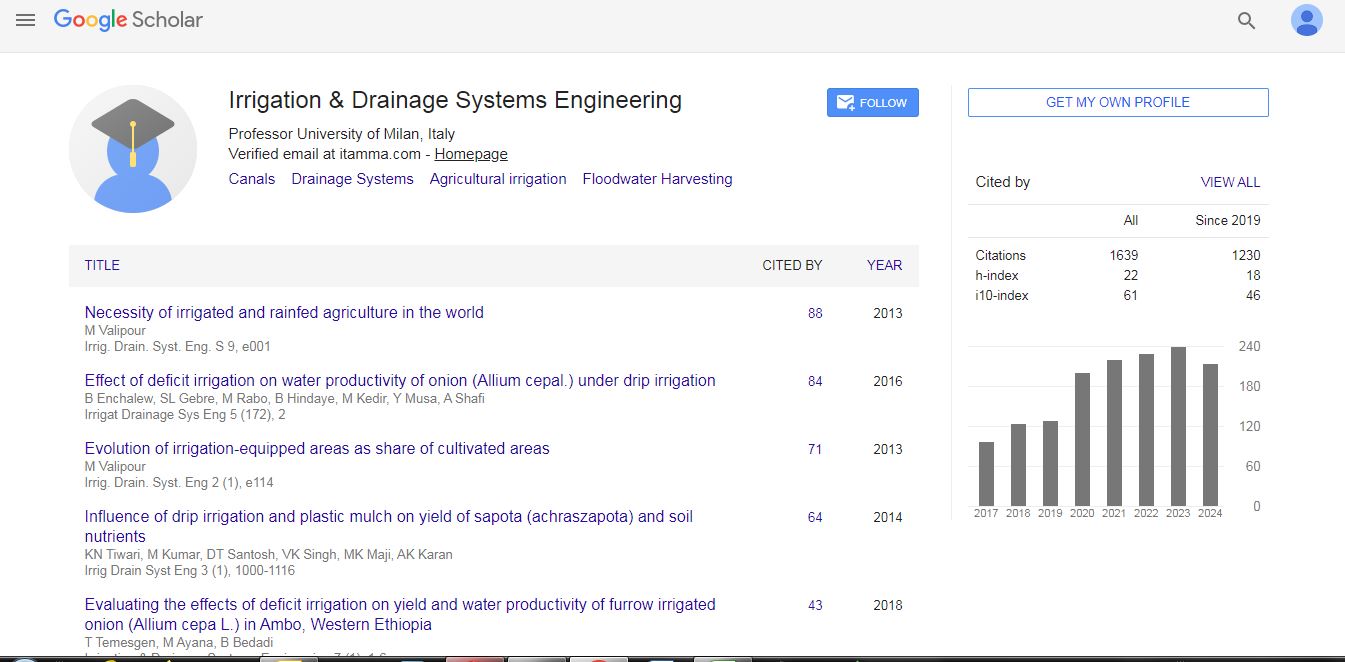
Irrigation & Drainage Systems Engineering received 835 citations as per Google Scholar report