Short Communication - (2025) Volume 17, Issue 4
Received: 01-Jul-2025, Manuscript No. jcst-25-174956;
Editor assigned: 03-Jul-2025, Pre QC No. P-174956;
Reviewed: 17-Jul-2025, QC No. Q-174956;
Revised: 22-Jul-2025, Manuscript No. R-174956;
Published:
29-Jul-2025
, DOI: 10.37421/1948-5956.2025.17.719
Citation: Taylor, William. ”Oncology: Therapies, Diagnostics,
Future Frontiers.” J Cancer Sci Ther 17 (2025):719.
Copyright: © 2025 Taylor W. This is an open-access article distributed under the terms of the Creative Commons Attribution License, which permits unrestricted use, distribution
and reproduction in any medium, provided the original author and source are credited.
Immunotherapy continues to redefine cancer treatment, particularly in head and neck squamous cell carcinoma (HNSCC). This evolving field is under intense scrutiny, with research detailing current applications, the precise mechanisms through which these therapies act, and emerging strategies designed to overcome inherent resistance. A significant focus here is on combination therapies and the identification of novel therapeutic targets to improve patient outcomes. [1] Parallel to these advancements, liquid biopsies are proving to be a truly transformative tool in precision oncology. Their immense utility spans several critical areas, including the early detection of cancer, meticulous monitoring of treatment responses, precise detection of minimal residual disease, and ultimately, the informed guidance of therapeutic decisions, thus personalizing treatment pathways for patients. [2] Significant progress is also evident in targeted therapies, specifically for non-small cell lung cancer (NSCLC). Recent reviews thoroughly detail approved therapeutic agents and highlight a continuously expanding array of emerging targets. Crucially, strategies to overcome treatment resistance are being developed, emphasizing the profound importance of molecular profiling for effective patient stratification and therapy selection. [3] Here's the thing, Artificial Intelligence (AI) is rapidly gaining traction and demonstrating a growing impact across the entire spectrum of oncology. Its applications are diverse and powerful, encompassing improved diagnostic accuracy, sophisticated treatment planning, advancements in precision medicine, accelerating the pace of drug discovery, and enhancing patient monitoring. However, as with any powerful technology, careful consideration of associated challenges and ethical implications is essential for its responsible deployment. [4] The therapeutic potential of CRISPR-Cas9 gene editing technology in cancer is a rapidly evolving area under intense investigation. This revolutionary technology is being explored for its application in developing novel cell therapies, facilitating direct gene targeting, and significantly enhancing existing immunotherapies. Despite these exciting prospects, the field is actively addressing numerous technical and complex ethical hurdles that must be navigated for widespread clinical translation. [5] Let's break it down: a fascinating and intricate relationship exists between the gut microbiome and the overall efficacy of cancer immunotherapy. Emerging research reveals how specific compositions of microbial communities within the gut can either profoundly enhance or unfortunately hinder therapeutic responses. This understanding opens entirely new avenues for modulating treatment outcomes, potentially by tailoring microbial interventions to optimize therapeutic benefit. [6] Additionally, a critical evaluation of the progression of Chimeric Antigen Receptor (CAR) T-cell therapy in its application to solid tumors reveals ongoing challenges. Experts meticulously outline the significant hurdles associated with the often-immunosuppressive tumor microenvironment, the problem of antigen heterogeneity, and difficulties with T-cell trafficking. Nevertheless, innovative strategies are consistently being proposed to enhance its efficacy and expand its reach beyond hematological malignancies. [7] What this really means is that the increasing integration of patient-reported outcomes (PROs) in clinical oncology is paramount. These outcomes are crucial for improving patient-centric care, specifically in areas such as symptom management, enhancing the overall quality of life for patients, and refining general patient care strategies. While their importance is recognized, rigorous methodological considerations for their effective and standardized use are continually being addressed. [8] An updated perspective on cancer metabolism offers deeper insights into the fundamental processes driving tumor growth. This includes exploring the well-known Warburg effect and other complex metabolic alterations that uniquely fuel cancer cells. Understanding how to precisely target these distinct metabolic pathways offers genuinely promising therapeutic opportunities for novel drug development and treatment strategies. [9] Finally, the complex and multifaceted role of epigenetic modifications in both cancer initiation and its subsequent progression represents a vital area of research. Researchers delve into how these crucial changes aberrantly drive oncogenesis and are actively exploring the significant potential of epigenetic therapies. The goal is to restore normal gene expression and inhibit tumor growth, offering a distinct class of therapeutic interventions. [10]
Contemporary oncology research highlights significant strides in several domains. For instance, the evolving landscape of immunotherapy for head and neck squamous cell carcinoma (HNSCC) is a focal point, with ongoing efforts to detail its current clinical applications, understand its intricate mechanisms of action, and develop innovative strategies to overcome common resistance mechanisms. This often involves exploring combination therapies and identifying novel targets to enhance therapeutic efficacy [1]. Adding to this, the intricate relationship between the gut microbiome and the effectiveness of cancer immunotherapy is revealing new insights. Specific microbial compositions have been found to either enhance or hinder therapeutic responses, pointing towards future interventions that could modulate treatment outcomes through gut flora manipulation [6].
The realm of diagnostics and precision oncology is undergoing a transformation with liquid biopsies. These non-invasive tools possess immense potential for various applications, including early cancer detection, meticulous monitoring of treatment responses, identifying minimal residual disease, and providing crucial guidance for therapeutic decisions, thereby enabling more personalized patient management [2]. Furthermore, patient-reported outcomes (PROs) are becoming increasingly integrated into clinical oncology. Their importance lies in improving symptom management, enhancing the quality of life for patients, and refining overall patient care. However, ensuring methodological rigor for their effective and standardized use remains a key area of focus for researchers and clinicians alike [8].
Targeted therapies for specific cancer types, such as non-small cell lung cancer (NSCLC), have seen remarkable advancements. Current reviews meticulously outline approved agents and spotlight a continuous discovery of emerging targets. A critical aspect of this research involves developing robust strategies to overcome drug resistance, consistently emphasizing the indispensable role of molecular profiling in tailoring treatments to individual patient profiles [3]. Beyond small molecule inhibitors, the therapeutic potential of advanced genetic technologies like CRISPR-Cas9 gene editing in cancer is being rigorously explored. This technology holds promise for developing novel cell therapies, facilitating precise direct gene targeting, and augmenting existing immunotherapies, though navigating the associated technical and ethical hurdles is paramount for its successful clinical implementation [5]. Similarly, Chimeric Antigen Receptor (CAR) T-cell therapy for solid tumors is critically evaluated, with researchers outlining significant hurdles related to the tumor microenvironment, antigen heterogeneity, and T-cell trafficking. Innovative strategies are continuously proposed to enhance efficacy and broaden applicability [7].
Diving into the fundamental biology of cancer, recent perspectives on cancer metabolism offer deeper insights. This includes a re-examination of the Warburg effect and other complex metabolic alterations that specifically fuel cancer growth. Understanding and precisely targeting these metabolic pathways present genuinely promising therapeutic opportunities for novel drug development [9]. Concurrently, the complex role of epigenetic modifications in cancer initiation and progression is a rich area of investigation. Researchers are discussing how these changes aberrantly drive oncogenesis and are exploring the potential of epigenetic therapies to restore normal gene expression and inhibit tumor growth, offering a distinct class of therapeutic interventions [10].
The integration of Artificial Intelligence (AI) into oncology stands out as a powerful technological advancement. AI applications are wide-ranging, improving diagnostic accuracy, streamlining treatment planning, advancing precision medicine initiatives, accelerating drug discovery pipelines, and enhancing continuous patient monitoring. However, the successful and ethical deployment of AI necessitates careful consideration of inherent challenges and ethical implications [4].
Recent advances in oncology span a broad spectrum, from refined immunotherapies for head and neck squamous cell carcinoma (HNSCC) and Chimeric Antigen Receptor (CAR) T-cell therapy for solid tumors, to the innovative applications of liquid biopsies in precision oncology for early detection and treatment guidance. Targeted therapies for non-small cell lung cancer (NSCLC) continue to evolve, with an emphasis on molecular profiling and overcoming resistance. Emerging technologies like CRISPR-Cas9 gene editing are exploring novel cell therapies and gene targeting for cancer, despite facing technical and ethical considerations. The role of Artificial Intelligence (AI) is growing significantly across diagnostics, treatment planning, and drug discovery, while the integration of patient-reported outcomes (PROs) is improving symptom management and quality of life. Fundamental research also sheds light on the complex interplay between the gut microbiome and immunotherapy efficacy, revealing how specific microbial compositions influence therapeutic responses. Further studies explore the unique metabolic alterations, like the Warburg effect, that fuel cancer growth, and the profound impact of epigenetic modifications on cancer initiation and progression, both offering new therapeutic avenues. These diverse research areas collectively underscore a dynamic and multi-pronged approach to understanding and combating cancer.
Indexed at, Google Scholar, Crossref
Indexed at, Google Scholar, Crossref
Indexed at, Google Scholar, Crossref
Indexed at, Google Scholar, Crossref
Indexed at, Google Scholar, Crossref
Indexed at, Google Scholar, Crossref
Indexed at, Google Scholar, Crossref
Indexed at, Google Scholar, Crossref
Indexed at, Google Scholar, Crossref
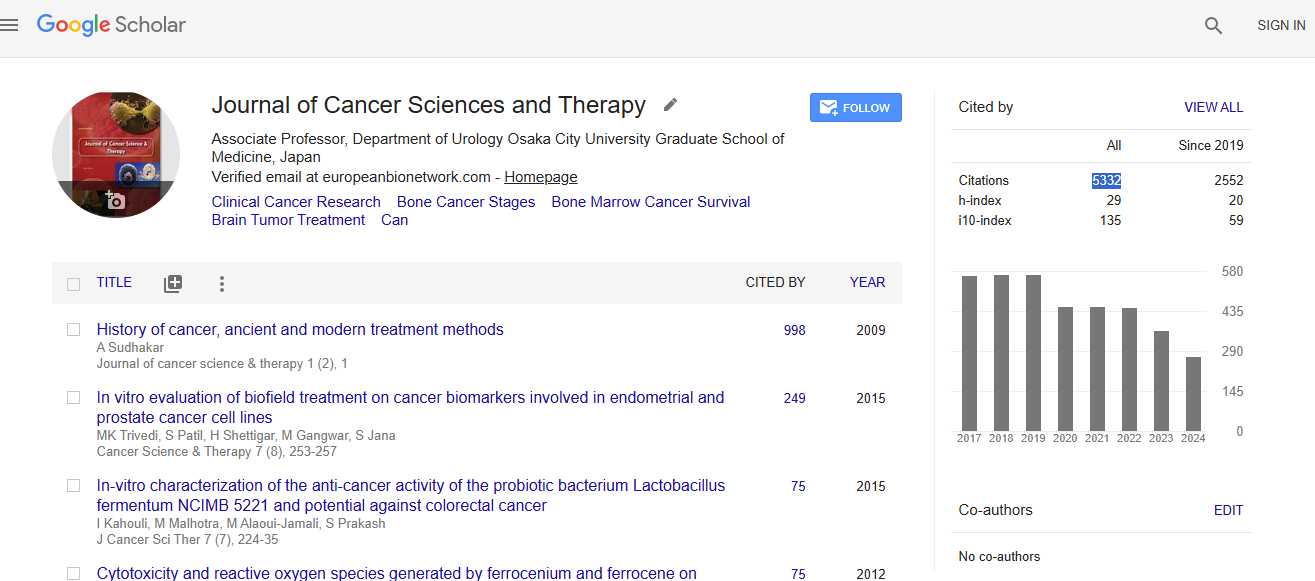
Cancer Science & Therapy received 5332 citations as per Google Scholar report