Short Communication - (2025) Volume 10, Issue 6
Received: 01-Nov-2025, Manuscript No. PE-26-179327;
Editor assigned: 03-Nov-2025, Pre QC No. P-179327;
Reviewed: 17-Nov-2025, QC No. Q-179327;
Revised: 24-Nov-2025, Manuscript No. R-179327;
Published:
29-Nov-2025
, DOI: 10.37421/2472-1042.2025.10.320
Citation: Kowalczyk, Emil. ”Oncology Pharmacoeconomics: Guiding Decisions, Valuing Therapies.” Pharmacoeconomics 10 (2025):320.
Copyright: © 2025 Kowalczyk E. This is an open-access article distributed under the terms of the Creative Commons Attribution License, which permits unrestricted use, distribution and reproduction in any medium, provided the original author and source are credited.
The field of oncology is increasingly characterized by the development of novel and often expensive therapeutic agents. This landscape necessitates rigorous economic evaluations to ensure that valuable treatments are accessible and that healthcare resources are utilized efficiently. Pharmacoeconomic studies play a crucial role in this process by assessing the cost-effectiveness of various treatment pathways, thereby guiding clinical decision-making and resource allocation in cancer care. These analyses are essential for identifying treatments that offer the best value for money, considering both clinical outcomes and associated healthcare costs. However, the application of such evaluations in oncology is not without its challenges, including difficulties in data availability and the inherent complexity of cancer treatment regimens, which can complicate comparative analyses [1].
A prominent area of pharmacoeconomic research involves the assessment of innovative therapies, such as immunotherapies, for advanced malignancies. For instance, budget impact models are frequently employed to quantify the financial implications of introducing new treatments into healthcare systems. These models compare the projected costs of novel agents against existing standards of care over specified timeframes. Such analyses are vital for payers and policymakers to understand the short-term and long-term financial consequences of adopting new therapies, informing strategic planning and budget allocation. The findings from these models can reveal whether the initial higher costs of new treatments are offset by potential downstream savings, such as reduced hospitalizations or improved patient outcomes [2].
The complexity of pharmacoeconomic methodologies is particularly evident in the evaluation of targeted therapies for solid tumors. Systematic reviews of these studies often identify common methodological issues that can impact the reliability and comparability of evidence. These issues include heterogeneity in outcome measures, the use of indirect treatment comparisons, and the inherent challenges in accurately modeling long-term survival, which is a critical factor in assessing the value of cancer treatments. Addressing these methodological inconsistencies is crucial for improving the quality of evidence used to support reimbursement decisions and clinical guideline development [3].
In the context of early-stage breast cancer, cost-effectiveness analyses of adjuvant chemotherapy regimens are essential for optimizing treatment selection. These studies often employ sophisticated modeling techniques, such as Markov models, to simulate patient outcomes and costs over a lifetime horizon. Such analyses provide valuable insights into whether newer regimens, which may offer improved survival, also present a favorable incremental cost-effectiveness ratio (ICER) compared to established, less expensive treatments. This is particularly important in resource-constrained settings where the economic implications of treatment choices can be substantial [4].
The burgeoning field of personalized medicine in oncology presents unique economic evaluation challenges. Genomic profiling, for example, aims to guide treatment selection by identifying specific genetic mutations, potentially leading to more targeted and effective therapies. While this approach holds promise for improving outcomes and reducing costs associated with ineffective treatments, assessing its cost-effectiveness is complex. The intricate nature of these diagnostic and therapeutic strategies requires specialized frameworks for economic valuation to fully capture their value [5].
Health technology assessment (HTA) plays a pivotal role in evaluating new oncology drugs by synthesizing evidence on clinical effectiveness, safety, and cost-effectiveness. HTA reports often compare novel agents with existing treatment options, providing a comprehensive assessment of their potential value. These evaluations consider not only clinical outcomes but also the impact on quality of life and overall survival, as well as the associated budget implications for healthcare systems. Such assessments are critical for informing decisions regarding the adoption and reimbursement of new technologies [6].
The increasing availability of real-world evidence (RWE) offers new opportunities for pharmacoeconomic evaluations in oncology. RWE can supplement data from randomized controlled trials (RCTs) by providing insights into treatment effectiveness and costs in broader patient populations and under diverse clinical settings. However, the validity of economic conclusions drawn from RWE hinges on robust methodologies for data collection and analysis. Addressing the inherent challenges in RWE studies is crucial for leveraging its potential to inform economic decision-making [7].
Economic evaluations are also critical for informing treatment decisions in hematological malignancies, such as multiple myeloma. Comparative studies assessing novel agents versus standard salvage therapies utilize advanced modeling techniques to evaluate cost-effectiveness. These analyses often demonstrate that while newer treatments may have higher acquisition costs, they can lead to improved progression-free survival and quality-adjusted life-years (QALYs), potentially rendering them cost-effective in specific patient subgroups. This underscores the importance of detailed economic analyses for complex diseases [8].
Patient-reported outcome measures (PROMs) are gaining recognition as essential components of pharmacoeconomic analyses in oncology. PROMs capture patients' perspectives on their health status and quality of life, providing a more comprehensive understanding of treatment value. By incorporating PROMs, economic evaluations can more accurately estimate utility values for QALY calculations and assess patient-centered benefits, which are critical for a holistic evaluation of treatment interventions [9].
Finally, the adoption of new combination therapies in oncology requires careful economic consideration. Cost-effectiveness analyses comparing sequential therapies with concurrent combinations must account for both drug costs and the management of adverse events. The economic viability of such approaches often depends on precise patient selection and proactive management of treatment-related toxicities, highlighting the interplay between clinical strategy and economic outcomes [10].
The economic implications of novel treatment pathways in oncology are a significant area of focus, driven by the need for cost-effectiveness analyses to guide clinical decision-making and resource allocation. These evaluations are crucial for identifying treatments that offer the best value by considering both clinical outcomes and healthcare expenditures. However, challenges such as data availability and the complexity of cancer treatment regimens often complicate these analyses [1].
Budget impact models are frequently utilized to assess the financial ramifications of introducing new therapies, such as immunotherapies, into healthcare systems. These models project the costs of new treatments against existing standards of care over several years, providing insights into potential cost offsets from improved long-term benefits and reduced hospitalizations, depending on patient selection and uptake [2].
Methodological rigor is paramount in pharmacoeconomic studies of targeted cancer therapies. Systematic reviews highlight common issues like heterogeneity in outcome measures, the use of indirect treatment comparisons, and difficulties in modeling long-term survival. Addressing these challenges is essential for enhancing the comparability and reliability of evidence used in reimbursement decisions [3].
Cost-effectiveness analyses of adjuvant chemotherapy for early-stage breast cancer often employ sophisticated modeling techniques, such as Markov models, to simulate lifetime patient outcomes and costs. These studies help determine whether newer regimens, despite higher initial costs, offer a favorable incremental cost-effectiveness ratio (ICER) compared to established treatments, especially in resource-limited environments [4].
Personalized medicine approaches in oncology, particularly those involving genomic profiling, present unique economic evaluation challenges. While identifying specific genetic mutations can lead to more targeted and potentially effective treatments, assessing the cost-effectiveness of these complex diagnostic and therapeutic strategies requires specialized frameworks to capture their full economic value [5].
Health technology assessments (HTAs) provide a comprehensive evaluation of new oncology drugs, synthesizing evidence on clinical effectiveness, safety, and cost-effectiveness. These assessments compare novel agents to existing options, considering impacts on quality of life, survival, and budget implications for healthcare services, thereby informing adoption and reimbursement decisions [6].
The integration of real-world evidence (RWE) into pharmacoeconomic evaluations in oncology offers opportunities to supplement traditional trial data. RWE can provide insights into treatment effectiveness and costs in broader patient populations and diverse clinical settings, provided robust methodologies are employed for data collection and analysis to ensure valid economic conclusions [7].
Economic evaluations of treatment strategies for hematological malignancies, such as relapsed or refractory multiple myeloma, often utilize discrete event simulation models. These studies assess the cost-effectiveness of novel agents against standard therapies, revealing that higher acquisition costs may be offset by improved progression-free survival and quality-adjusted life-years (QALYs) in specific patient subgroups [8].
Patient-reported outcome measures (PROMs) are increasingly recognized for their importance in pharmacoeconomic analyses of oncology treatments. By incorporating PROMs, which capture patients' perspectives on health status and quality of life, economic evaluations can more accurately estimate utility values for QALY calculations and assess patient-centered benefits, leading to a more comprehensive understanding of treatment value [9].
Economic evaluations of combination therapies for advanced melanoma necessitate a thorough comparison of sequential versus concurrent regimens, considering drug costs and the management of adverse events. The economic viability of these strategies is often contingent on careful patient selection and proactive management of treatment-related toxicities, underscoring the delicate balance between therapeutic benefit and economic feasibility [10].
Pharmacoeconomic evaluations are crucial in oncology to guide clinical decisions and resource allocation, especially with the advent of novel and costly therapies. These studies assess cost-effectiveness by considering clinical outcomes and healthcare costs, though challenges like data availability and treatment complexity exist. Budget impact models analyze the financial implications of new treatments like immunotherapies, while systematic reviews highlight methodological issues in evaluating targeted therapies. Cost-effectiveness analyses are vital for optimizing treatment selection in diseases like breast cancer and for assessing personalized medicine approaches. Health technology assessments synthesize evidence on clinical effectiveness, safety, and cost. Real-world evidence offers complementary data, but requires robust methodologies. Economic evaluations in hematological malignancies show novel agents can be cost-effective despite higher initial costs. Patient-reported outcome measures are essential for capturing patient-centered benefits. Finally, combination therapies require careful economic assessment considering drug costs and adverse events, with patient selection being key.
None
None
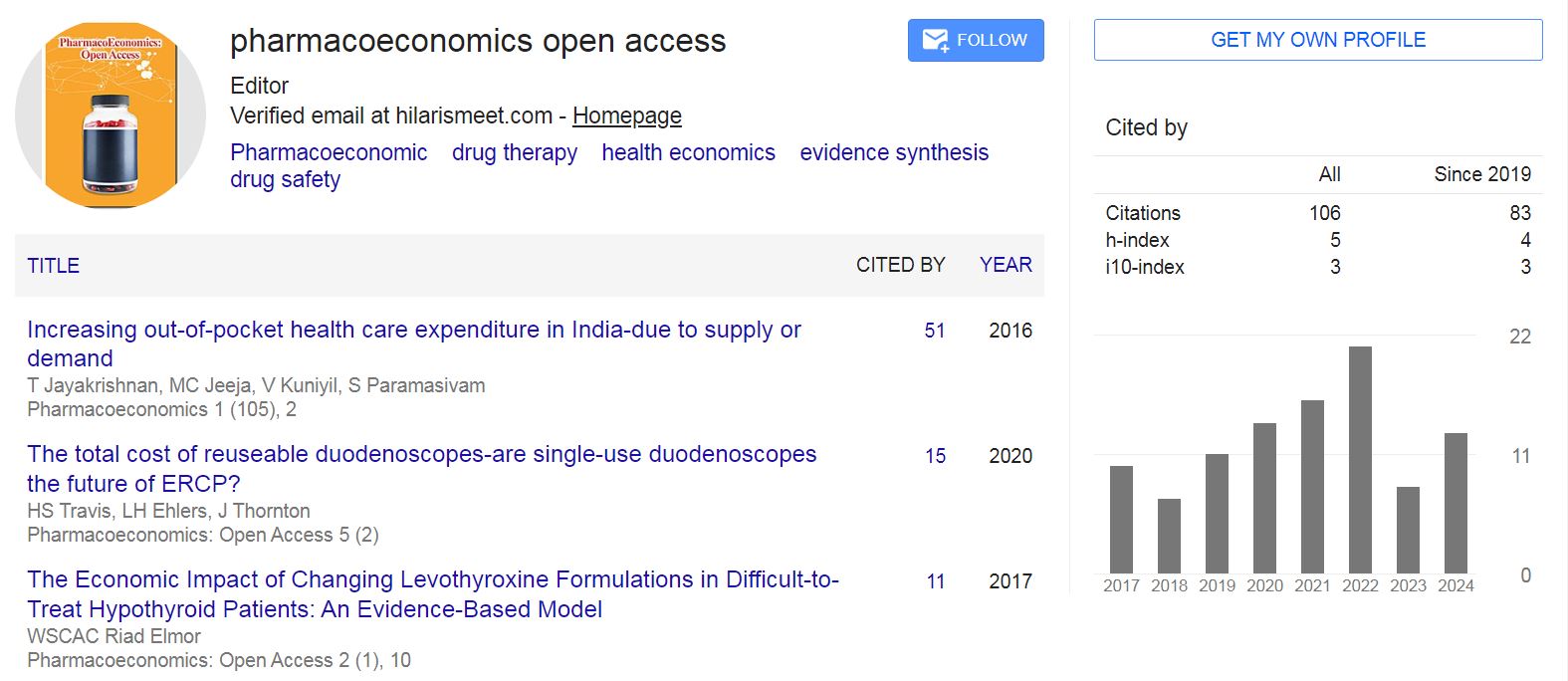
Pharmacoeconomics: Open Access received 106 citations as per Google Scholar report