Perspective - (2025) Volume 15, Issue 6
Received: 01-Dec-2025, Manuscript No. jprm-25-174602;
Editor assigned: 03-Dec-2025, Pre QC No. P-174602;
Reviewed: 17-Dec-2025, QC No. Q-174602;
Revised: 22-Dec-2025, Manuscript No. R-174602;
Published:
29-Dec-2025
, DOI: 10.37421/2161-105X.2025.15.771
Citation: Park, Jinwoo. ”Obstructive Sleep Apnea: Advances in Personalized Management.” J Pulm Respir Med 15 (2025):771.
Copyright: © 2025 Park J. This is an open-access article distributed under the terms of the Creative Commons Attribution License, which permits unrestricted use, distribution and reproduction in any medium, provided the original author and source are credited.
This systematic review and meta-analysis highlights a significant link between obstructive sleep apnea (OSA) and an increased risk of various cardiovascular events, including coronary heart disease, stroke, and heart failure. The findings underscore the importance of early OSA diagnosis and management for cardiovascular disease prevention [1].
This meta-analysis explores factors influencing Continuous Positive Airway Pressure (CPAP) adherence in patients with obstructive sleep apnea, identifying psychological traits, social support, and specific device features as key determinants. Understanding these predictors is crucial for developing targeted interventions to improve treatment uptake and effectiveness [2].
This systematic review and meta-analysis delves into the diverse phenotypes of obstructive sleep apnea, recognizing that OSA is not a single entity but a heterogeneous disorder. Identifying distinct phenotypes, such as those related to upper airway anatomy or ventilatory control, is essential for advancing personalized treatment strategies [3].
This review discusses the emerging field of precision medicine for obstructive sleep apnea, emphasizing the move from a one-size-fits-all approach to tailored therapies. It highlights the potential for phenotyping and endotyping OSA to guide individualized treatment selection, improving patient outcomes [4].
This systematic review examines the impact of obstructive sleep apnea on neurocognitive function, revealing that OSA is associated with deficits in various cognitive domains, including attention, memory, and executive function. The findings suggest that effective OSA treatment may mitigate or reverse these cognitive impairments [5].
This comprehensive review updates our understanding of the strong reciprocal relationship between obstructive sleep apnea and hypertension. It elucidates the mechanisms by which OSA contributes to blood pressure elevation and discusses how treating OSA can improve blood pressure control, emphasizing the importance of screening for OSA in hypertensive patients [6].
This systematic review and meta-analysis evaluates the efficacy of telemedicine approaches in the management of obstructive sleep apnea. It concludes that telemedicine offers a viable and effective alternative to traditional in-person care for OSA diagnosis, treatment initiation, and ongoing support, particularly in improving adherence and patient satisfaction [7].
This review provides an overview of oral appliances as a treatment option for obstructive sleep apnea, discussing their mechanisms, effectiveness, and future perspectives. It emphasizes that oral appliances are an important alternative for patients who cannot tolerate CPAP, with ongoing advancements enhancing their design and personalized application [8].
This systematic review explores the role of biomarkers in the diagnosis, prognosis, and therapeutic monitoring of obstructive sleep apnea. It highlights various circulating and genetic biomarkers that show promise in reflecting disease severity and predicting treatment response, moving towards a more precise and individualized management of OSA [9].
This systematic review and meta-analysis investigates the potential association between obstructive sleep apnea and cancer risk. The findings suggest a complex relationship, indicating that OSA may increase the incidence and mortality of certain cancers, underscoring the need for further research into the underlying mechanisms and clinical implications [10].
Obstructive Sleep Apnea (OSA) is a prevalent and multifaceted disorder with widespread implications for patient health. Recent systematic reviews and meta-analyses consistently highlight its critical link to various significant health issues. For instance, there's a strong connection between OSA and an increased risk of numerous cardiovascular events, specifically coronary heart disease, stroke, and heart failure [1]. The essential message here is that early OSA diagnosis and effective management are key for preventing cardiovascular disease. This underscores OSA's role not just as a sleep disorder, but as a systemic condition demanding comprehensive attention.
Addressing OSA effectively involves diverse treatment modalities and an understanding of patient adherence. A significant challenge lies in ensuring adherence to Continuous Positive Airway Pressure (CPAP) therapy, which is a cornerstone of OSA treatment. Studies reveal that factors such as psychological traits, social support networks, and specific device features are key determinants influencing CPAP adherence. What this really means is that understanding these predictors is crucial for developing targeted interventions designed to improve treatment uptake and overall effectiveness [2]. Beyond CPAP, oral appliances present a valuable alternative, especially for patients who cannot tolerate CPAP therapy. These appliances have seen ongoing advancements, enhancing their design and allowing for more personalized application in treatment [8].
Innovations in care delivery are also transforming OSA management. Telemedicine approaches have shown efficacy as a viable and effective alternative to traditional in-person care for diagnosis, treatment initiation, and ongoing support, particularly in boosting patient adherence and patient satisfaction [7]. Moreover, the scientific community recognizes that OSA isn't a single, uniform condition, but rather a heterogeneous disorder characterized by diverse phenotypes. Identifying these distinct phenotypes, which might relate to upper airway anatomy or ventilatory control mechanisms, is essential for advancing personalized treatment strategies [3].
This deeper understanding of OSA heterogeneity paves the way for precision medicine in OSA management. The goal is to move beyond a one-size-fits-all approach towards tailored therapies. Here's the thing, leveraging phenotyping and endotyping can guide individualized treatment selection, ultimately improving patient outcomes [4]. Complementing this focus is the exploration of biomarkers. Let's break it down: biomarkers play an increasingly important role in the diagnosis, prognosis, and therapeutic monitoring of obstructive sleep apnea [9]. Various circulating and genetic biomarkers show significant promise as they can reflect disease severity and are critical for predicting treatment response.
Beyond cardiovascular health, OSA's impact extends to other vital bodily systems. For example, it significantly affects neurocognitive function, manifesting as deficits across various cognitive domains including attention, memory, and executive function. The good news is that effective OSA treatment may mitigate or even reverse these cognitive impairments [5]. There's also a deeply intertwined, reciprocal relationship between obstructive sleep apnea and hypertension. This comprehensive review explains the mechanisms by which OSA contributes to blood pressure elevation. Crucially, treating OSA can improve blood pressure control, emphasizing the importance of screening for OSA in hypertensive patients [6]. Finally, emerging research investigates a potential association between obstructive sleep apnea and cancer risk. While complex, findings suggest OSA might increase the incidence and mortality of certain cancers, underscoring the urgent need for further research into underlying mechanisms and clinical implications [10].
None
None
Hui C, Xue Y, Shaowei C. "Obstructive Sleep Apnea and Risk of Cardiovascular Events: A Systematic Review and Meta-Analysis".J Am Heart Assoc 12 (2023):e026601.
Indexed at, Google Scholar, Crossref
Lixue Z, Jun H, Shasha C. "CPAP Adherence in Obstructive Sleep Apnea: A Meta-Analysis of Predictors".J Clin Sleep Med 18 (2022):805-816.
Indexed at, Google Scholar, Crossref
Valeria P, Marianna C, Alessandra C. "Phenotypes of obstructive sleep apnea: a systematic review and meta-analysis".Sleep Med Rev 68 (2023):101750.
Indexed at, Google Scholar, Crossref
Grace WP, Reena M, Daniel JG. "Precision medicine for obstructive sleep apnea".Lancet Respir Med 9 (2021):97-108.
Indexed at, Google Scholar, Crossref
Xiao P, Kainan W, Wei J. "Impact of Obstructive Sleep Apnea on Neurocognitive Function: A Systematic Review".Sleep Breath 27 (2023):153-167.
Indexed at, Google Scholar, Crossref
Atul M, David PW, Nicholas TA. "Obstructive Sleep Apnea and Hypertension: An Updated Review".Hypertension 79 (2022):940-951.
Indexed at, Google Scholar, Crossref
Hussain K, Senthil G, Jiali L. "Telemedicine for Obstructive Sleep Apnea: A Systematic Review and Meta-Analysis".J Clin Sleep Med 17 (2021):1079-1089.
Indexed at, Google Scholar, Crossref
Leslie CD, M. JLR, Didier H. "Oral Appliances for Obstructive Sleep Apnea: Current State and Future Perspectives".Sleep Med Clin 16 (2021):123-138.
Indexed at, Google Scholar, Crossref
Hui C, Xue Y, Shaowei C. "Biomarkers in obstructive sleep apnea: A systematic review".Sleep Med Rev 67 (2023):101732.
Indexed at, Google Scholar, Crossref
Ying M, Yaxin W, Xiaohui H. "Obstructive Sleep Apnea and Cancer: A Systematic Review and Meta-Analysis".Sleep Breath 27 (2023):1413-1428.
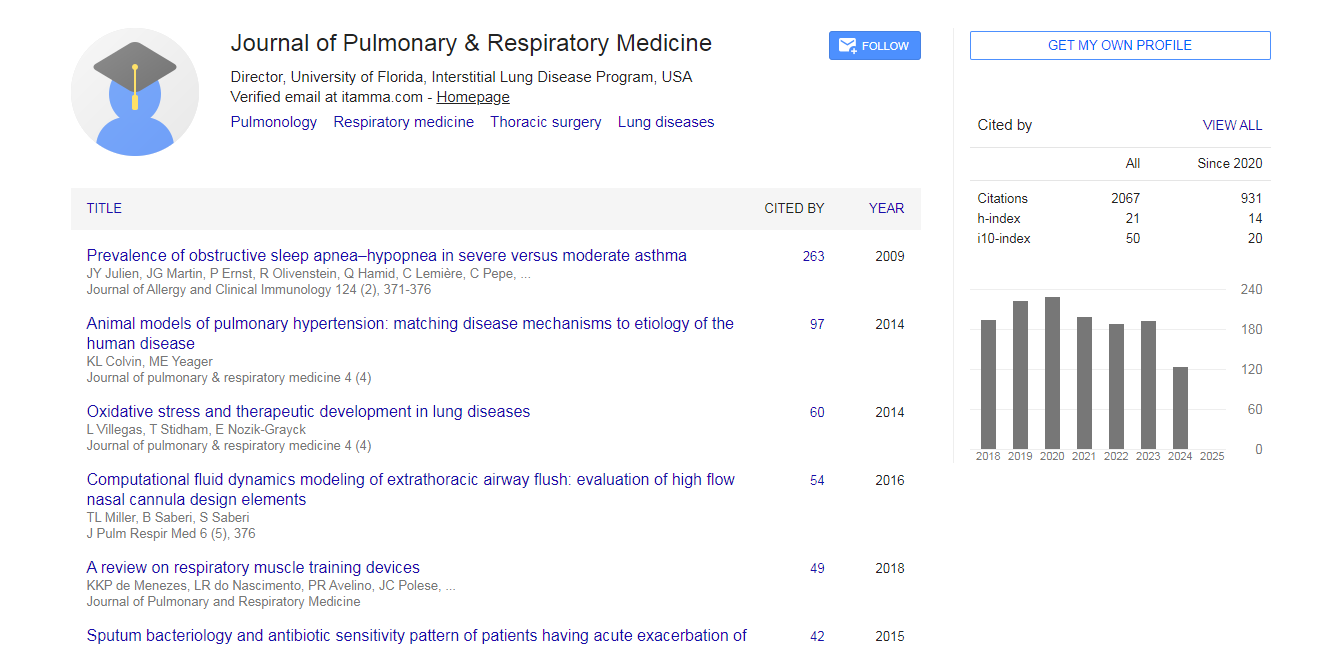
Pulmonary & Respiratory Medicine received 1690 citations as per Google Scholar report