Perspective - (2025) Volume 10, Issue 3
Received: 01-May-2025, Manuscript No. apn-26-179099;
Editor assigned: 04-May-2025, Pre QC No. P-179099;
Reviewed: 14-May-2025, QC No. Q-179099;
Revised: 21-May-2025, Manuscript No. R-179099;
Published:
28-May-2025
, DOI: 10.37421/2573-0347.2025.10.431
Citation: Villanueva, Marco. âNursingâs Role In Hemodynamic Stability Management.â J Adv Practice Nurs 10 (2025):431.
Copyright: © 2025 Villanueva M. This is an open-access article distributed under the terms of the Creative Commons Attribution License, which permits unrestricted use,
distribution and reproduction in any medium, provided the original author and source are credited.
The critical care environment is characterized by patients with complex and often life-threatening conditions, necessitating precise and vigilant patient management. Among the most vital aspects of care in this setting is hemodynamic monitoring and management, which directly impacts patient outcomes and survival rates. Nurses play a central role in this process, requiring a deep understanding of physiological principles and the ability to translate complex data into actionable interventions. This article aims to provide a comprehensive overview of nursing strategies for optimizing hemodynamic management in critical care settings, drawing upon recent advancements and established best practices. This exploration begins with an examination of essential nursing strategies for optimizing hemodynamic management in critical care, emphasizing the nurse's pivotal role in continuous monitoring, early recognition of hemodynamic instability, and timely intervention. Key strategies include understanding cardiac output determinants, managing fluid balance, utilizing vasopressors and inotropes effectively, and implementing evidence-based protocols for conditions like sepsis-induced hypotension and cardiogenic shock. The focus is on translating hemodynamic data into actionable nursing care to improve patient outcomes and reduce morbidity and mortality [1].
Building upon foundational knowledge, the review details the application of advanced hemodynamic monitoring techniques in critically ill patients. It highlights how technologies such as arterial waveform analysis, central venous oximetry, and continuous cardiac output monitoring empower nurses to make more informed decisions. The article discusses the interpretation of these complex data streams and their integration into nursing practice for proactive management of shock states and fluid responsiveness [2].
Addressing a prevalent and critical condition, the focus shifts to sepsis, which remains a leading cause of mortality in ICUs. Early hemodynamic optimization is crucial, and this study investigates nursing-driven interventions for sepsis resuscitation, emphasizing the achievement of specific hemodynamic targets like mean arterial pressure and central venous pressure. It underscores the importance of rapid fluid administration and judicious use of vasopressors, guided by continuous hemodynamic assessment [3].
Further delving into specific critical conditions, cardiogenic shock presents complex hemodynamic challenges. This article examines the nurse's role in managing patients with acute myocardial infarction and cardiogenic shock, emphasizing the titration of vasoactive medications and the monitoring of invasive hemodynamic parameters. It highlights strategies to improve cardiac contractility and reduce afterload, aiming to restore adequate tissue perfusion [4].
A cornerstone of hemodynamic stability is fluid management. This research evaluates different approaches to fluid resuscitation in critically ill patients, detailing how nurses can assess fluid responsiveness using dynamic parameters and interpret static measures. It provides evidence-based guidance for avoiding both hypovolemia and fluid overload, which can have detrimental effects on organ function [5].
Complementing fluid management, vasopressor and inotrope therapy are vital for maintaining hemodynamic stability in shock. This article delves into the pharmacology and nursing implications of administering these agents. It emphasizes the importance of individualized titration based on patient response and hemodynamic goals, as well as the monitoring for adverse effects and the timely de-escalation when appropriate [6].
The impact of structured protocols on patient care is significant. The implementation of a dedicated hemodynamic management protocol can substantially improve patient outcomes. This paper describes the development and evaluation of such a protocol within a nursing-led critical care environment, detailing key components, including nurse-initiated interventions for hypotension and the use of standardized hemodynamic targets, demonstrating its impact on patient safety and clinical effectiveness [7].
Beyond immediate interventions, a foundational understanding of physiological principles is essential. Hemodynamic monitoring extends beyond basic vital signs to encompass a deeper understanding of circulatory function. This article focuses on the physiological basis of hemodynamic monitoring and how nurses can interpret trends to anticipate and prevent adverse events, such as organ hypoperfusion. It emphasizes the importance of a holistic approach, integrating hemodynamic data with other clinical indicators [8].
Finally, the role of advanced technology in patient management is explored. The management of intra-aortic balloon pump (IABP) therapy requires specialized nursing knowledge and vigilance. This paper outlines the nursing care of patients with IABP support, focusing on hemodynamic monitoring, troubleshooting, and the prevention of complications. It highlights how nurses contribute to optimizing IABP timing to improve cardiac output and reduce myocardial oxygen demand [9].
To ensure competency in this dynamic field, educating critical care nurses on hemodynamic principles is paramount for skilled patient management. This article discusses innovative educational strategies, including simulation-based training and case studies, to enhance nurses' understanding and application of hemodynamic concepts. It emphasizes the importance of continuous learning and skill development to address the evolving complexities of critical care hemodynamics [10].
This article delves into the critical role of nurses in optimizing hemodynamic management within critical care settings, highlighting essential strategies for patient care. It underscores the importance of continuous monitoring, early identification of hemodynamic instability, and prompt intervention to improve patient outcomes and reduce mortality. Key nursing responsibilities include understanding the determinants of cardiac output, proficient fluid balance management, effective utilization of vasopressors and inotropes, and adherence to evidence-based protocols for conditions such as sepsis-induced hypotension and cardiogenic shock. The central theme revolves around the practical application of hemodynamic data to enhance nursing care and positively influence patient trajectories [1].
Expanding on monitoring capabilities, the review details the application of advanced hemodynamic monitoring techniques tailored for critically ill patients. It emphasizes how sophisticated technologies, including arterial waveform analysis, central venous oximetry, and continuous cardiac output monitoring, empower nurses with the insights needed for more informed decision-making. The content also addresses the complexities of interpreting these data streams and their seamless integration into daily nursing practice to proactively manage shock states and assess fluid responsiveness [2].
Addressing the pervasive threat of sepsis, the article focuses on its significant impact as a leading cause of mortality in intensive care units and the critical need for early hemodynamic optimization. It investigates specific nursing-driven interventions designed for sepsis resuscitation, with a particular emphasis on achieving predefined hemodynamic targets, such as mean arterial pressure and central venous pressure. The review highlights the imperative for rapid fluid administration and judicious application of vasopressors, guided by continuous hemodynamic assessment [3].
In the context of cardiogenic shock, a condition posing profound hemodynamic challenges, this article meticulously examines the multifaceted role of nurses. It focuses on the management of patients experiencing acute myocardial infarction complicated by cardiogenic shock, with a strong emphasis on the precise titration of vasoactive medications and vigilant monitoring of invasive hemodynamic parameters. Strategies aimed at enhancing cardiac contractility and mitigating afterload are presented as crucial for restoring adequate tissue perfusion [4].
Fluid management is presented as a fundamental pillar of hemodynamic stability in critically ill patients. This research critically evaluates diverse approaches to fluid resuscitation, providing detailed guidance on how nurses can effectively assess fluid responsiveness using dynamic parameters and interpret static measures. The article offers evidence-based recommendations to prevent both hypovolemia and fluid overload, both of which can have deleterious effects on organ function [5].
The administration of vasopressors and inotropes is recognized as indispensable for maintaining hemodynamic stability, particularly in states of shock. This article offers an in-depth exploration of the pharmacology associated with these agents and their specific nursing implications. It stresses the paramount importance of personalized titration strategies, tailored to individual patient responses and established hemodynamic goals, alongside diligent monitoring for adverse effects and timely de-escalation when clinically appropriate [6].
The transformative potential of structured protocols in improving patient care is a key takeaway. The implementation of a well-defined hemodynamic management protocol is shown to significantly enhance patient outcomes. This paper outlines the development process and subsequent evaluation of such a protocol within a nursing-led critical care setting, detailing its core components, including nurse-initiated interventions for hypotension and the adherence to standardized hemodynamic targets, thereby demonstrating its positive impact on patient safety and clinical efficacy [7].
Moving beyond immediate interventions, the article emphasizes the necessity of a robust understanding of the underlying physiological principles governing hemodynamic monitoring. It posits that hemodynamic monitoring encompasses more than basic vital signs, extending to a comprehensive understanding of circulatory function. The article highlights how nurses can interpret hemodynamic trends to proactively anticipate and prevent adverse events, such as organ hypoperfusion, advocating for a holistic approach that integrates hemodynamic data with other clinical indicators [8].
The specialized care required for patients on advanced support devices is addressed. The management of intra-aortic balloon pump (IABP) therapy is discussed, emphasizing the need for specialized nursing knowledge and constant vigilance. This paper delineates the essential nursing care for patients receiving IABP support, focusing on meticulous hemodynamic monitoring, effective troubleshooting, and proactive prevention of potential complications. It specifically highlights the nurse's role in optimizing IABP timing to enhance cardiac output and decrease myocardial oxygen demand [9].
Finally, the importance of continuous education and competency development in this specialized field is recognized. Educating critical care nurses on fundamental hemodynamic principles is deemed essential for proficient patient management. This article explores innovative educational methodologies, including simulation-based training and the utilization of case studies, designed to augment nurses' comprehension and practical application of hemodynamic concepts. It underscores the critical need for ongoing learning and skill enhancement to navigate the ever-evolving complexities of critical care hemodynamics [10].
This compilation of articles focuses on the crucial role of nurses in managing hemodynamic stability in critical care. It covers essential strategies for monitoring, early recognition of instability, and timely interventions, including understanding cardiac output determinants, fluid management, and the appropriate use of vasopressors and inotropes. Advanced monitoring techniques, interpretation of complex data, and evidence-based protocols for conditions like sepsis and cardiogenic shock are discussed. The importance of physiological principles, structured protocols, and specialized care for devices like intra-aortic balloon pumps is highlighted. Furthermore, the need for continuous nursing education and skill development in hemodynamic management is emphasized to improve patient outcomes and reduce morbidity and mortality.
None
None
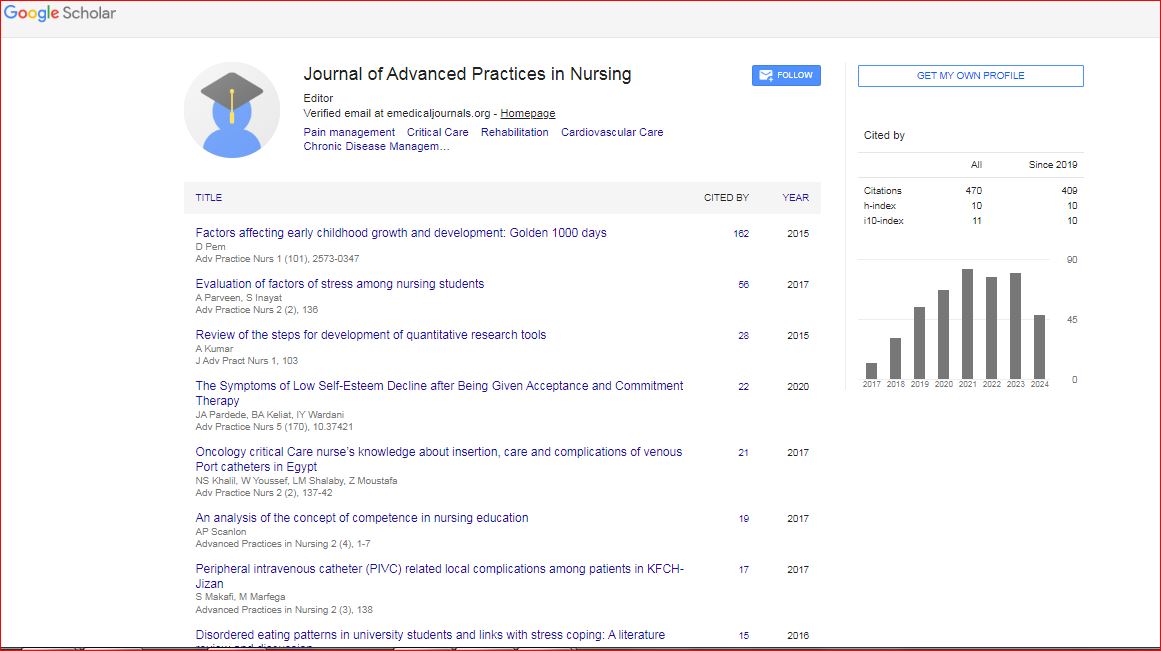
Journal of Advanced Practices in Nursing received 410 citations as per Google Scholar report