Perspective - (2025) Volume 11, Issue 2
Received: 01-Mar-2025, Manuscript No. ldt-25-178418;
Editor assigned: 03-Mar-2025, Pre QC No. P178418;
Reviewed: 17-Mar-2025, QC No. Q178418;
Revised: 24-Mar-2025, Manuscript No. R178418;
Published:
31-Mar-2025
, DOI: 10.37421/2472-1018.2025.11.300
Citation: Petrovic, Sofia. ”Novel Lung Disease Treatments: Beyond Traditional Approaches.” J Lung Dis Treat 11 (2025):300.
Copyright: © 2025 Petrovic S. This is an open-access article distributed under the terms of the Creative Commons Attribution License, which permits unrestricted use, distribution and reproduction in any medium, provided the original author and source are credited.
The landscape of treating chronic lung diseases is undergoing a significant transformation, moving beyond traditional therapeutic paradigms to embrace novel pharmacological strategies. These advancements are driven by a deeper understanding of disease pathogenesis, leading to the identification of new molecular targets and the development of innovative treatment modalities. The focus is increasingly on precision medicine and targeted therapies that aim to address the underlying mechanisms of these complex conditions, offering improved efficacy and better patient outcomes. Emerging pharmacological strategies for chronic lung diseases are highlighting novel targets and therapeutic approaches that move beyond traditional treatments. This review examines advancements in biologics, small molecule inhibitors, and gene therapies aimed at addressing the underlying mechanisms of diseases like COPD, asthma, and idiopathic pulmonary fibrosis. The focus is on treatments that offer improved efficacy and patient outcomes by modulating inflammation, fibrosis, and airway remodeling [1].
The development of targeted therapies for idiopathic pulmonary fibrosis (IPF) has seen significant progress. This article discusses the mechanisms of action of new antifibrotic agents and their impact on disease progression and survival. It also touches upon the challenges in clinical trial design and the potential for combination therapies to improve patient management in IPF [2].
Biologics have revolutionized the management of severe asthma by targeting specific inflammatory pathways. This paper reviews the efficacy and safety profiles of currently available biologics, including anti-IgE, anti-IL-5, and anti-IL-4/IL-13 agents. It explores their role in reducing exacerbations and improving lung function in patients with different asthma phenotypes [3].
The concept of precision medicine is gaining traction in chronic obstructive pulmonary disease (COPD) treatment. This article discusses how genetic profiling and biomarkers can help stratify COPD patients and guide the selection of personalized pharmacological interventions, potentially leading to more effective and individualized care [4].
Emerging therapies targeting the microbiome in chronic lung diseases are showing promise. This review explores how dysbiosis in the lung microbiome contributes to disease pathogenesis and how interventions aimed at restoring microbial balance, such as probiotics or fecal microbiota transplantation, could offer new therapeutic avenues [5].
This research investigates the potential of senolytic drugs, which selectively clear senescent cells, in treating chronic lung diseases characterized by persistent inflammation and tissue damage. The study outlines the preclinical evidence and discusses the challenges for clinical translation of senolytic therapies in conditions like pulmonary fibrosis [6].
The role of extracellular vesicles (EVs) in intercellular communication within the diseased lung is explored. This article highlights how EVs can deliver therapeutic payloads and modulate disease processes, paving the way for EV-based therapies in chronic lung conditions. It discusses their potential in delivering anti-inflammatory or antifibrotic agents [7].
This study examines the efficacy of small interfering RNA (siRNA) therapeutics in silencing genes involved in the pathogenesis of chronic lung diseases. It provides an overview of current delivery strategies and preclinical data, focusing on siRNA's potential to target specific disease-causing pathways in conditions like cystic fibrosis and COPD [8].
The article explores the potential of inhaled therapies for delivering novel pharmacological agents directly to the lungs. It discusses advancements in inhaler technology and formulation science that enable the efficient delivery of biologics and small molecules for treating chronic lung diseases, aiming to maximize local efficacy and minimize systemic side effects [9].
This review focuses on novel immunomodulatory agents for chronic lung diseases, particularly those with inflammatory components. It discusses therapies that target specific immune cells or signaling pathways to rebalance immune responses, offering new hope for conditions such as hypersensitivity pneumonitis and eosinophilic granulomatosis with polyangiitis [10].
The current pharmacological approaches to chronic lung diseases are being significantly augmented by innovative therapeutic strategies that address the complex pathophysiological mechanisms underlying these conditions. These emerging treatments aim to provide more targeted and effective interventions compared to traditional therapies, thereby improving patient prognosis and quality of life. The review by PetroviÄ? et al. comprehensively examines novel pharmacological treatments for chronic lung diseases, emphasizing new targets and therapeutic modalities that extend beyond conventional care. It delves into the advancements in biologics, small molecule inhibitors, and gene therapies designed to combat the root causes of diseases such as COPD, asthma, and idiopathic pulmonary fibrosis, with a focus on enhancing treatment efficacy and patient outcomes through modulation of inflammation, fibrosis, and airway remodeling [1].
In the realm of idiopathic pulmonary fibrosis (IPF), substantial progress has been made in developing targeted therapies. Wei et al. provide an in-depth discussion on the mechanisms of action of new antifibrotic agents and their demonstrable effects on disease progression and patient survival. Furthermore, this work highlights the inherent challenges encountered in designing clinical trials and explores the promising potential of combination therapies for optimizing IPF patient management [2].
The application of biologics has been transformative in managing severe asthma by targeting specific inflammatory pathways. Jones et al. present a review of the efficacy and safety profiles of existing biologic agents, including anti-IgE, anti-IL-5, and anti-IL-4/IL-13 therapies. Their article elucidates the role of these agents in reducing asthma exacerbations and improving lung function across diverse asthma phenotypes [3].
Precision medicine is increasingly influencing the therapeutic strategies for chronic obstructive pulmonary disease (COPD). Sato et al. discuss the integration of genetic profiling and biomarker identification to stratify COPD patients, thereby enabling the selection of personalized pharmacological interventions for more effective and individualized patient care [4].
The exploration of emerging therapies that target the lung microbiome in chronic lung diseases is yielding promising results. Sharma et al. investigate the contribution of lung microbiome dysbiosis to disease pathogenesis and propose that interventions aimed at restoring microbial balance, such as probiotics or fecal microbiota transplantation, represent novel therapeutic avenues [5].
Research into senolytic drugs, which are designed to selectively eliminate senescent cells, is revealing their therapeutic potential in chronic lung diseases characterized by chronic inflammation and tissue damage. Lee et al. present preclinical evidence and discuss the obstacles to the clinical translation of senolytic therapies for conditions like pulmonary fibrosis [6].
The intricate role of extracellular vesicles (EVs) in facilitating intercellular communication within the diseased lung is a subject of ongoing investigation. Ivanova et al. highlight the capacity of EVs to deliver therapeutic payloads and modulate disease processes, thus establishing them as promising candidates for EV-based therapies in chronic lung conditions, including their potential for delivering anti-inflammatory or antifibrotic agents [7].
Rossi et al. examine the effectiveness of small interfering RNA (siRNA) therapeutics in silencing genes implicated in the pathogenesis of chronic lung diseases. Their study offers a comprehensive overview of current delivery methodologies and preclinical findings, emphasizing the potential of siRNA to target specific disease-driving pathways in conditions such as cystic fibrosis and COPD [8].
Schmidt et al. explore the advantages of inhaled therapies for delivering novel pharmacological agents directly to the lungs. This article details advancements in inhaler technology and formulation science that facilitate the efficient delivery of biologics and small molecules for treating chronic lung diseases, aiming to maximize local therapeutic effects while minimizing systemic adverse reactions [9].
Kuznetsova et al. focus on novel immunomodulatory agents for chronic lung diseases, particularly those with significant inflammatory components. Their review discusses therapies designed to modulate specific immune cells or signaling pathways to restore immune balance, offering new therapeutic prospects for conditions like hypersensitivity pneumonitis and eosinophilic granulomatosis with polyangiitis [10].
This collection of research highlights significant advancements in the treatment of chronic lung diseases, moving beyond traditional methods to incorporate novel pharmacological strategies. Emerging therapies include biologics for severe asthma targeting inflammatory pathways, and antifibrotic agents for idiopathic pulmonary fibrosis that impact disease progression. Precision medicine approaches are being developed for COPD, utilizing genetic profiling to personalize treatments. The lung microbiome is being explored as a therapeutic target, with interventions aimed at restoring microbial balance. Senolytic drugs, which clear senescent cells, show promise for inflammatory lung conditions. Extracellular vesicles are being investigated as nanocarriers for delivering therapeutic agents directly to the lungs. RNA interference therapeutics, specifically siRNA, are being developed to silence disease-causing genes, while inhaled therapies are being optimized for targeted drug delivery. Immunomodulatory agents are also emerging as a key strategy for managing inflammatory lung diseases. These diverse approaches collectively aim to improve patient outcomes by addressing the underlying mechanisms of chronic lung conditions.
None
None
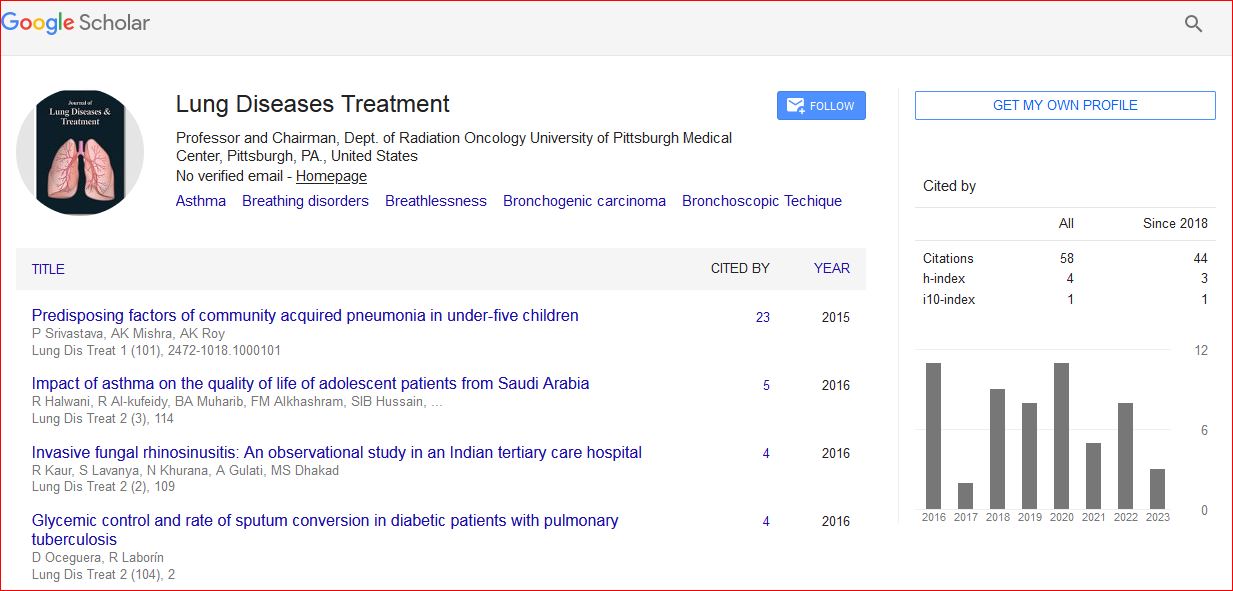
Journal of Lung Diseases & Treatment received 247 citations as per Google Scholar report