Opinion - (2025) Volume 9, Issue 2
Received: 01-Apr-2025, Manuscript No. jcre-26-187109;
Editor assigned: 03-Apr-2025, Pre QC No. P-187109;
Reviewed: 17-Apr-2025, QC No. Q-187109;
Revised: 22-Apr-2025, Manuscript No. R-187109;
Published:
29-Apr-2025
, DOI: 10.37421/2795-6172.2025.9.292
Citation: Rahman, Ayesha. ”Novel Antihypertensive Agents: Improved Blood Pressure Control.” J Clin Res 09 (2025):292.
Copyright: © 2025 Rahman A. This is an open-access article distributed under the terms of the Creative Commons Attribution License, which permits unrestricted use, distribution and reproduction in any medium, provided the original author and source are credited.
The management of hypertension remains a cornerstone of cardiovascular disease prevention, with ongoing research dedicated to identifying more effective and safer therapeutic agents. Novel antihypertensive drugs are continually being developed and evaluated to address the persistent challenges of achieving optimal blood pressure control and improving patient outcomes. This includes the exploration of new drug classes, combination therapies, and formulations designed to enhance efficacy and tolerability. One area of significant advancement involves agents that target specific pathways involved in blood pressure regulation. For instance, studies have investigated novel drugs that act as angiotensin receptor-neprilysin inhibitors, demonstrating promising results in blood pressure reduction and potentially impacting other cardiovascular parameters. These agents represent a shift towards more targeted therapeutic strategies. Furthermore, the development of combination antihypertensive therapies has been a key focus in simplifying treatment regimens and improving adherence. Head-to-head comparisons of these novel combinations against existing standards of care are crucial for establishing their superiority and role in clinical practice, particularly for patients with difficult-to-manage hypertension. The pursuit of agents with dual mechanisms of action also holds promise for enhancing antihypertensive effects. Dual-acting agents that target multiple pathways involved in blood pressure regulation are being explored for their potential to achieve greater and more sustained reductions in blood pressure, thereby improving clinical outcomes. Fixed-dose combination pills have emerged as a valuable tool for improving patient adherence and achieving blood pressure targets more effectively. Assessing their impact on the proportion of patients reaching goal blood pressure underscores their utility in simplifying hypertension management and improving overall therapeutic success. The introduction of new antihypertensive drugs with novel mechanisms of action continues to expand the therapeutic armamentarium. Randomized controlled trials comparing these novel agents against placebo are essential for demonstrating their efficacy and safety, providing critical evidence for their integration into clinical guidelines and practice. Real-world data analyses are increasingly important for understanding the effectiveness of newly approved antihypertensive medications in routine clinical practice. These studies provide valuable insights into how drugs perform across diverse patient populations and under real-world prescribing conditions, complementing data from controlled clinical trials. The characterization of dose-response relationships for new antihypertensive agents is fundamental for optimizing their clinical use. Understanding how different doses affect blood pressure reduction and identifying potential plateau effects helps in establishing effective and safe dosing strategies for individual patients. Beyond their primary blood pressure-lowering effects, some novel antihypertensive drugs are being evaluated for their pleiotropic cardiovascular benefits. Examining their impact on endothelial function, vascular stiffness, and other surrogate markers of cardiovascular risk can reveal additional therapeutic advantages that extend beyond simple blood pressure control. Finally, systematic reviews and meta-analyses play a vital role in synthesizing the evidence from multiple studies on new antihypertensive agents. By pooling data from various trials, these analyses can confirm the efficacy and safety of these drugs, assess their cardiovascular risk reduction profile, and support their broader clinical adoption and integration into patient care.
The efficacy and safety of a novel angiotensin receptor-neprilysin inhibitor in controlling blood pressure among patients with moderate to severe hypertension were rigorously evaluated. This study demonstrated statistically significant reductions in both systolic and diastolic blood pressure when compared to a placebo. Importantly, the novel agent exhibited a favorable safety profile, suggesting its potential as a valuable addition to the existing therapeutic options for hypertension management [1].
A comparative study assessed a new combination antihypertensive therapy against established standard care, revealing a superior blood pressure reduction with the novel regimen. This combination therapy showed a greater likelihood of achieving target blood pressure levels, especially in patients with resistant hypertension, without an attendant increase in adverse events [2].
Research into a novel dual-acting agent for hypertension demonstrated substantial and sustained reductions in both systolic and diastolic blood pressure through a phase III trial. The drug was well-tolerated, with commonly reported side effects being mild and transient, indicating a potential for improved patient adherence and therapeutic outcomes [3].
The introduction and assessment of a new fixed-dose combination pill for hypertension therapy revealed a significant increase in the proportion of patients reaching their goal blood pressure. This finding underscores the utility of simplified combination regimens in achieving effective blood pressure control [4].
A randomized controlled trial compared a novel mechanism of action antihypertensive drug against a placebo in a population with uncontrolled hypertension. The new drug achieved a statistically significant and clinically relevant reduction in both systolic and diastolic blood pressure, with no unexpected safety signals identified [5].
An analysis of real-world data explored the effectiveness of a newly approved antihypertensive medication in routine clinical practice. The findings indicated that the drug achieved significant blood pressure control in a diverse patient population, mirroring the efficacy observed in clinical trials and suggesting good pragmatic applicability [6].
Investigations into the dose-response relationship of a new antihypertensive agent revealed that higher doses led to more pronounced blood pressure reductions. A clear plateau effect was observed at the highest tested dose, providing guidance for optimal dosing strategies for clinical use [7].
The impact of a new antihypertensive drug on endothelial function was examined, revealing that beyond its blood pressure-lowering effects, the drug exhibited beneficial effects on vascular stiffness and flow-mediated dilation. This suggests pleiotropic cardiovascular benefits that extend beyond its primary antihypertensive action [8].
A systematic review and meta-analysis synthesized evidence from multiple studies on a new class of antihypertensive agents. The pooled data confirmed their significant efficacy in lowering blood pressure and suggested a potentially favorable cardiovascular risk reduction profile, supporting their broader clinical adoption [9].
A 1-year extension study assessed the long-term efficacy and tolerability of a novel antihypertensive drug. Patients maintained significant blood pressure reductions throughout the study period, and the drug continued to be well-tolerated, indicating its suitability for the chronic management of hypertension [10].
Research into novel antihypertensive agents demonstrates significant advancements in blood pressure control and patient outcomes. New drugs, including angiotensin receptor-neprilysin inhibitors and dual-acting agents, show considerable efficacy in reducing both systolic and diastolic blood pressure compared to placebo. Combination therapies and fixed-dose pills simplify treatment regimens and improve adherence, leading to better achievement of blood pressure targets, particularly in resistant hypertension. Real-world data confirms the effectiveness of newly approved medications in diverse populations. Beyond blood pressure lowering, some agents offer additional cardiovascular benefits, such as improved endothelial function. Dose-response studies guide optimal therapeutic strategies, while long-term follow-up studies confirm sustained efficacy and tolerability, supporting their role in chronic hypertension management.
None
None
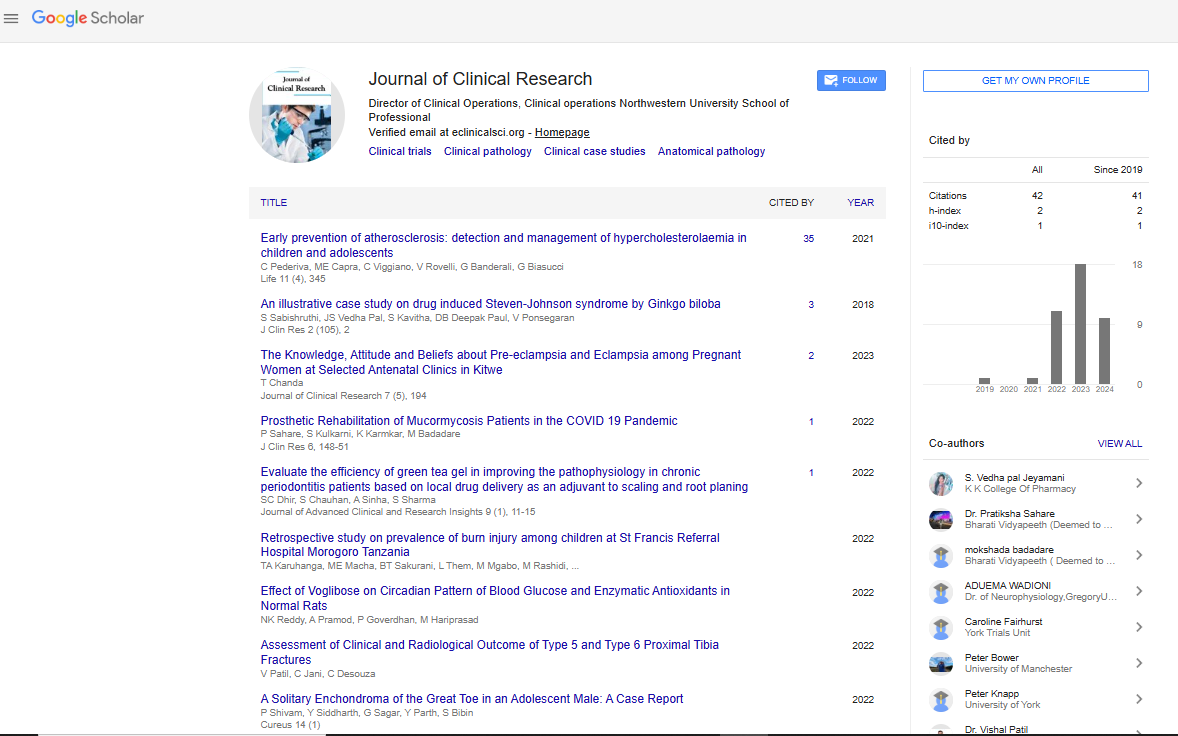
Journal of Clinical Research received 11 citations as per Google Scholar report