Perspective - (2025) Volume 16, Issue 3
Received: 01-Aug-2025, Manuscript No. hgec-25-174741;
Editor assigned: 04-Aug-2025, Pre QC No. P-174741;
Reviewed: 18-Aug-2025, QC No. Q-174741;
Revised: 22-Aug-2025, Manuscript No. R-174741;
Published:
29-Aug-2025
, DOI: 10.37421/2161-0436.2025.16.296
Citation: Renwick, Thomas J.. ”Non-Mendelian Inheritance: Epigenetics, Environment, Traits.” Human Genet Embryol 16 (2025):296.
Copyright: © 2025 Renwick J. Thomas This is an open-access article distributed under the terms of the Creative Commons Attribution License, which permits unrestricted use, distribution and reproduction in any medium, provided the original author and source are credited.
Non-Mendelian inheritance encompasses a diverse array of genetic phenomena that deviate from classical Mendelian patterns, offering crucial insights into the complexities of heredity. A significant area explores how maternal environmental exposures can lead to such non-Mendelian inheritance through epigenetic mechanisms. This involves the transmission of acquired traits across generations without altering the fundamental DNA sequence. Here, epigenetic marks play a key role in mediating these effects, with profound implications for offspring development and their susceptibility to various diseases [1].
Genomic imprinting represents another key form of non-Mendelian inheritance, where gene expression is determined specifically by parental origin. Researchers delve into the intricate molecular mechanisms underpinning imprinting and its substantial roles in a range of human diseases. From various developmental disorders to different forms of cancer, genomic imprinting impacts health, highlighting its diagnostic and therapeutic implications in clinical practice [2].
Mitochondrial inheritance provides a classic and well-understood example of non-Mendelian maternal transmission. This mechanism features unique patterns of mitochondrial DNA (mtDNA) transmission, including phenomena like heteroplasmy and the bottleneck effect. Understanding these specific transmission characteristics is crucial for the effective diagnosis, accurate prognosis, and development of therapeutic strategies for various human mitochondrial genetic disorders [3].
Paramutation is an intriguing non-Mendelian inheritance phenomenon where one allele can epigenetically influence another allele at the same locus. This interaction leads to heritable changes in gene expression, importantly, without any alteration to the underlying DNA sequence. Studies discuss the molecular mechanisms involved, often including RNA-mediated pathways, emphasizing its significance in plant biology and broader implications for understanding epigenetic inheritance across species [4].
Parental effects stand out as a crucial form of non-Mendelian inheritance, particularly observed in plants, where experiences of parents can profoundly influence offspring phenotypes across multiple generations. Investigations explore the underlying mechanisms responsible for these transgenerational effects, which encompass epigenetic modifications and maternal provisioning. These effects carry significant ecological and evolutionary implications, particularly for adaptation to changing environmental conditions [5].
Genetic anticipation describes a distinct non-Mendelian inheritance pattern where symptoms of a genetic disorder become apparent at an earlier age, or their severity increases with each successive generation. Research focuses on the underlying molecular basis of this phenomenon, primarily identifying the expansion of unstable repeat sequences as a key driver. This understanding has vital implications for diagnosing and comprehending neurodegenerative and other complex genetic diseases [6].
The concept of epigenetic inheritance extends to common human diseases, where environmental factors are shown to induce heritable changes in gene expression. These alterations occur without modifications to the DNA sequence itself. Various mechanisms are explored, including DNA methylation, histone modifications, and the involvement of non-coding RNAs. These elements are emphasized for their critical roles in disease susceptibility and their potential as targets for novel therapeutic strategies [7].
Another fascinating area explores the gut microbiome as a significant contributor to non-Mendelian inheritance, capable of influencing host phenotypes across generations. Researchers discuss how microbial communities can be transmitted vertically, and how these microbes can epigenetically modulate host gene expression. This impacts complex traits and disease susceptibility, operating independently of classical genetic transmission and highlighting a new dimension of heritability [8].
Non-coding RNAs (ncRNAs) are examined for their pivotal role as key mediators in transgenerational epigenetic inheritance, which is a form of non-Mendelian transmission. Studies highlight how small RNAs and other ncRNAs effectively carry epigenetic information across generations. By influencing gene expression and phenotypic traits in offspring without alterations to the primary DNA sequence, these ncRNAs significantly impact health and disease outcomes [9].
Finally, understanding how environmental stresses can lead to transgenerational epigenetic inheritance in plants offers a powerful model for grasping non-Mendelian inheritance principles. This work describes the mechanisms by which plants transmit stress-induced epigenetic marks to their offspring, thereby influencing their resilience and adaptation to future challenges. This occurs without changes to the underlying DNA sequence, revealing a flexible and dynamic mode of heredity [10].
Non-Mendelian inheritance patterns are increasingly recognized for their profound impact on biological systems, diverging from the straightforward principles of classical genetics. A major theme in this field is epigenetic inheritance, where changes in gene expression are passed down generations without altering the DNA sequence itself. This can arise from maternal environmental exposures, leading to the transmission of acquired traits and influencing offspring development and disease susceptibility [1]. Similarly, environmental factors are crucial in inducing heritable changes in gene expression in the context of common human diseases, with mechanisms like DNA methylation, histone modifications, and non-coding RNAs playing critical roles in disease susceptibility and offering new therapeutic avenues [7]. Plants also serve as excellent models for studying transgenerational epigenetic inheritance, demonstrating how environmental stresses can lead to the transmission of stress-induced epigenetic marks, thereby enhancing resilience and adaptation to future challenges [10]. These findings underscore a flexible mode of heredity that extends beyond the genetic code.
Beyond broad environmental epigenetic influences, specific epigenetic phenomena exemplify non-Mendelian inheritance. Genomic imprinting, for instance, is a key mechanism where gene expression is dictated by parental origin, and its molecular underpinnings are deeply implicated in various human diseases, from developmental disorders to cancers, informing both diagnosis and therapy [2]. Paramutation offers another fascinating example: an allele can epigenetically influence another at the same locus, resulting in heritable gene expression changes without any DNA sequence modification. RNA-mediated pathways are often central to these molecular mechanisms, highlighting their significance in plant biology and the broader understanding of epigenetic inheritance [4]. Furthermore, non-coding RNAs (ncRNAs) are increasingly recognized as pivotal mediators in transgenerational epigenetic inheritance. Small RNAs and other ncRNAs can carry epigenetic information across generations, shaping gene expression and phenotypic traits in offspring, affecting health and disease outcomes without altering the primary DNA sequence [9].
Non-Mendelian inheritance also extends to patterns of transmission that operate outside the nuclear genome or exhibit unique generational dynamics. Mitochondrial inheritance is a classic example, characterized by maternal transmission. The unique patterns of mitochondrial DNA (mtDNA) transmission, including phenomena like heteroplasmy and the bottleneck effect, are critically important for the diagnosis, prognosis, and therapeutic strategies of human mitochondrial genetic disorders [3]. Another intriguing pattern is genetic anticipation, where the symptoms of a genetic disorder manifest at an earlier age or increase in severity with each successive generation. This is primarily attributed to the expansion of unstable repeat sequences and has significant implications for understanding and diagnosing neurodegenerative and other complex genetic diseases [6].
The scope of non-Mendelian inheritance is expanding to include even broader influences on heritability. Parental effects, especially prominent in plants, illustrate how parental experiences can influence offspring phenotypes across generations [5]. These transgenerational effects involve epigenetic modifications and maternal provisioning, having significant ecological and evolutionary consequences for adaptation to changing environments [5]. Moreover, the gut microbiome has emerged as a novel contributor to non-Mendelian inheritance. Microbial communities can be transmitted vertically and epigenetically modulate host gene expression, affecting complex traits and disease susceptibility independently of classical genetic transmission. This unveils a new dimension of heritability and underscores the intricate interplay between host and microbe in shaping phenotypic outcomes across generations [8].
Non-Mendelian inheritance patterns reveal complex mechanisms of heredity beyond classical genetics. Epigenetic inheritance, triggered by maternal environmental exposures, leads to transgenerational transmission of acquired traits through epigenetic marks, impacting development and disease susceptibility. Similarly, environmental factors in common human diseases induce heritable gene expression changes via DNA methylation, histone modifications, and non-coding RNAs, offering new therapeutic targets. Plants model this well, transmitting stress-induced epigenetic marks to offspring for adaptation. Genomic imprinting, dependent on parental origin, influences gene expression and is implicated in developmental disorders and cancer, requiring careful diagnostic and therapeutic approaches. Paramutation, an allele influencing another epigenetically at the same locus through RNA-mediated pathways, causes heritable gene expression changes without DNA alteration, significant in plant biology. Mitochondrial inheritance, a classic maternal transmission, involves mtDNA patterns like heteroplasmy and the bottleneck effect, crucial for diagnosing and treating mitochondrial genetic disorders. Genetic anticipation, characterized by earlier onset or increased severity of genetic disorder symptoms across generations, is linked to unstable repeat sequence expansion, important for neurodegenerative disease understanding. Parental effects in plants show how parental experiences influence offspring phenotypes transgenerationally via epigenetic modifications and maternal provisioning, with ecological and evolutionary importance. Finally, the gut microbiome contributes to non-Mendelian inheritance by vertical transmission and epigenetic modulation of host gene expression, impacting complex traits and disease susceptibility independently of classical genetics, adding a new dimension to heritability. This collective research expands our understanding of how traits are passed down, highlighting the dynamic interplay of genetics, epigenetics, and environment.
None
None
Indexed at, Google Scholar, Crossref
Indexed at, Google Scholar, Crossref
Indexed at, Google Scholar, Crossref
Indexed at, Google Scholar, Crossref
Indexed at, Google Scholar, Crossref
Indexed at, Google Scholar, Crossref
Indexed at, Google Scholar, Crossref
Indexed at, Google Scholar, Crossref
Indexed at, Google Scholar, Crossref
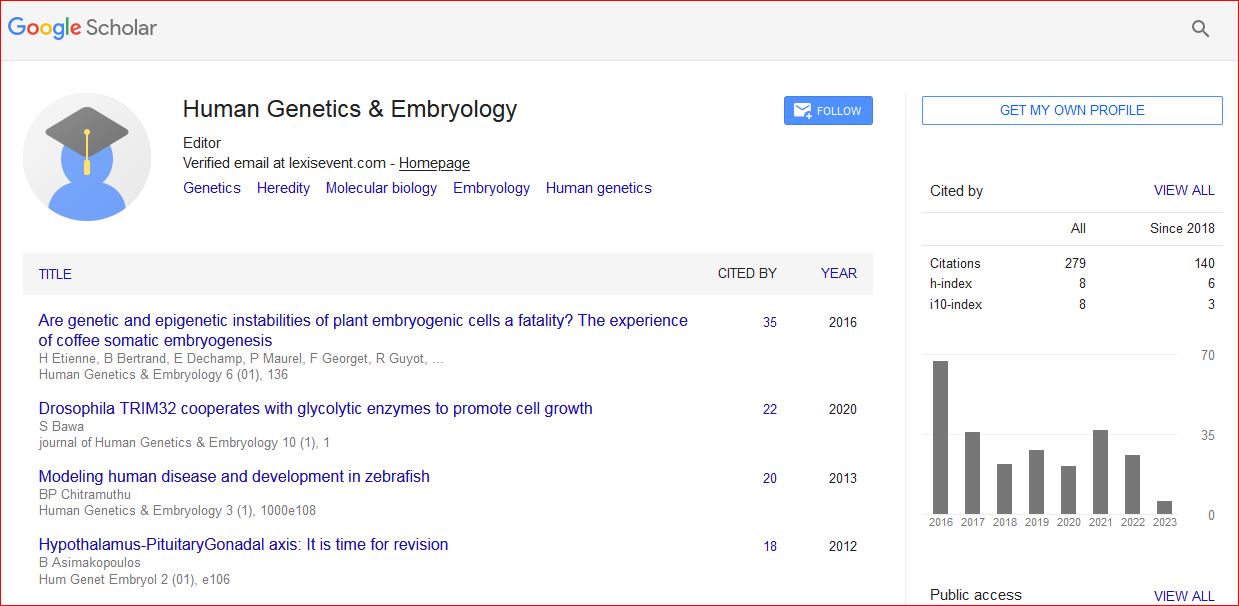
Human Genetics & Embryology received 309 citations as per Google Scholar report