Perspective - (2025) Volume 16, Issue 2
Received: 01-Mar-2025, Manuscript No. jhmi-26-178825;
Editor assigned: 03-Mar-2025, Pre QC No. P-178825;
Reviewed: 17-Mar-2025, QC No. Q-178825;
Revised: 24-Mar-2025, Manuscript No. R-178825;
Published:
31-Mar-2025
, DOI: 10.37421/2157-7420.2025.16.585
Citation: Dlamini, Lindiwe M.. ”NLP in Healthcare: Enhancing Clinical Data Analysis.” J Health Med Informat 16 (2025):585.
Copyright: © 2025 Dlamini M. Lindiwe This is an open-access article distributed under the terms of the Creative Commons Attribution License, which permits unrestricted use, distribution and reproduction in any medium, provided the original author and source are credited.
Natural Language Processing (NLP) has emerged as a transformative technology in the healthcare domain, enabling the extraction of valuable insights from the vast repository of unstructured clinical text. This review explores the foundational principles and applications of NLP in this specialized field. One of the primary areas of application lies in the extraction of specific information from clinical notes, a task that has been significantly advanced by NLP techniques. These methods are crucial for converting raw text into structured data amenable to computational analysis and research endeavors. The automation of information extraction from electronic health records (EHRs) is another critical area where NLP plays a pivotal role. The ability to process large volumes of clinical data automatically facilitates more efficient and scalable research and clinical applications. Recent advancements in deep learning, particularly transformer-based models like BERT, have revolutionized clinical concept extraction. These models exhibit a superior ability to understand the nuances of clinical language, leading to more accurate identification of medical entities. The extraction of patient phenotypes from clinical narratives presents a complex challenge, which has been effectively addressed by deep learning frameworks. These frameworks leverage various neural network architectures to capture the intricate patterns within textual data. Furthermore, NLP is instrumental in identifying and extracting social determinants of health (SDoH) from clinical notes. This capability is vital for public health research, enabling a deeper understanding of the societal factors impacting patient well-being. The critical task of de-identifying clinical text to protect patient privacy is also heavily reliant on NLP. Various techniques, ranging from rule-based systems to advanced deep learning models, are employed to ensure the secure handling of sensitive health information. NLP is also being utilized for the automated classification of clinical notes, a valuable tool for organizing and retrieving relevant information. This is particularly useful in identifying notes pertaining to specific health conditions or patient populations. The application of NLP for named entity recognition (NER) in clinical text has seen significant improvements with the advent of transformer models. These models demonstrate enhanced performance in identifying medical concepts compared to traditional methods. Finally, NLP enables the extraction of patient-reported outcomes (PROs) from free-text feedback. This allows for the systematic analysis of qualitative patient data, providing crucial insights into treatment effectiveness and patient experiences. Both the challenges and advancements in these areas are continually shaping the landscape of clinical informatics and patient care. The ongoing development of NLP techniques promises to unlock even greater potential for data-driven healthcare solutions. The integration of NLP into clinical workflows is no longer a futuristic concept but a present reality, driving innovation and improving patient outcomes. The complexity of clinical language, with its unique terminology and abbreviations, necessitates sophisticated NLP approaches to achieve high accuracy. The evolution of NLP models reflects a growing understanding of the specific needs of the healthcare industry. The ethical considerations surrounding data privacy and security are paramount, and NLP plays a role in addressing these concerns through techniques like de-identification. The ability to synthesize information from diverse clinical sources through NLP opens up new avenues for personalized medicine and predictive analytics. The continuous improvement in computational power and algorithmic sophistication further accelerates the progress of NLP in healthcare. The collaborative efforts between NLP researchers and clinical practitioners are essential for the successful translation of these technologies into real-world applications. The future of healthcare will undoubtedly be shaped by the intelligent analysis of clinical data, with NLP at its core. The development of robust and interpretable NLP models remains a key area of research. The potential for NLP to improve public health surveillance and response to emerging health threats is immense. The widespread adoption of NLP tools will democratize access to valuable clinical information, fostering greater transparency and understanding. The increasing availability of large clinical datasets fuels the development and refinement of NLP algorithms. The ongoing quest for more accurate and efficient NLP solutions is driven by the profound impact they can have on healthcare delivery. The integration of NLP into clinical decision support systems is a significant step towards proactive and personalized patient care. The exploration of novel NLP architectures is crucial for tackling increasingly complex clinical information extraction tasks. The ability of NLP to uncover hidden patterns in clinical text can lead to groundbreaking discoveries in medical research. The journey of NLP in healthcare is one of continuous innovation and adaptation. The impact of NLP extends beyond data analysis to enhancing communication and collaboration among healthcare professionals. The persistent pursuit of excellence in NLP development will undoubtedly lead to a more efficient and effective healthcare system for all. The transformative power of NLP in healthcare is only beginning to be fully realized, with its influence expected to grow exponentially in the coming years. The ethical deployment of NLP technologies ensures that patient well-being remains the central focus. The continuous evolution of NLP methodologies ensures that healthcare systems can adapt to new challenges and opportunities. The intricate tapestry of clinical information can be unraveled and understood through the lens of advanced NLP. The collaborative synergy between human expertise and NLP capabilities offers a powerful paradigm for the future of medicine. The pursuit of knowledge within the healthcare sector is greatly amplified by the analytical prowess of NLP. The ongoing research into NLP for clinical applications promises to yield significant improvements in diagnosis, treatment, and patient care. The ability to glean actionable intelligence from clinical narratives is a testament to the sophistication of modern NLP. The ongoing dialogue surrounding the implementation and ethical use of NLP in healthcare is crucial for its responsible advancement. The ever-expanding domain of clinical data necessitates sophisticated NLP tools for effective management and interpretation. The continuous refinement of NLP algorithms ensures their increasing accuracy and reliability in critical healthcare settings. The profound impact of NLP on transforming raw clinical data into meaningful insights cannot be overstated. The future trajectory of medical research and practice is intrinsically linked to the advancements in NLP. The dedication to developing advanced NLP solutions signifies a commitment to improving global health outcomes. The comprehensive exploration of NLP's capabilities in healthcare promises a paradigm shift in how medical information is accessed and utilized.
The application of Natural Language Processing (NLP) techniques to clinical text represents a significant stride in harnessing unstructured data for diverse healthcare purposes. These techniques are vital for transforming verbose clinical notes into structured, actionable information, thereby enhancing research capabilities and supporting clinical decision-making processes. The extraction of specific entities and relationships from clinical narratives forms a cornerstone of NLP in healthcare. This process allows for the systematic identification of key medical concepts, such as diseases, symptoms, medications, and procedures, which are essential for various analytical tasks. Automating the extraction of adverse drug event (ADE) information from electronic health records (EHRs) is a prime example of NLP's utility in patient safety. By employing sophisticated NLP pipelines, including those utilizing deep learning, accurate identification of potential drug-related harms can be achieved, thereby bolstering pharmacovigilance efforts. The advent of powerful language models like BERT has considerably advanced the field of clinical concept extraction. These models excel at understanding the contextual nuances of clinical language, leading to improved accuracy in identifying medical terms and their relationships. Phenotype extraction from clinical narratives is another area where deep learning approaches have demonstrated considerable promise. By employing neural networks such as RNNs and CNNs, these systems can effectively capture complex patterns within text to identify patient phenotypes with high precision. The identification and extraction of social determinants of health (SDoH) from clinical notes are crucial for public health initiatives. NLP tools enable the systematic capture of information related to socioeconomic factors, lifestyle, and environmental influences that impact health outcomes. Ensuring patient privacy through the de-identification of clinical text is a non-negotiable aspect of healthcare data processing. NLP techniques, including rule-based systems and machine learning classifiers, are employed to effectively remove or mask protected health information (PHI). Automated classification of clinical notes is facilitated by NLP, enabling efficient organization and retrieval of relevant medical documents. This is particularly useful for tasks such as identifying notes pertaining to specific conditions, like mental health disorders, thereby streamlining clinical workflows. Named Entity Recognition (NER) within the biomedical domain, especially for clinical entities, has been significantly enhanced by transformer-based models. These models offer superior performance in identifying medical concepts compared to traditional NLP methods, highlighting the importance of contextual embeddings. Extracting patient-reported outcomes (PROs) from free-text feedback using NLP provides a direct channel to understand patient experiences and treatment efficacy. This capability allows for the systematic analysis of qualitative data, offering valuable insights into the patient's perspective on their health and treatment journey. The continuous development of NLP methods is pushing the boundaries of what can be achieved in clinical data analysis. The integration of these technologies into routine clinical practice is accelerating, driven by the tangible benefits they offer. The ability to process and understand the vast amount of text generated in healthcare settings is critical for advancing medical knowledge and improving patient care. The challenges associated with clinical language, such as ambiguity, abbreviations, and domain-specific jargon, are being progressively addressed by sophisticated NLP algorithms. The ongoing research in this field focuses on developing more robust, interpretable, and generalizable NLP models. The ethical considerations surrounding the use of patient data, particularly in the context of AI and NLP, are being carefully navigated. The potential for NLP to democratize access to health information and empower patients is also a significant area of interest. The collaboration between NLP experts and healthcare professionals is essential for ensuring the relevance and efficacy of these tools. The future promises even more sophisticated NLP applications that can support personalized medicine, predictive analytics, and population health management. The ongoing advancements in deep learning architectures continue to drive progress in NLP for clinical text analysis. The ability to derive meaningful insights from unstructured data is transforming the way medical research is conducted and clinical decisions are made. The increasing availability of large, annotated clinical datasets is fueling the development of more accurate NLP models. The focus on developing NLP tools that are not only accurate but also explainable is crucial for their adoption in high-stakes clinical environments. The impact of NLP extends to improving the efficiency of administrative tasks within healthcare organizations. The continuous innovation in NLP techniques is paving the way for novel applications that were previously unimaginable. The systematic extraction of clinical information through NLP supports evidence-based medicine and the advancement of healthcare standards. The ability to synthesize information from diverse sources of clinical text enhances the comprehensiveness of medical data analysis. The ongoing efforts to standardize clinical terminology and data formats further complement the application of NLP. The evolving landscape of healthcare necessitates adaptive and intelligent NLP solutions to address emerging challenges. The profound implications of NLP for patient outcomes and healthcare system efficiency are driving widespread adoption. The commitment to advancing NLP in healthcare reflects a broader trend towards leveraging data for improved health and well-being. The intricate nature of clinical narratives requires specialized NLP approaches that can handle the complexities of medical language. The ongoing dialogue surrounding the ethical and societal implications of NLP in healthcare is vital for its responsible development and deployment. The continuous pursuit of accuracy and efficiency in NLP models is paramount for their successful integration into clinical workflows. The transformative potential of NLP in revolutionizing healthcare data analysis is undeniable. The dedication to developing advanced NLP solutions signifies a commitment to improving global health outcomes through data-driven insights. The intricate tapestry of clinical information can be unraveled and understood through the lens of advanced NLP, leading to a more nuanced understanding of patient health. The collaborative synergy between human expertise and NLP capabilities offers a powerful paradigm for the future of medicine, enhancing both diagnostic accuracy and treatment planning. The pursuit of knowledge within the healthcare sector is greatly amplified by the analytical prowess of NLP, enabling researchers to identify novel patterns and correlations in vast datasets. The ongoing research into NLP for clinical applications promises to yield significant improvements in diagnosis, treatment, and patient care, ultimately leading to better health outcomes for individuals. The ability to glean actionable intelligence from clinical narratives is a testament to the sophistication of modern NLP, allowing for the extraction of critical information that might otherwise be overlooked. The ongoing dialogue surrounding the implementation and ethical use of NLP in healthcare is crucial for its responsible advancement, ensuring that patient privacy and well-being are prioritized. The ever-expanding domain of clinical data necessitates sophisticated NLP tools for effective management and interpretation, making vast amounts of information accessible and understandable. The continuous refinement of NLP algorithms ensures their increasing accuracy and reliability in critical healthcare settings, fostering greater trust in their outputs. The profound impact of NLP on transforming raw clinical data into meaningful insights cannot be overstated, as it unlocks the hidden potential within medical records. The future trajectory of medical research and practice is intrinsically linked to the advancements in NLP, as it provides the tools to analyze complex health information. The dedication to developing advanced NLP solutions signifies a commitment to improving global health outcomes through data-driven insights and personalized healthcare approaches.
This compilation of research explores the multifaceted applications of Natural Language Processing (NLP) in healthcare. It highlights how NLP techniques are crucial for extracting valuable information from unstructured clinical text, thereby facilitating research, clinical decision support, and public health surveillance. Key areas of focus include the automated extraction of adverse drug events from electronic health records, clinical concept extraction using advanced models like BERT, and phenotype identification from clinical narratives. The research also emphasizes the role of NLP in extracting social determinants of health, de-identifying patient data for privacy, and classifying clinical notes. Furthermore, it showcases the effectiveness of transformer-based models for named entity recognition and the extraction of patient-reported outcomes. Overall, these studies underscore the transformative potential of NLP in enhancing the efficiency, accuracy, and depth of clinical data analysis for improved patient care and medical understanding.
None
None
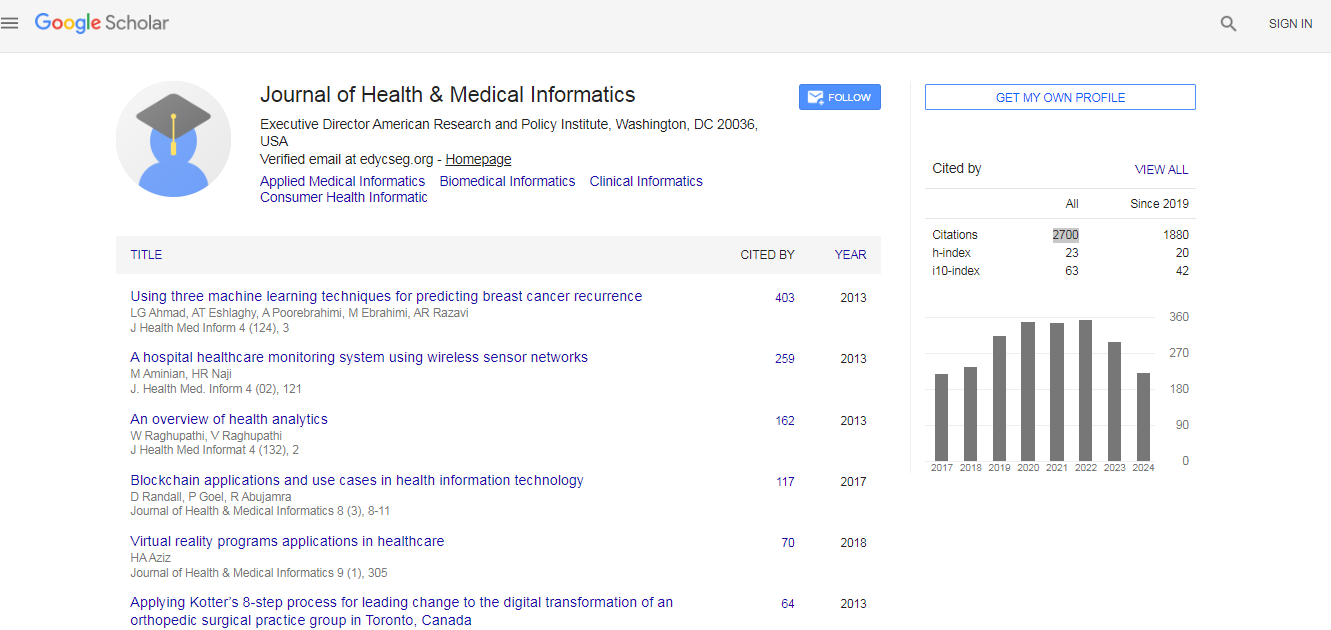
Journal of Health & Medical Informatics received 2700 citations as per Google Scholar report