Short Communication - (2025) Volume 11, Issue 2
Received: 02-May-2025, Manuscript No. jotr-25-175580;
Editor assigned: 05-May-2025, Pre QC No. P-175580;
Reviewed: 19-May-2025, QC No. Q-175580;
Revised: 23-May-2025, Manuscript No. R-175580;
Published:
30-May-2025
, DOI: 10.37421/2476-2261. 2025.11.309
Citation: Ricci, Matteo. ”NGS: Revolutionizing Genomics, Diagnostics, Precision Medicine.” J Oncol Transl Res 11 (2025):309.
Copyright: © 2025 Ricci M. This is an open-access article distributed under the terms of the Creative Commons Attribution License, which permits unrestricted use, distribution and reproduction in any medium, provided the original author and source are credited.
This article looks at the latest progress and future directions for using next-generation sequencing, or NGS, to diagnose genetic conditions. It covers how NGS is getting better at spotting variations and its expanding role in clinical settings, touching on both its current utility and upcoming possibilities[1].
This paper offers an updated look at how next-generation sequencing (NGS) is used in cancer research. It details the genomic applications, like identifying mutations, and also delves into epigenomic uses, such as methylation profiling, showing how NGS helps understand cancer at a deeper molecular level[2].
This article gives a broad overview of single-cell next-generation sequencing, or scNGS. It explains the various methods currently used to perform scNGS and highlights its diverse applications across different biological research areas, emphasizing its power to analyze individual cells[3].
This piece explores how next-generation sequencing (NGS) is being used to diagnose infectious diseases. It covers the methods and benefits of NGS for pathogen identification, strain typing, and resistance gene detection, showing its increasing importance in clinical microbiology[4].
This article reviews the current state of long-read sequencing technologies, which are a form of next-generation sequencing. It discusses the capabilities of platforms like PacBio and Oxford Nanopore, highlights their advantages in resolving complex genomic regions, and addresses the remaining challenges in data analysis and accuracy[5].
This paper focuses on how next-generation sequencing (NGS) is applied in clinical genomics. It explores the different NGS technologies available and their specific uses in diagnostic settings, covering areas like inherited disease detection and pharmacogenomics[6].
Here, the authors discuss the role of next-generation sequencing (NGS) in pharmacogenomics. They cover how NGS is currently used to identify genetic variations influencing drug response and explore the ongoing challenges in translating this data into personalized medicine[7].
This paper reviews the progress in RNA sequencing (RNA-Seq) technologies, a key application of next-generation sequencing. It covers different RNA-Seq methodologies and their diverse applications, from gene expression profiling to novel transcript discovery, highlighting how these advancements deepen our understanding of transcriptomes[8].
This article looks at the latest developments and challenges in using next-generation sequencing (NGS) for metagenomics. It covers how NGS enables comprehensive analysis of microbial communities, discusses various sequencing strategies, and points out the computational and biological hurdles that still need to be addressed[9].
This paper discusses the potential and obstacles of integrating next-generation sequencing (NGS) into precision medicine. It explores how NGS can personalize treatments by identifying individual genetic variations and details the challenges in data interpretation, clinical implementation, and ethical considerations[10].
Next-generation sequencing (NGS) stands as a transformative technology, continually redefining diagnostics and fundamental biological research. It has significantly advanced, enhancing the ability to identify subtle genetic variations critical for diagnosing a spectrum of genetic conditions. Its expanding role in clinical settings underscores both its present utility and substantial future possibilities in patient care [1]. In cancer research, NGS offers an updated view, thoroughly detailing genomic applications like precise mutation identification and delving into epigenomic uses, such as methylation profiling. This comprehensive approach provides a deeper molecular understanding of cancer's intricacies, aiding in better diagnostic and therapeutic strategies [2].
Specialized applications of NGS address unique biological challenges. Single-cell NGS (scNGS), for example, is highlighted for its diverse methods and broad applications across various biological research areas, emphasizing its unparalleled power to analyze individual cells. This capacity allows for granular insights not achievable with bulk sequencing [3]. Furthermore, long-read sequencing technologies, a distinct form of NGS, are reviewed for their current status and challenges. These technologies, exemplified by platforms like PacBio and Oxford Nanopore, offer advantages in resolving complex genomic regions, providing crucial information often missed by shorter reads, although ongoing efforts are needed to refine data analysis and accuracy [5].
The clinical relevance of NGS is profound, particularly in infectious disease management and broader clinical genomics. NGS is increasingly important for diagnosing infectious diseases, encompassing methods and clear benefits for rapid pathogen identification, precise strain typing, and efficient resistance gene detection. This makes it an indispensable tool in modern clinical microbiology [4]. The application extends to clinical genomics, where various NGS technologies are explored for their specific uses in diagnostic settings. This includes the accurate detection of inherited diseases and its significant contribution to pharmacogenomics, tailoring medical approaches to individual genetic makeup [6].
Pharmacogenomics benefits immensely from NGS, which facilitates the identification of genetic variations directly influencing drug response. While this is a critical step towards personalized medicine, the field still grapples with challenges in translating complex sequencing data into practical clinical guidance [7]. In parallel, RNA sequencing (RNA-Seq) technologies, a key application under the NGS umbrella, have seen substantial progress. These advancements offer diverse methodologies and applications, from comprehensive gene expression profiling to the discovery of novel transcripts, significantly deepening our understanding of dynamic transcriptomes and their roles in health and disease [8].
NGS has also driven significant advancements in metagenomics, enabling comprehensive analysis of microbial communities within diverse environments. This involves various sequencing strategies, though the field continues to tackle computational and biological hurdles to refine its utility further [9]. Ultimately, integrating NGS into precision medicine holds immense promise. It explores how NGS can personalize treatments by identifying individual genetic variations, yet this pathway is not without obstacles. Challenges in data interpretation, successful clinical implementation, and critical ethical considerations must be carefully navigated to fully realize the potential of NGS in transforming personalized healthcare [10].
Next-generation sequencing (NGS) has rapidly evolved, becoming indispensable across numerous biological and clinical fields. Its applications span the accurate diagnosis of genetic conditions, where it excels at spotting subtle variations and plays an expanding role in clinical settings. NGS is also critical in cancer research, revealing genomic and epigenomic insights like mutations and methylation profiles for a deeper molecular understanding. In clinical microbiology, it's vital for identifying infectious pathogens, typing strains, and detecting resistance genes, significantly improving diagnostics. Beyond diagnostics, NGS encompasses specialized techniques such as single-cell sequencing, which provides granular insights into individual cells, and long-read sequencing, valuable for resolving complex genomic regions despite analytical challenges. The technology is fundamental in clinical genomics, aiding in inherited disease detection and pharmacogenomics by identifying genetic variations influencing drug responses, thereby supporting personalized medicine. Further extending its reach, RNA sequencing advances our understanding of transcriptomes through gene expression profiling, while metagenomics uses NGS for comprehensive microbial community analysis. However, integrating NGS into precision medicine, though promising for personalized treatments, faces ongoing hurdles in data interpretation, clinical implementation, and ethical considerations. Overall, NGS continues to drive significant progress, navigating challenges to deliver increasingly precise and comprehensive genomic insights.
None
None
Jiwei Y, Yan Z, Jianqiao L. "Next-generation sequencing for diagnosis of genetic diseases: recent advances and future perspectives".J Med Genet 61 (2024):589-599.
Indexed at, Google Scholar, Crossref
Chiara R, Chiara DM, Luca R. "Next-generation sequencing in cancer: an update on genomic and epigenomic applications".Front Oncol 13 (2023):1189312.
Indexed at, Google Scholar, Crossref
Peng Y, Yan W, Xiang-Hong Y. "Single-cell next-generation sequencing (scNGS): an overview of methods and applications".J Cell Mol Med 27 (2023):1993-2006.
Indexed at, Google Scholar, Crossref
Bo M, Jin-Feng L, Hui-Fen X. "Next-generation sequencing for diagnosis of infectious diseases".J Clin Microbiol 60 (2022):e0064222.
Indexed at, Google Scholar, Crossref
Zhujun L, Chao-Chun H, Hai-Ying S. "Long-read sequencing: current status and challenges".Brief Bioinform 23 (2022):bbac327.
Indexed at, Google Scholar, Crossref
Min S, Minmin W, Wenjia S. "Next-generation sequencing in clinical genomics: technologies and applications".J Cell Mol Med 25 (2021):8243-8255.
Indexed at, Google Scholar, Crossref
Zilin L, Zhihua L, Yuanyuan Z. "Next-generation sequencing in pharmacogenomics: current applications and future challenges".Pharmacogenomics 22 (2021):849-866.
Indexed at, Google Scholar, Crossref
Zhen H, Kai T, Kai W. "Advances in RNA sequencing technologies and applications".Genomics Proteomics Bioinformatics 18 (2020):367-379.
Indexed at, Google Scholar, Crossref
Meng L, Qi L, Jihua W. "Next-generation sequencing in metagenomics: recent advances and challenges".Microbiome 8 (2020):125.
Indexed at, Google Scholar, Crossref
Yanan H, Pengcheng H, Wenjuan C. "Next-generation sequencing in precision medicine: promises and challenges".Genomics Proteomics Bioinformatics 18 (2020):83-93.
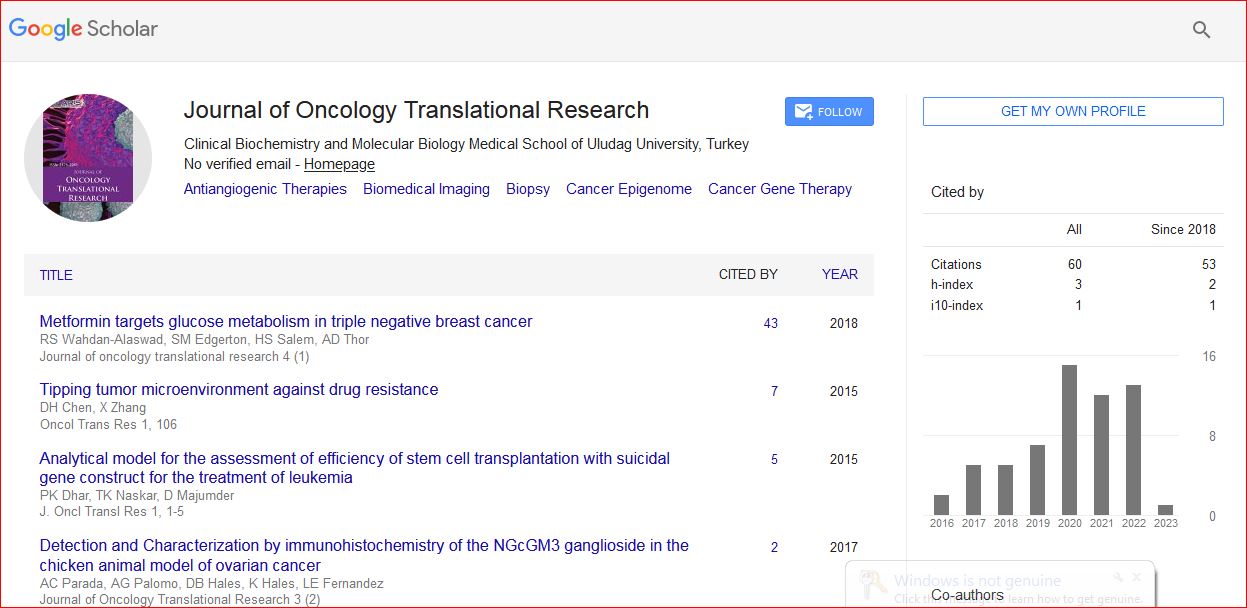
Journal of Oncology Translational Research received 93 citations as per Google Scholar report