Opinion - (2025) Volume 14, Issue 5
Received: 02-Sep-2025, Manuscript No. pbt-25-173775;
Editor assigned: 04-Sep-2025, Pre QC No. P-173775;
Reviewed: 18-Sep-2025, QC No. Q-173775;
Revised: 23-Sep-2025, Manuscript No. R-173775;
Published:
30-Sep-2025
, DOI: 10.37421/2167-7689.2025.14.504
Citation: Petrova, Helena. ”New ICH Guidelines Transform Biopharma Development.” Pharmaceut Reg Affairs 14 (2025):504.
Copyright: © 2025 Petrova H. This is an open-access article distributed under the terms of the Creative Commons Attribution License, which permits unrestricted use,
distribution and reproduction in any medium, provided the original author and source are credited.
This article discusses the new ICH Q14 guideline on Analytical Procedure Development and the revised ICH Q2(R2) guideline on Analytical Procedure Validation. It highlights their significant impact on the biopharmaceutical industry, especially in terms of lifecycle management for analytical procedures. The guidelines emphasize a science- and risk-based approach, encouraging a more structured and robust development process, ultimately leading to higher quality drug products. Companies will need to adapt their existing quality management systems and data integrity practices to align with these new expectations [1].
This paper examines the implications of the ICH E6(R3) guideline, focusing on its potential to enhance the quality and efficiency of clinical trials. It delves into the guidelines emphasis on proportionality, risk-based quality management, and the use of technology, advocating for a modern approach to Good Clinical Practice (GCP). The authors suggest that implementing these revised principles will lead to more robust clinical data, protect trial participants more effectively, and streamline the conduct of studies in a globalized research environment [2].
This review analyzes the ICH Q13 guideline on Continuous Manufacturing of Drug Substances and Drug Products, highlighting its role in accelerating the adoption of advanced manufacturing technologies. It discusses the regulatory flexibility offered by the guideline, promoting innovation and efficiency in pharmaceutical production. The authors emphasize the benefits of continuous manufacturing, such as reduced footprint, improved quality control, and faster time to market, while also addressing the challenges associated with its implementation and the need for robust control strategies [3].
The article explores the integration of real-world data (RWD) and real-world evidence (RWE) into regulatory decision-making, particularly through the lens of emerging ICH guidelines. It discusses how RWD/RWE can complement traditional clinical trial data, offering new perspectives on drug safety and effectiveness in diverse patient populations. The authors highlight the importance of data quality, standardization, and appropriate methodologies for generating reliable evidence from real-world sources, underscoring the shift towards more holistic evidence generation in drug development [4].
This article offers a practical guide to the ICH M12 guideline on Drug Interaction Studies, which standardizes approaches for assessing potential drug-drug interactions. It provides clarity on study design, data analysis, and reporting requirements, crucial for ensuring patient safety and effective drug use. The authors emphasize the guidelines role in harmonizing global regulatory expectations, facilitating the development of drugs with predictable interaction profiles, and ultimately improving prescribing practices and reducing adverse events [5].
The paper discusses the ICH E8(R1) guideline on General Considerations for Clinical Studies, which provides overarching principles for designing, conducting, and reporting clinical trials. It highlights the guidelines focus on quality by design, patient centricity, and the importance of scientific validity and ethical considerations. The authors suggest that adherence to these principles is fundamental for generating reliable evidence and ensuring the protection of human subjects, thereby underpinning the integrity of global drug development [6].
This study focuses on the implementation of the ICH M7(R2) guideline for assessing and controlling DNA reactive (mutagenic) impurities in drug products. It provides insights into the risk assessment strategies and acceptable intake limits for these impurities, crucial for ensuring long-term patient safety. The authors discuss the analytical challenges and regulatory expectations for genotoxic impurities, emphasizing the need for robust control strategies throughout the drug lifecycle to minimize potential carcinogenic risks [7].
This article reviews the ICH Q3D(R2) guideline concerning elemental impurities in pharmaceuticals, providing an update on the control strategies and risk assessment methodologies. It highlights the importance of identifying and quantifying potentially toxic elements to ensure patient safety. The authors delve into the revised limits and the application of a risk-based approach for managing elemental impurities, which is vital for global regulatory compliance and the manufacture of high-quality medicinal products [8].
This paper provides an overview of the ICH S1(R2) guideline for rodent carcinogenicity testing, detailing its principles for assessing the carcinogenic potential of pharmaceuticals. It discusses the updated approach that encourages a weight-of-evidence assessment, aiming to reduce unnecessary animal testing while maintaining patient safety standards. The authors highlight the guidelines role in harmonizing global regulatory requirements for non-clinical safety studies and promoting more efficient and ethical drug development practices [9].
The article explores the critical aspects of the ICH E14/S7B Q&As, which offer guidance on managing cardiac safety in non-clinical and clinical drug development. It emphasizes the importance of evaluating a drugs potential to prolong the QT interval and induce arrhythmias. The authors discuss how these Q&As refine previous guidelines, providing clearer instructions for thorough cardiac risk assessment, thus contributing to safer drug profiles and reducing the risk of life-threatening cardiac events in patients [10].
New ICH guidelines, Q14 and Q2(R2), are significantly impacting the biopharmaceutical industry by focusing on analytical procedure development and validation. These guidelines promote a science and risk-based approach, fostering structured and robust development processes that lead to higher quality drug products. Companies must adapt their quality management systems and data integrity practices to meet these new expectations [1]. Expanding on this, the ICH E6(R3) guideline aims to enhance the quality and efficiency of clinical trials. It emphasizes proportionality, risk-based quality management, and the use of technology, advocating for a modern approach to Good Clinical Practice. Implementing these revised principles is expected to generate more robust clinical data, protect trial participants more effectively, and streamline study conduct within a globalized research environment [2].
Innovation in pharmaceutical manufacturing is driven by the ICH Q13 guideline on Continuous Manufacturing of Drug Substances and Drug Products. This guideline provides regulatory flexibility, promoting efficiency and advanced manufacturing technologies. Benefits include reduced operational footprint, improved quality control, and faster time to market, although robust control strategies are essential for successful implementation [3]. Complementing this, emerging ICH guidelines are integrating Real-World Data (RWD) and Real-World Evidence (RWE) into regulatory decision-making. RWD and RWE offer new perspectives on drug safety and effectiveness in diverse patient populations, supplementing traditional clinical trial data. Ensuring high data quality, standardization, and appropriate methodologies is crucial for generating reliable evidence from real-world sources and fostering a more holistic approach to drug development [4].
A practical guide to the ICH M12 guideline focuses on Drug Interaction Studies, standardizing approaches for assessing potential drug-drug interactions. It clarifies study design, data analysis, and reporting requirements, which is important for patient safety and effective drug use. This guideline harmonizes global regulatory expectations, facilitating the development of drugs with predictable interaction profiles and ultimately improving prescribing practices while reducing adverse events [5]. Furthermore, the ICH E8(R1) guideline provides general considerations for clinical studies, establishing overarching principles for designing, conducting, and reporting clinical trials. It highlights quality by design, patient centricity, and the importance of scientific validity and ethical considerations. Adherence to these principles is fundamental for generating reliable evidence and ensuring the protection of human subjects, thereby underpinning the integrity of global drug development [6].
Controlling impurities is a critical area addressed by ICH guidelines. The ICH M7(R2) guideline focuses on assessing and controlling DNA reactive (mutagenic) impurities in drug products. It offers insights into risk assessment strategies and acceptable intake limits, crucial for long-term patient safety. The guideline discusses analytical challenges and regulatory expectations for genotoxic impurities, emphasizing the need for robust control strategies throughout the drug lifecycle to minimize potential carcinogenic risks [7]. Similarly, the ICH Q3D(R2) guideline reviews elemental impurities in pharmaceuticals, updating control strategies and risk assessment methodologies. It underscores the importance of identifying and quantifying potentially toxic elements to ensure patient safety, detailing revised limits and the application of a risk-based approach for managing these impurities. This is vital for global regulatory compliance and the manufacture of high-quality medicinal products [8].
For non-clinical safety studies, the ICH S1(R2) guideline provides an overview of rodent carcinogenicity testing. It details principles for assessing the carcinogenic potential of pharmaceuticals, promoting an updated weight-of-evidence assessment that aims to reduce unnecessary animal testing while maintaining patient safety standards. This guideline plays a role in harmonizing global regulatory requirements for non-clinical safety studies, promoting more efficient and ethical drug development practices [9]. Finally, the ICH E14/S7B Q&As explore critical aspects of managing cardiac safety in both non-clinical and clinical drug development. This guidance emphasizes evaluating a drugs potential to prolong the QT interval and induce arrhythmias. These Q&As refine previous guidelines, providing clearer instructions for thorough cardiac risk assessment, which contributes to safer drug profiles and reduces the risk of life-threatening cardiac events in patients [10].
The biopharmaceutical industry sees significant impact from new ICH guidelines like Q14 and Q2(R2), focusing on analytical procedure development and validation. These promote a science- and risk-based approach for higher quality drug products. Companies must adapt their quality management systems and data integrity practices. ICH E6(R3) aims to improve clinical trial quality and efficiency, emphasizing proportionality, risk-based quality management, and technology. This advocates for a modern Good Clinical Practice, leading to robust clinical data, better participant protection, and streamlined global studies. ICH Q13 encourages continuous manufacturing with regulatory flexibility for advanced technologies. Benefits include reduced footprint, improved quality control, and faster market entry, though robust control strategies are key. Emerging ICH guidelines support integrating Real-World Data (RWD) and Real-World Evidence (RWE) into regulatory decision-making, complementing traditional clinical trial data. This offers new insights into drug safety and effectiveness, stressing data quality and standardization. ICH M12 standardizes drug interaction studies, providing clarity on design, analysis, and reporting. It harmonizes global regulatory expectations, facilitating the development of drugs with predictable interaction profiles and reducing adverse events. ICH E8(R1) sets overarching principles for clinical studies, highlighting quality by design, patient centricity, scientific validity, and ethical considerations. Adherence generates reliable evidence and ensures human subject protection. ICH M7(R2) addresses DNA reactive impurities in drug products, offering risk assessment strategies and acceptable intake limits for patient safety. This guideline emphasizes robust control throughout the drug lifecycle to minimize potential carcinogenic risks. ICH Q3D(R2) updates control strategies for elemental impurities, focusing on identification and quantification of toxic elements. It includes revised limits and a risk-based approach for global regulatory compliance and high-quality medicinal products. ICH S1(R2) outlines rodent carcinogenicity testing, promoting a weight-of-evidence assessment to reduce animal testing while maintaining safety. This harmonizes non-clinical safety studies, fostering efficient and ethical drug development. ICH E14/S7B Q&As provide guidance on cardiac safety management in drug development, evaluating a drugs potential to prolong the QT interval and induce arrhythmias. These Q&As refine previous guidelines for thorough cardiac risk assessment, contributing to safer drug profiles.
None
None
1. Anil S, Baljeet K, Kulwant K. "ICH Q14 and Q2(R2) Guidelines for Analytical Procedure Development and Validation: Impact on Biopharmaceutical Industry".PDA J Pharm Sci Technol 78 (2024):2300055.
Indexed at, Google Scholar, Crossref
2. Vikram S, Ankit M, Sahil G. "Enhancing Clinical Trial Quality and Efficiency: Implications of the ICH E6(R3) Guideline".Indian J Pharm Sci 85 (2023):1123-1126.
Indexed at, Google Scholar, Crossref
3. Brijeshkumar T, Dhruv G, Kaushal P. "Continuous Manufacturing in Pharmaceutical Industry: An Overview of ICH Q13 Guideline".Recent Pat Drug Deliv Formul 17 (2023):174-184.
Indexed at, Google Scholar, Crossref
4. Mandy L, Andrew BN, John DS. "Real-World Data and Real-World Evidence: Bridging the Gap from Clinical Trials to Regulatory Decision-Making".Clin Pharmacol Ther 113 (2023):288-297.
Indexed at, Google Scholar, Crossref
5. Mehnaz K, M. I, A. I. "A Guide to ICH M12 Guideline on Drug Interaction Studies".J Pharm Pharm Sci 26 (2023):102454.
Indexed at, Google Scholar, Crossref
6. Mansi S, Neha S, Reetu D. "ICH E8(R1) Guideline: General Considerations for Clinical Studies".J Pharm Bioallied Sci 14 (2022):S1607-S1611.
Indexed at, Google Scholar, Crossref
7. Qingyuan Y, Huifang Y, Lili Z. "Recent Advances and Challenges in ICH M7(R2) Guideline on Control of DNA Reactive (Mutagenic) Impurities".J Pharm Anal 12 (2022):635-645.
Indexed at, Google Scholar, Crossref
8. Preeti D, Ankit K, Deepak K. "ICH Q3D(R2) Guideline: Control of Elemental Impurities in Pharmaceutical Products".Pharm Anal Acta 11 (2020):638.
Indexed at, Google Scholar, Crossref
9. Harpreet K, Gurneet K, Jaswinder K. "ICH S1(R2) Guideline on Rodent Carcinogenicity Testing for Pharmaceuticals".J Adv Pharm Technol Res 11 (2020):134-138.
Indexed at, Google Scholar, Crossref
10. Tetsuya S, Tetsuya S, Kiyofumi F. "ICH E14/S7B Q&As: New Guidance on Nonclinical and Clinical Proarrhythmia Assessment".J Cardiovasc Electrophysiol 31 (2020):261-267.
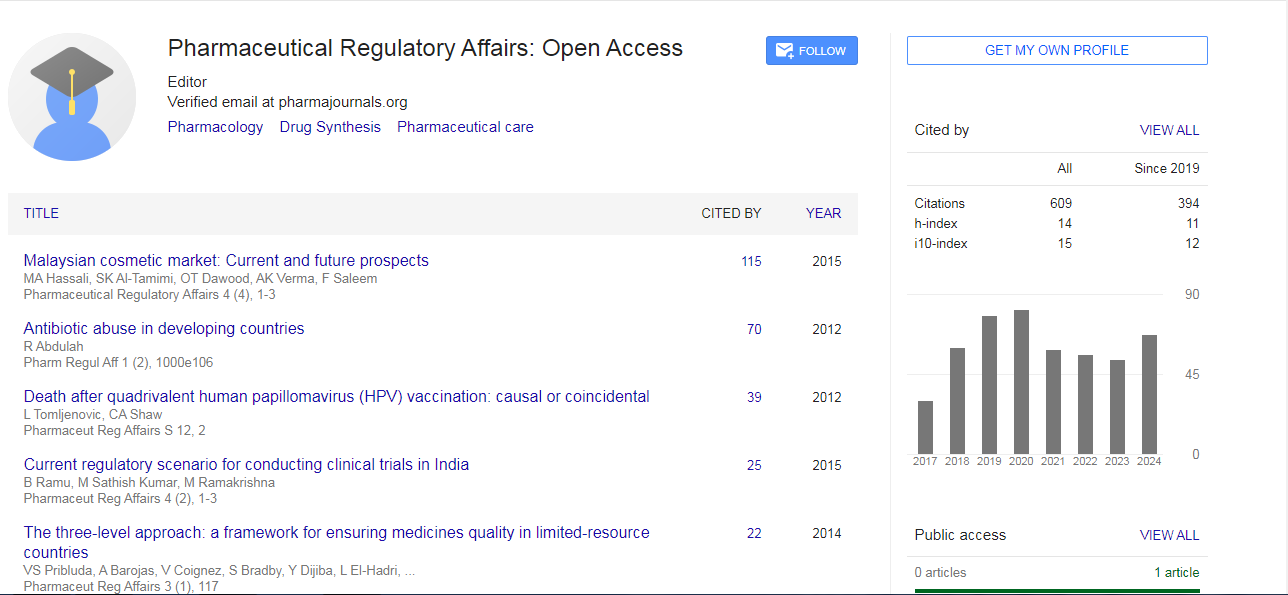
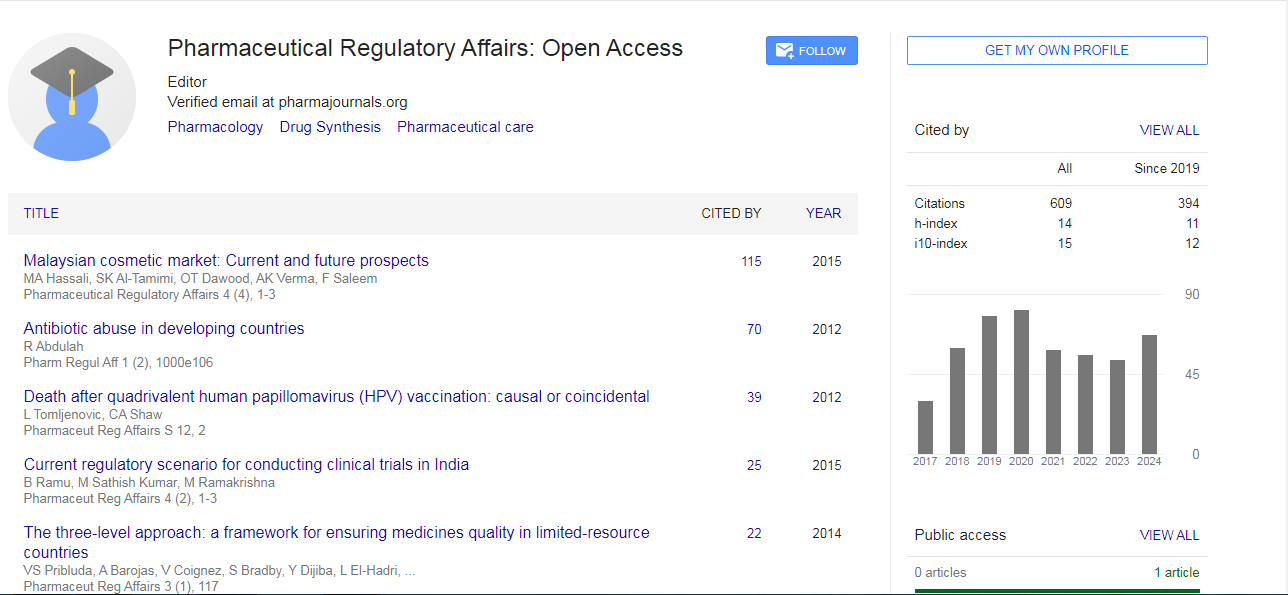
Pharmaceutical Regulatory Affairs: Open Access received 533 citations as per Google Scholar report