Perspective - (2025) Volume 10, Issue 3
Received: 01-May-2025, Manuscript No. JPNM-26-185771;
Editor assigned: 05-May-2025, Pre QC No. P-185771;
Reviewed: 19-May-2025, QC No. Q-185771;
Revised: 22-May-2025, Manuscript No. R-185771;
Published:
29-May-2025
, DOI: 10.37421/2472-100X.2025.10.351
Citation: Martinez, Sofia. ”Neurogenetics: Precision in Pediatric Neurological Disorders.” J Pediatr Neurol Med 10 (2025):351.
Copyright: © 2025 Martinez S. This is an open-access article distributed under the terms of the Creative Commons Attribution License, which permits unrestricted use, distribution and reproduction in any medium, provided the original author and source are credited.
Neurogenetics is profoundly transforming our comprehension of pediatric neurological disorders, enabling more precise diagnoses and the development of targeted therapeutic strategies. Recent significant advancements in this field are centered on the identification of novel genetic variants that are associated with a spectrum of conditions including epilepsy, autism spectrum disorder, and developmental delays, thereby paving the way for the implementation of personalized medicine approaches. Furthermore, this dynamic field offers critical insights into the intricate interplay between genetic predispositions and environmental factors that exert influence on neurodevelopmental processes. Whole-exome sequencing (WES) has emerged as an exceptionally powerful and indispensable tool for the diagnostic process of rare and complex pediatric neurological disorders. By meticulously examining the protein-coding regions of the entire genome, WES possesses the remarkable capability to identify causative genetic mutations that might have been overlooked by conventional genetic testing methods, ultimately leading to earlier and more accurate diagnoses for affected children and their families. Contemporary advances in gene editing technologies, with CRISPR-Cas9 being a prominent example, hold immense and unparalleled promise for the effective treatment of a variety of genetic neurological disorders. Although these sophisticated tools are still largely in the preclinical stages of development for pediatric applications, they offer the groundbreaking potential to correct disease-causing mutations directly at their source, signifying a true paradigm shift in therapeutic strategies. A deep and thorough understanding of the genetic underpinnings of pediatric epilepsy is absolutely crucial for its effective management and treatment. The precise identification of specific genetic variants that are intrinsically associated with different epilepsy syndromes facilitates more accurate prognostication and the judicious selection of appropriate anti-epileptic drugs, a concept often referred to as precision epilepsy care. Autism spectrum disorder (ASD) is recognized as a complex neurodevelopmental condition that possesses a significant and demonstrable genetic component. Neurogenetic research is increasingly succeeding in identifying specific genes and critical pathways that are implicated in the pathogenesis of ASD, thereby opening up new and promising avenues for understanding its highly diverse clinical presentations and for developing potential therapeutic interventions. Genetic factors undeniably play a critical and fundamental role in the etiology of intellectual disability (ID). The identification of the underlying genetic causes through the application of advanced sequencing technologies is absolutely essential for achieving an accurate diagnosis, providing effective genetic counseling, and exploring personalized management strategies for children affected by this condition. The neurogenetics of rare pediatric movement disorders, encompassing conditions such as dystonia and chorea, are progressively being elucidated with greater clarity and detail. The identification of specific genetic mutations that cause these disorders provides invaluable insights into the affected neuronal circuits and consequently informs the development of highly targeted and effective therapies. Pharmacogenomics, which is the scientific study dedicated to understanding how an individual's genetic makeup influences their response to pharmaceutical drugs, is steadily gaining significant traction and acceptance within the field of pediatric neurology. A comprehensive understanding of the genetic basis governing drug metabolism and response is instrumental in optimizing medication choices and significantly minimizing adverse drug effects for children suffering from various neurological conditions. The role and influence of epigenetics in the context of pediatric neurological disorders represent an emerging and exciting area of active research. Epigenetic modifications have the capacity to alter gene expression patterns without necessitating any changes to the underlying DNA sequence itself, potentially exerting a substantial influence on neurodevelopment and an individual's susceptibility to disease. A thorough understanding of these complex epigenetic mechanisms may reveal novel and highly effective therapeutic targets. Undiagnosed rare genetic diseases continue to present a significant and persistent diagnostic challenge in the field of pediatrics. Neurogenetics, particularly through the powerful application of next-generation sequencing technologies, is critically important in identifying these often elusive diagnoses, thereby enabling the provision of appropriate medical care and facilitating informed family planning. The remarkably rapid advancement in genomic technologies continues to systematically expand the known spectrum of genetic neurological disorders.
Neurogenetics is revolutionizing our understanding of pediatric neurological disorders, enabling more precise diagnoses and targeted therapies. Recent advancements focus on identifying novel genetic variants associated with conditions like epilepsy, autism spectrum disorder, and developmental delays, paving the way for personalized medicine approaches. This field also sheds light on the complex interplay between genetics and environmental factors influencing neurodevelopment [1].
Whole-exome sequencing (WES) has become a powerful tool for diagnosing rare and complex pediatric neurological disorders. By examining the protein-coding regions of the genome, WES can identify causative genetic mutations that may have been missed by traditional genetic testing, leading to earlier and more accurate diagnoses for affected children and their families [2].
Advances in gene editing technologies, such as CRISPR-Cas9, hold immense promise for treating genetic neurological disorders. While still largely in preclinical stages for pediatric applications, these tools offer the potential to correct disease-causing mutations at their source, representing a paradigm shift in therapeutic strategies [3].
Understanding the genetic basis of pediatric epilepsy is crucial for effective management. Identifying specific genetic variants associated with different epilepsy syndromes allows for more accurate prognostication and the selection of appropriate anti-epileptic drugs, sometimes referred to as precision epilepsy care [4].
Autism spectrum disorder (ASD) is a complex neurodevelopmental condition with a significant genetic component. Neurogenetic research is increasingly identifying specific genes and pathways involved in ASD pathogenesis, offering new avenues for understanding its diverse presentations and developing potential interventions [5].
Genetic factors play a critical role in intellectual disability (ID). Identifying the underlying genetic causes through advanced sequencing technologies is essential for accurate diagnosis, genetic counseling, and exploring personalized management strategies for affected children [6].
The neurogenetics of rare pediatric movement disorders, such as dystonia and chorea, are increasingly being elucidated. Identifying specific genetic mutations provides insights into the affected neuronal circuits and informs the development of targeted therapies [7].
Pharmacogenomics, the study of how genes affect a person's response to drugs, is gaining traction in pediatric neurology. Understanding the genetic basis of drug metabolism and response can help optimize medication choices and minimize adverse effects for children with neurological conditions [8].
The role of epigenetics in pediatric neurological disorders is an emerging area of research. Epigenetic modifications can alter gene expression without changing the underlying DNA sequence, potentially influencing neurodevelopment and disease susceptibility. Understanding these mechanisms may offer novel therapeutic targets [9].
Undiagnosed rare genetic diseases remain a significant challenge in pediatrics. Neurogenetics, particularly through the use of next-generation sequencing, is crucial in identifying these elusive diagnoses, thereby enabling appropriate care and family planning. The rapid advancement in genomic technologies continues to expand the spectrum of known genetic neurological disorders [10].
Neurogenetics is transforming pediatric neurology by enabling precise diagnoses and targeted therapies for disorders like epilepsy, autism, and developmental delays, incorporating personalized medicine approaches and considering genetic-environmental interactions [1].
Whole-exome sequencing (WES) is a key tool for diagnosing complex cases, identifying causative mutations missed by traditional tests [2].
Gene editing technologies like CRISPR-Cas9 offer potential for correcting genetic defects at their source [3].
Understanding genetic variants in epilepsy aids in prognostication and drug selection [4].
Research into the genetic basis of autism is identifying pathways for intervention [5].
Accurate genetic diagnosis is vital for intellectual disability, informing counseling and management [6].
Neurogenetics of movement disorders provides insights for targeted therapies [7].
Pharmacogenomics optimizes drug selection in pediatric neurology [8].
Epigenetics is an emerging area for understanding neurodevelopment and disease susceptibility [9].
Genomic technologies are crucial for diagnosing undiagnosed rare genetic diseases, expanding the understanding of genetic neurological disorders [10].
None
None
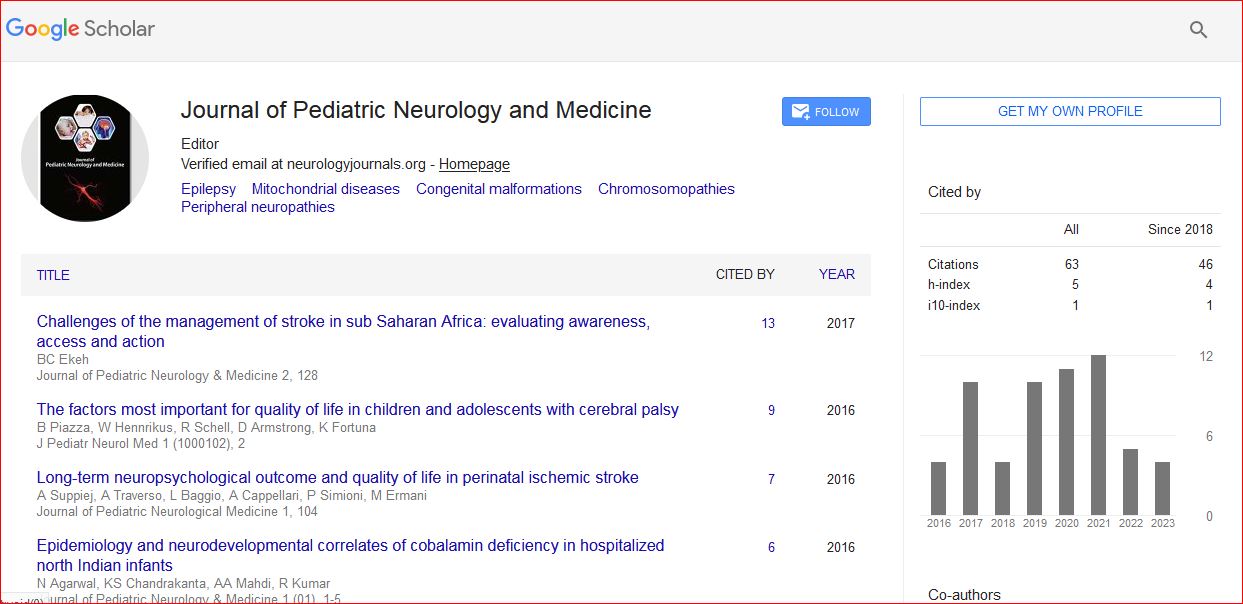
Journal of Pediatric Neurology and Medicine received 68 citations as per Google Scholar report