Opinion - (2025) Volume 11, Issue 3
Received: 02-Jun-2025, Manuscript No. jpnp-25-175494;
Editor assigned: 04-Jun-2025, Pre QC No. P-175494;
Reviewed: 18-Jun-2025, QC No. Q-175494;
Revised: 23-Jun-2025, Manuscript No. R-175494;
Published:
30-Jun-2025
, DOI: 10.37421/2472-0992.2025.11.366
Citation: Morgan, Grace L.. ”Network Pharmacology: Holistic Drug Discovery for Complex Diseases.” J Pharmacogn Nat Prod 11 (2025):366.
Copyright: © 2025 Morgan L. Grace This is an open-access article distributed under the terms of the Creative Commons Attribution License, which permits unrestricted use, distribution and reproduction in any medium, provided the original author and source are credited.
This article explores the fundamental principles of network pharmacology, illustrating its broad utility in drug discovery and development, especially for complex diseases. It discusses how the approach integrates omics data to identify multi-target interventions and predicts drug-target interactions, paving the way for personalized medicine.[1] This review highlights network pharmacology as a powerful strategy for tackling complex diseases. It emphasizes its role in identifying therapeutic targets and pathways by analyzing biological networks, moving beyond the traditional 'one target, one drug' paradigm to reveal synergistic drug combinations.[2] This piece details the application of network pharmacology in deciphering the mechanisms of Traditional Chinese Medicine (TCM). It shows how this approach can elucidate the multi-component, multi-target nature of TCM prescriptions, providing a scientific basis for their efficacy and modernization.[3] This article explores network pharmacology's role in precision medicine, from identifying individual patient responses at a molecular level to guiding clinical applications. It demonstrates how integrating patient-specific omics data with network analysis can personalize treatment strategies.[4] This review covers the latest advancements in network pharmacology, including new computational tools and databases. It outlines various applications across disease areas, while also addressing existing challenges like data integration and validation, and proposing future directions.[5] This study applies network pharmacology to investigate how Traditional Chinese Medicine (TCM) combats COVID-19. It identifies potential active compounds, their targets, and relevant pathways, shedding light on the multi-faceted therapeutic mechanisms of TCM in viral infections.[6] This article focuses on using network pharmacology to unravel the mechanisms of natural products in cancer therapy. It illustrates how this methodology can pinpoint multiple active components and their synergistic effects on various cancer-related targets and pathways, offering new insights for drug development.[7] This paper discusses how network pharmacology is applied to investigate the mechanisms of Chinese herbal medicine in treating cardiovascular diseases. It reveals the complex interactions between herbal components, their targets, and related signaling pathways, providing a scientific basis for their therapeutic effects.[8] This article explores the utility of network pharmacology in discovering and developing drugs for neurological disorders. It demonstrates how this approach can identify novel therapeutic targets, understand disease mechanisms, and reposition existing drugs by analyzing intricate brain networks.[9] This review examines network pharmacology's potential in drug discovery for inflammatory diseases. It highlights how the method can uncover multi-target strategies, predict drug efficacy, and reveal the underlying mechanisms of anti-inflammatory compounds by mapping complex inflammatory pathways.[10]
Network pharmacology has emerged as a fundamental and potent approach in drug discovery and development, particularly for addressing complex diseases. It integrates diverse omics data, such as genomics, proteomics, and metabolomics, to identify multi-target interventions and accurately predict drug-target interactions, thus laying the groundwork for personalized medicine [1]. This innovative strategy truly represents a paradigm shift, moving beyond the conventional 'one target, one drug' philosophy. By meticulously analyzing intricate biological networks, network pharmacology effectively pinpoints crucial therapeutic targets and pathways, ultimately revealing synergistic drug combinations essential for managing and treating complex conditions [2]. The field has seen remarkable advancements, including the development of sophisticated computational tools and comprehensive databases, which enable a broad spectrum of applications across various disease areas. However, persistent challenges like data integration, standardization, and experimental validation highlight the ongoing need for robust research and methodological refinement [5].
The scope of network pharmacology significantly extends to unraveling the intricate mechanisms of Traditional Chinese Medicine (TCM). It effectively elucidates the inherently multi-component and multi-target nature of TCM prescriptions, thereby providing a much-needed scientific basis for validating their efficacy and supporting their modernization [3]. A compelling demonstration of this application involves investigating how TCM intervenes in viral infections, such as COVID-19. Studies utilizing this network-based approach identify potential active compounds, their specific targets, and relevant biological pathways, offering profound insights into the multi-faceted therapeutic mechanisms of TCM in combating viral pathogens [6]. In a similar vein, network pharmacology is instrumental in researching the mechanisms of Chinese herbal medicine when applied to cardiovascular diseases. It reveals the complex interplay between various herbal components, their multitude of targets, and associated signaling pathways, consequently providing a solid scientific underpinning for their observed therapeutic effects [8].
Crucially, network pharmacology plays a pivotal role in the advancement of precision medicine. Its utility ranges from identifying unique individual patient responses at a molecular level to directly guiding clinical applications. The integration of patient-specific omics data with sophisticated network analysis allows for the development of highly personalized and effective treatment strategies, signifying a tailored approach to patient care [4]. Moreover, this methodology proves invaluable in deciphering the mechanisms of natural products, especially in the context of cancer therapy. It precisely pinpoints multiple active components within these products and clarifies their synergistic effects on various cancer-related targets and pathways, thereby offering new and promising insights for drug development in oncology [7].
The practical utility of network pharmacology extends further into the realm of discovering and developing novel drugs for neurological disorders. By analyzing intricate brain networks, this approach helps identify innovative therapeutic targets, enhance the understanding of complex disease mechanisms, and even facilitate the repositioning of existing drugs for new applications [9]. This remarkable capacity to map and interpret complex biological pathways is equally promising for drug discovery efforts focused on inflammatory diseases. The method adeptly uncovers multi-target strategies, accurately predicts drug efficacy, and thoroughly reveals the underlying mechanisms of anti-inflammatory compounds by systematically mapping complex inflammatory pathways, offering a comprehensive understanding of disease progression and intervention [10].
Collectively, the widespread application of network pharmacology across diverse disease areas underscores its transformative impact on modern pharmacology. It represents a powerful, holistic strategy for drug discovery, development, and understanding disease pathogenesis, moving towards more effective and personalized therapeutic interventions. Its ability to integrate vast amounts of biological data and identify complex interactions positions it as an indispensable tool for future medical research.
Network pharmacology stands out as a critical methodology for drug discovery and development, especially for complex diseases. It integrates omics data to identify multi-target interventions and predict drug-target interactions, fundamentally shifting towards personalized medicine. This strategy is highly effective in tackling complex diseases by identifying therapeutic targets and pathways through in-depth biological network analysis. It moves past the 'one target, one drug' model, uncovering synergistic drug combinations. The approach helps decode the intricate mechanisms of Traditional Chinese Medicine (TCM), revealing the multi-component and multi-target nature of its prescriptions and offering a scientific foundation for their effectiveness and modernization. It also contributes significantly to precision medicine, where it guides clinical applications by integrating patient-specific omics data with network analysis, customizing treatment strategies. There have been notable advancements, including the development of new computational tools and comprehensive databases. These outline broad applications across various disease areas, even as challenges like data integration and validation persist, prompting future research directions. Furthermore, network pharmacology illuminates how natural products function in cancer therapy, identifying multiple active components and their synergistic impacts on various cancer-related targets and pathways. Its utility extends to neurological disorders, where it aids in discovering novel therapeutic targets, understanding disease mechanisms, and repositioning existing drugs by analyzing intricate brain networks. The method also holds considerable promise in drug discovery for inflammatory diseases, revealing multi-target strategies and predicting the efficacy of anti-inflammatory compounds through the mapping of complex inflammatory pathways. Overall, it provides a holistic view, essential for modern pharmacology.
None
None
Indexed at, Google Scholar, Crossref
Indexed at, Google Scholar, Crossref
Indexed at, Google Scholar, Crossref
Indexed at, Google Scholar, Crossref
Indexed at, Google Scholar, Crossref
Indexed at, Google Scholar, Crossref
Indexed at, Google Scholar, Crossref
Indexed at, Google Scholar, Crossref
Indexed at, Google Scholar, Crossref
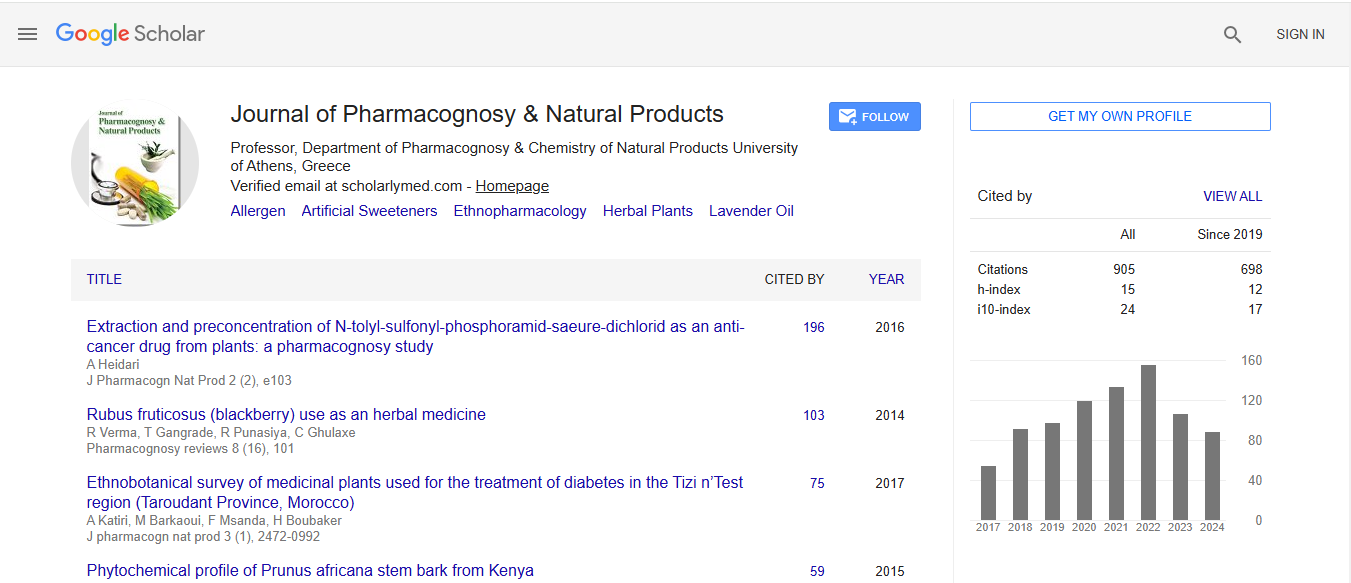
Journal of Pharmacognosy & Natural Products received 606 citations as per Google Scholar report