Brief Report - (2025) Volume 16, Issue 6
Received: 01-Dec-2025, Manuscript No. jmbd-25-168376;
Editor assigned: 03-Dec-2025, Pre QC No. P-168376;
Reviewed: 15-Dec-0025, QC No. Q-168376;
Revised: 22-Dec-2025, Manuscript No. R-168376;
Published:
29-Dec-2025
, DOI: 10.37421/2155-9929.2025.16.738
Citation: Park, Min-Jae. ”Epigenomic Biomarkers: Revolutionizing Personalized Medicine.” J Mol Biomark Diagn 16 (2025):738.
Copyright: © 2025 Park M. This is an open-access article distributed under the terms of the Creative Commons Attribution License, which permits unrestricted use, distribution
and reproduction in any medium, provided the original author and source are credited.
Epigenomic biomarkers, encompassing modifications to DNA methylation and histone profiles, are increasingly recognized for their significant diagnostic and prognostic value across a spectrum of diseases. These intricate molecular signatures possess the capacity to accurately reflect disease states and monitor their progression, thereby offering a less invasive and often more sensitive alternative to conventional diagnostic methods. The field of Human Genetics has been particularly instrumental in driving the exploration and understanding of these vital markers. [1] DNA methylation patterns represent a particularly promising avenue for the early detection of diseases and the precise stratification of patients. Specific methylation profiles identified within circulating cell-free DNA can function as non-invasive biomarkers for a range of conditions, including various cancers and neurodegenerative diseases, which is advantageous for facilitating timely therapeutic interventions. [2] Histone modifications are recognized for their critical role in the regulation of gene expression and are implicated in the pathogenesis of numerous diseases. Aberrant histone marks can serve as valuable diagnostic indicators, especially within the context of inflammatory and autoimmune disorders, highlighting their potential in understanding disease mechanisms. [3] Beyond DNA and histone modifications, non-coding RNAs, such as microRNAs and long non-coding RNAs, are also emerging as significant epigenomic biomarkers. Their dysregulation has been associated with the development and progression of diseases, presenting opportunities for early detection and the identification of therapeutic targets. [4] The comprehensive integration of multi-omic data, which crucially includes epigenomic information, is fundamental to the development of robust and effective diagnostic strategies. By combining data from methylation, histone modifications, and transcriptomics, the accuracy and reliability of disease biomarkers can be significantly enhanced. [5] Epigenetic alterations are considered key drivers in the process of tumorigenesis and can be strategically exploited for the early detection of cancer. Circulating tumor DNA methylation profiles are especially promising for non-invasive diagnostics and for the effective monitoring of treatment response, offering new avenues for cancer management. [6] The profound role of epigenetics in neurological disorders is attracting considerable attention within the scientific community. Documented changes in DNA methylation and histone acetylation can profoundly impact neuronal function and survival, positioning these epigenetic modifications as potential biomarkers for debilitating conditions such as Alzheimer's and Parkinson's disease. [7] Despite the immense potential, significant challenges persist in the clinical translation of epigenomic biomarkers. These hurdles include the critical need for standardization of assays and rigorous validation in extensive patient cohorts. Overcoming these obstacles is an essential prerequisite for their widespread adoption in routine clinical diagnostic settings. [8] The continuous development of high-throughput sequencing technologies has dramatically advanced our capacity to comprehensively profile epigenomes. This technological progress has unlocked new possibilities for the discovery of novel epigenomic biomarkers that promise improved diagnostic accuracy and utility. [9] Collectively, epigenomic biomarkers are poised to fundamentally revolutionize disease diagnosis by providing an unprecedented window into cellular states and underlying disease mechanisms. Their multifaceted applications, ranging from early detection and risk stratification to monitoring therapeutic response, underscore their escalating importance in the era of personalized medicine. [10]
Epigenomic biomarkers, such as DNA methylation and histone modifications, are increasingly recognized for their diagnostic and prognostic potential in various diseases. These molecular signatures can reflect disease states and progression, offering a less invasive and more sensitive approach compared to traditional methods. The department of Human Genetics has been instrumental in exploring these markers. [1] DNA methylation patterns offer a promising avenue for early disease detection and patient stratification. Specific methylation profiles in circulating cell-free DNA can serve as non-invasive biomarkers for conditions like cancer and neurodegenerative diseases, providing an advantage for early intervention. [2] Histone modifications play a crucial role in regulating gene expression and are implicated in the pathogenesis of various diseases. Aberrant histone marks can serve as diagnostic indicators, particularly in the context of inflammatory and autoimmune disorders. [3] Non-coding RNAs, including microRNAs and long non-coding RNAs, are also emerging as significant epigenomic biomarkers. Their dysregulation is associated with disease development and progression, offering potential for early detection and therapeutic targeting. [4] The integration of multi-omic data, including epigenomic information, is crucial for developing comprehensive diagnostic strategies. Combining methylation, histone modification, and transcriptomic data can enhance the accuracy and reliability of disease biomarkers. [5] Epigenetic alterations are key drivers of tumorigenesis and can be exploited for early cancer detection. Circulating tumor DNA methylation profiles are particularly promising for non-invasive diagnostics and monitoring treatment response. [6] The role of epigenetics in neurological disorders is gaining significant attention. Changes in DNA methylation and histone acetylation can impact neuronal function and survival, making them potential biomarkers for conditions like Alzheimer's and Parkinson's disease. [7] Challenges remain in the clinical translation of epigenomic biomarkers, including standardization of assays and validation in large patient cohorts. Overcoming these hurdles is essential for their widespread adoption in diagnostic settings. [8] The development of high-throughput sequencing technologies has significantly advanced our ability to profile epigenomes. This has opened up new possibilities for identifying novel epigenomic biomarkers with improved diagnostic accuracy. [9] Epigenomic biomarkers are poised to revolutionize disease diagnosis by offering a window into cellular states and disease mechanisms. Their application spans from early detection and risk stratification to monitoring therapeutic response, underscoring their growing importance in personalized medicine. [10]
Epigenomic biomarkers, including DNA methylation, histone modifications, and non-coding RNAs, are emerging as powerful tools for disease diagnosis and prognosis. These molecular signatures offer less invasive and more sensitive alternatives to traditional methods. DNA methylation patterns in cell-free DNA show promise for early detection of cancer and neurodegenerative diseases. Histone modifications and non-coding RNAs are also implicated in disease pathogenesis and progression. Integrating multi-omic data, particularly epigenomic information, enhances biomarker accuracy. While challenges in clinical translation exist, advancements in sequencing technologies are facilitating the discovery of novel epigenomic biomarkers. These biomarkers are set to revolutionize personalized medicine by enabling early detection, risk stratification, and monitoring of treatment response.
None
None
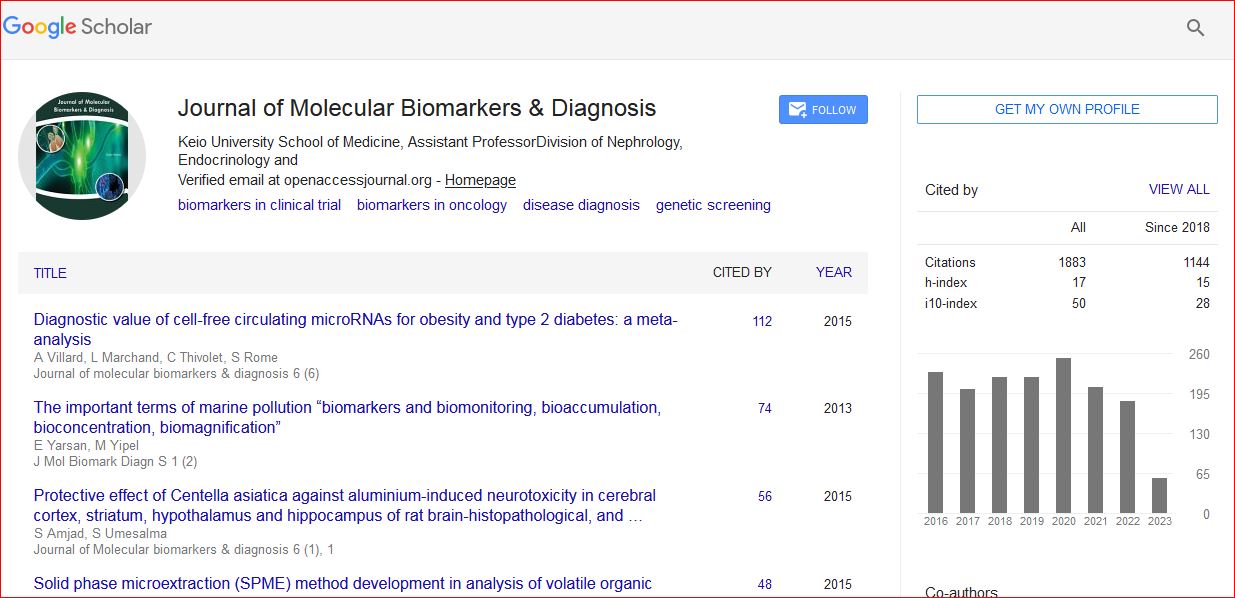
Journal of Molecular Biomarkers & Diagnosis received 2054 citations as per Google Scholar report