Perspective - (2025) Volume 16, Issue 2
Received: 01-Mar-2025, Manuscript No. jhmi-26-178827;
Editor assigned: 03-Mar-2025, Pre QC No. P-178827;
Reviewed: 17-Mar-2025, QC No. Q-178827;
Revised: 24-Mar-2025, Manuscript No. R-178827;
Published:
31-Mar-2025
, DOI: 10.37421/2157-7420.2025.16.586
Citation: Wilson, Andrew C.. ”Navigating Health Informatics: Ethics, Privacy and Governance.” J Health Med Informat 16 (2025):586.
Copyright: © 2025 Wilson C. Andrew This is an open-access article distributed under the terms of the Creative Commons Attribution License, which permits unrestricted use, distribution and reproduction in any medium, provided the original author and source are credited.
The rapid advancement of health informatics has brought about unprecedented opportunities for improving patient care, streamlining healthcare operations, and accelerating medical research. This progress, however, is intrinsically linked to the responsible management of sensitive health data. The ethical and privacy considerations surrounding health informatics systems are paramount, demanding a comprehensive understanding of the challenges and the development of robust governance frameworks. The increasing reliance on digital health data underscores the necessity of safeguarding patient confidentiality, ensuring ethical data use, and establishing strong oversight mechanisms. Proactive strategies and thoughtful policy development are crucial for fostering trust and promoting responsible innovation within this dynamic field [1].
The integration of artificial intelligence (AI) into healthcare informatics presents a transformative potential, yet it also introduces significant ethical complexities. A primary concern is the risk of algorithmic bias, which can inadvertently perpetuate or even exacerbate existing health disparities among patient populations. To mitigate these risks, transparency in the development and deployment of AI systems is essential. Furthermore, establishing clear mechanisms for accountability and implementing continuous ethical evaluation are vital steps to ensure that AI contributes to equitable patient care rather than undermining it [2].
As the healthcare landscape becomes increasingly interconnected, the regulatory environment for health data governance is also evolving. Challenges arise particularly from cross-border data flows, necessitating a global perspective on data management. The call for harmonized international standards reflects the growing recognition that consistent and adaptable governance models are needed. These models must strike a delicate balance, enabling data innovation and its associated benefits while upholding stringent privacy protections for individuals [3].
The secondary analysis of electronic health records (EHRs) holds immense promise for advancing research and public health initiatives. However, the use of this data is fraught with ethical considerations, particularly concerning patient privacy. A critical aspect of this domain involves finding the right equilibrium between facilitating valuable research that can lead to better health outcomes and rigorously upholding individual patient privacy rights. Strategies such as de-identification and the implementation of robust consent mechanisms are key to navigating this complex ethical terrain [4].
Big data analytics are revolutionizing health informatics, offering deep insights into population health trends, disease patterns, and treatment efficacy. Yet, the sheer volume and complexity of this data present significant governance challenges. Clear policies are indispensable regarding data ownership, access, and stewardship. A multi-stakeholder approach is vital for developing effective governance frameworks that can ensure both data integrity and the responsible utilization of these powerful datasets for the betterment of health [5].
The burgeoning field of personalized medicine relies heavily on the availability of patient data to tailor treatments to individual needs. This reliance necessitates careful consideration of the ethical implications of patient data sharing. Ensuring informed consent and maintaining robust data security are paramount concerns. While shared data can unlock significant advancements in treatment, the potential risks to individual privacy must be thoroughly understood and mitigated [6].
Privacy-preserving technologies are emerging as critical tools for enabling the utilization of health data without compromising individual privacy. Techniques such as differential privacy and federated learning offer innovative solutions for data analysis in health informatics. These technologies provide a means to conduct valuable research and derive insights while effectively protecting sensitive personal information, showcasing their significant applicability to secure health data utilization [7].
Wearable health devices have become ubiquitous, generating vast amounts of personal health data that offer unique opportunities for health monitoring and management. However, this proliferation of data also raises significant ethical challenges and governance needs. Transparent data collection practices and clear, understandable user agreements are essential to ensure the responsible use of this data and to adequately protect individual privacy [8].
The application of predictive analytics in healthcare holds the potential to anticipate health risks, optimize resource allocation, and improve diagnostic accuracy. However, the ethical implications of using patient data for these purposes are substantial. Concerns about potential biases within predictive models and the critical need for robust validation processes must be addressed. Adherence to ethical guidelines is crucial to ensure that predictive models are fair, accurate, and ultimately beneficial to all patient populations [9].
Health information exchanges (HIEs) are vital infrastructure for improving care coordination and patient outcomes through the secure sharing of health data among providers. However, establishing effective governance models for HIEs presents challenges related to interoperability, data security, and patient consent. Flexible yet secure governance structures are needed to facilitate efficient and ethical data sharing, ultimately enhancing the quality and accessibility of healthcare services [10].
The foundational principles of health informatics are increasingly being shaped by the imperative to address the critical intersection of privacy, ethics, and governance within digital health systems. This involves a deep dive into the growing dependence on electronic health records and the inherent complexities of protecting patient confidentiality, promoting ethical data usage, and instituting comprehensive governance structures. The authors strongly advocate for the adoption of proactive strategies and the formulation of pertinent policies to cultivate trust and foster responsible advancements in the field of health informatics [1].
Examining the ethical dimensions of artificial intelligence (AI) within health informatics reveals significant concerns, particularly regarding algorithmic bias and its potential to widen health disparities. Consequently, there is an urgent demand for transparency in AI development and deployment processes. Moreover, the establishment of robust accountability frameworks and ongoing ethical evaluations is crucial to guarantee equitable care for all patients [2].
This research offers an insightful analysis of the evolving regulatory framework governing health data. It highlights the multifaceted challenges posed by international data transfers and underscores the pressing need for globally standardized regulations. The study emphasizes the importance of developing adaptable governance models that can effectively reconcile the drive for data innovation with the stringent requirements for privacy protection [3].
The ethical landscape surrounding the secondary analysis of electronic health records (EHRs) for research and public health purposes is complex. This area of study necessitates a careful calibration between facilitating groundbreaking research and steadfastly upholding the privacy rights of patients. The implementation of de-identification techniques and the establishment of comprehensive consent mechanisms are highlighted as essential practices [4].
The governance of big data within health informatics presents a distinct set of challenges, emphasizing the requirement for clearly defined policies concerning data ownership, access protocols, and stewardship responsibilities. The authors argue for a collaborative, multi-stakeholder approach in the development of governance frameworks to ensure the integrity of data and its responsible application [5].
The ethical considerations associated with patient data sharing, particularly for the advancement of personalized medicine, are a significant focus. This includes the critical importance of obtaining informed consent and implementing rigorous data security measures. The potential benefits for treatment advancement are weighed against the inherent risks to individual privacy, necessitating a balanced approach [6].
Privacy-preserving technologies, such as differential privacy and federated learning, are explored for their capacity to enable data analysis in health informatics while rigorously safeguarding individual information. This study provides a comprehensive review of these advanced techniques and their practical applications in ensuring secure health data utilization [7].
The ethical considerations and governance requirements related to wearable health devices, which generate substantial personal health data, are meticulously examined. The authors stress the necessity of transparent data collection methodologies and unambiguous user agreements to ensure data privacy and responsible usage [8].
The ethical implications of utilizing patient data for predictive analytics in healthcare are thoroughly investigated, including the risks of embedded biases and the need for rigorous validation processes. The paper advocates for the development and adherence to ethical guidelines to ensure that predictive models are fair, accurate, and ultimately beneficial to all patient demographics [9].
Governance models for health information exchanges (HIEs) are explored, focusing on the critical issues of interoperability, data security, and the crucial aspect of patient consent. The article advocates for the implementation of governance structures that are both flexible and secure, thereby facilitating efficient and ethical data sharing among healthcare providers [10].
This collection of research addresses the multifaceted ethical, privacy, and governance challenges in health informatics. It highlights the increasing reliance on digital health data and the need for robust frameworks to protect patient confidentiality. Key areas explored include the ethical implications of artificial intelligence and algorithmic bias, the complexities of global health data governance, and the responsible use of electronic health records for secondary analysis. The research also covers governance models for big data, ethical considerations in patient data sharing for personalized medicine, and the role of privacy-preserving technologies. Furthermore, it examines the ethical challenges of wearable health devices and predictive analytics, alongside governance models for health information exchanges. The overarching theme is the necessity of balancing data innovation with stringent privacy protections and ensuring equitable patient care.
None
None
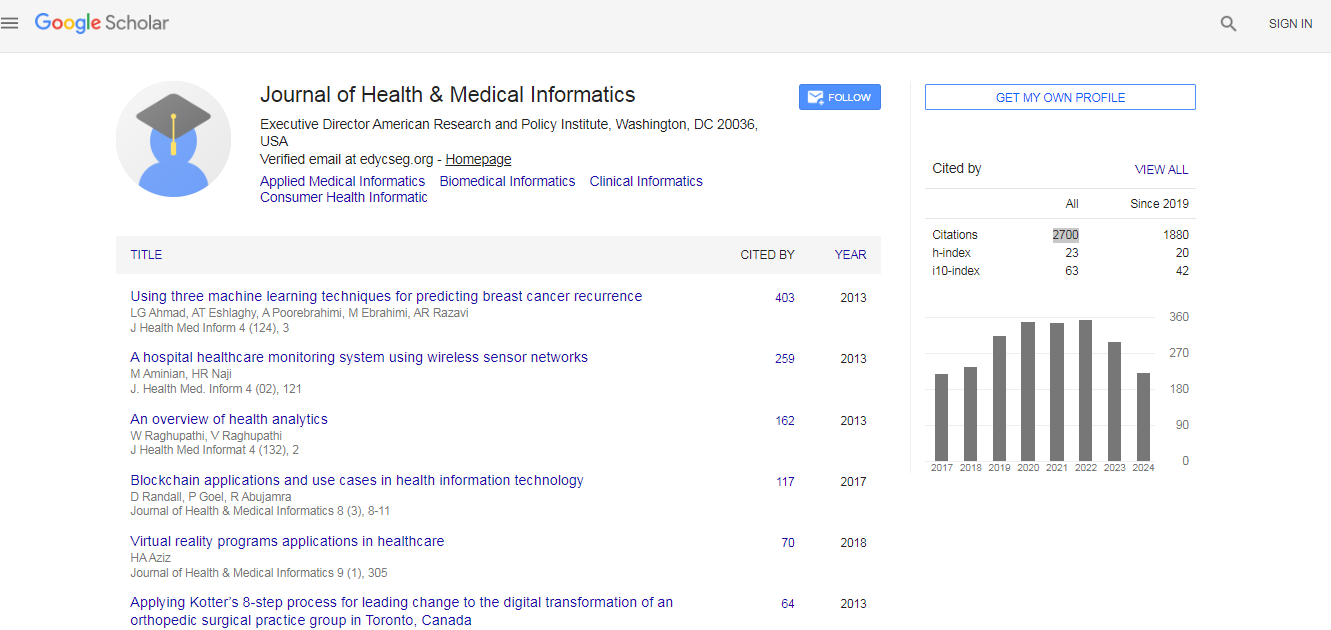
Journal of Health & Medical Informatics received 2700 citations as per Google Scholar report