Brief Report - (2025) Volume 16, Issue 2
Received: 01-Mar-2025, Manuscript No. jhmi-26-178819;
Editor assigned: 03-Mar-2025, Pre QC No. P-178819;
Reviewed: 17-Mar-2025, QC No. Q-178819;
Revised: 24-Mar-2025, Manuscript No. R-178819;
Published:
31-Mar-2025
, DOI: 10.37421/2157-7420.2025.16.581
Citation: Nair, Priya S.. ”Navigating Health Data Interoperability: Challenges and Solutions.” J Health Med Informat 16 (2025):581.
Copyright: © 2025 Nair S. Priya This is an open-access article distributed under the terms of the Creative Commons Attribution License, which permits unrestricted use, distribution and reproduction in any medium, provided the original author and source are credited.
Interoperability remains a significant hurdle in health information exchange (HIE) systems, with key challenges stemming from the lack of standardized terminologies, diverse data formats and structures across different healthcare providers, and varying legal and regulatory frameworks. Addressing these issues requires a multi-faceted approach, including the adoption of universal data standards like FHIR, robust data governance policies, and collaborative efforts between technology vendors, healthcare organizations, and policymakers [1].
The complexity of healthcare data, encompassing clinical notes, imaging, and genomic information, presents substantial interoperability challenges. Semantic interoperability, which ensures that data is not only exchanged but also understood and usable by different systems, is particularly difficult to achieve. Solutions often involve advanced natural language processing and machine learning techniques to extract and standardize meaning from unstructured text [2].
Technical barriers to HIE interoperability include the heterogeneity of IT infrastructures, legacy systems, and the lack of common data models. Implementing HL7 FHIR (Fast Healthcare Interoperability Resources) has emerged as a critical step towards overcoming these technical limitations by providing a modern, web-based API standard for data exchange [3].
Organizational and governance challenges are substantial. Different healthcare organizations have varying priorities, resources, and willingness to share data. Establishing trust, clear data ownership, and effective governance frameworks are crucial for successful HIE initiatives, requiring strong leadership and stakeholder engagement [4].
Privacy and security concerns remain paramount. Ensuring patient data confidentiality and integrity during exchange is critical, necessitating robust security protocols, compliance with regulations like HIPAA, and transparent data access policies. Encryption, access controls, and audit trails are essential components [5].
The development of national and regional interoperability frameworks is crucial for setting standards and facilitating broader HIE. These frameworks often involve government initiatives to promote data sharing and the creation of connected health ecosystems, aiming to improve patient care coordination and public health outcomes [6].
Measuring the impact and effectiveness of HIE systems is an ongoing challenge. Without clear metrics and standardized evaluation methods, it's difficult to demonstrate the return on investment and identify areas for improvement in interoperability efforts [7].
The integration of emerging technologies like blockchain and artificial intelligence holds promise for enhancing HIE interoperability. Blockchain can offer secure and transparent data sharing, while AI can improve data analysis and extract meaningful insights from disparate health records [8].
Interoperability challenges are particularly acute in the context of public health surveillance and emergency response. The ability to rapidly and reliably exchange data across different jurisdictions and systems is critical for timely disease tracking and intervention [9].
Workforce training and education are essential for addressing interoperability. Healthcare professionals need to understand the principles of HIE, the use of standardized data, and the importance of data quality to effectively utilize and contribute to interoperable systems [10].
Interoperability in health information exchange (HIE) systems faces significant hurdles, primarily due to the absence of standardized terminologies, varied data formats and structures across healthcare providers, and divergent legal and regulatory landscapes. Effective solutions necessitate a comprehensive strategy, including the adoption of universal data standards such as FHIR, the implementation of strong data governance policies, and robust collaboration among technology vendors, healthcare organizations, and policymakers [1].
The inherent complexity of healthcare data, spanning clinical notes, imaging, and genomic information, poses considerable interoperability challenges. Achieving semantic interoperability, which ensures not just data exchange but also its comprehension and usability across different systems, is particularly demanding. Advanced natural language processing and machine learning techniques are frequently employed to extract and standardize meaning from unstructured text data [2].
Technical impediments to HIE interoperability are rooted in the heterogeneity of IT infrastructures, the prevalence of legacy systems, and the absence of common data models. The adoption of HL7 FHIR (Fast Healthcare Interoperability Resources) has become a pivotal development in overcoming these technical limitations by offering a contemporary, web-based API standard for efficient data exchange [3].
Organizational and governance factors present substantial obstacles. Healthcare organizations differ in their priorities, available resources, and willingness to share data. Cultivating trust, defining clear data ownership, and establishing effective governance frameworks are indispensable for the success of HIE initiatives, requiring dedicated leadership and broad stakeholder engagement [4].
Privacy and security considerations are of utmost importance. Safeguarding patient data confidentiality and integrity during exchange is critical, demanding stringent security protocols, adherence to regulations such as HIPAA, and transparent data access policies. Essential components include encryption, access controls, and audit trails [5].
The establishment of national and regional interoperability frameworks is fundamental to setting standards and enabling widespread HIE. These frameworks often involve governmental initiatives aimed at promoting data sharing and fostering connected health ecosystems to enhance patient care coordination and improve public health outcomes [6].
A persistent challenge lies in measuring the impact and effectiveness of HIE systems. The absence of clear metrics and standardized evaluation methodologies complicates the demonstration of return on investment and the identification of areas ripe for improvement in interoperability efforts [7].
Emerging technologies such as blockchain and artificial intelligence offer promising avenues for bolstering HIE interoperability. Blockchain technology can facilitate secure and transparent data sharing, while AI can enhance data analysis capabilities and enable the extraction of valuable insights from diverse health records [8].
Interoperability challenges are particularly pronounced within public health surveillance and emergency response contexts. The capacity for rapid and dependable data exchange across disparate jurisdictions and systems is crucial for effective disease tracking and timely intervention [9].
Workforce training and education are vital components in addressing interoperability challenges. Healthcare professionals must acquire a thorough understanding of HIE principles, the utilization of standardized data, and the significance of data quality to effectively engage with and contribute to interoperable systems [10].
Interoperability in health information exchange (HIE) systems is hindered by non-standardized terminologies, diverse data formats, and varying regulations. Addressing these requires adopting standards like FHIR, implementing robust governance, and fostering collaboration. Semantic interoperability is challenging due to complex data, often necessitating NLP and ML solutions. Technical barriers include heterogeneous IT infrastructures and legacy systems, with FHIR offering a modern API standard. Organizational factors like differing priorities and willingness to share data, alongside privacy and security concerns, are critical. National frameworks and government initiatives aim to promote data sharing and connected health ecosystems. Measuring HIE effectiveness remains difficult without standardized metrics. Emerging technologies like blockchain and AI show potential for enhancing secure data sharing and analysis. Interoperability is especially critical for public health surveillance and emergency response. Finally, workforce training on HIE principles and data quality is essential.
None
None
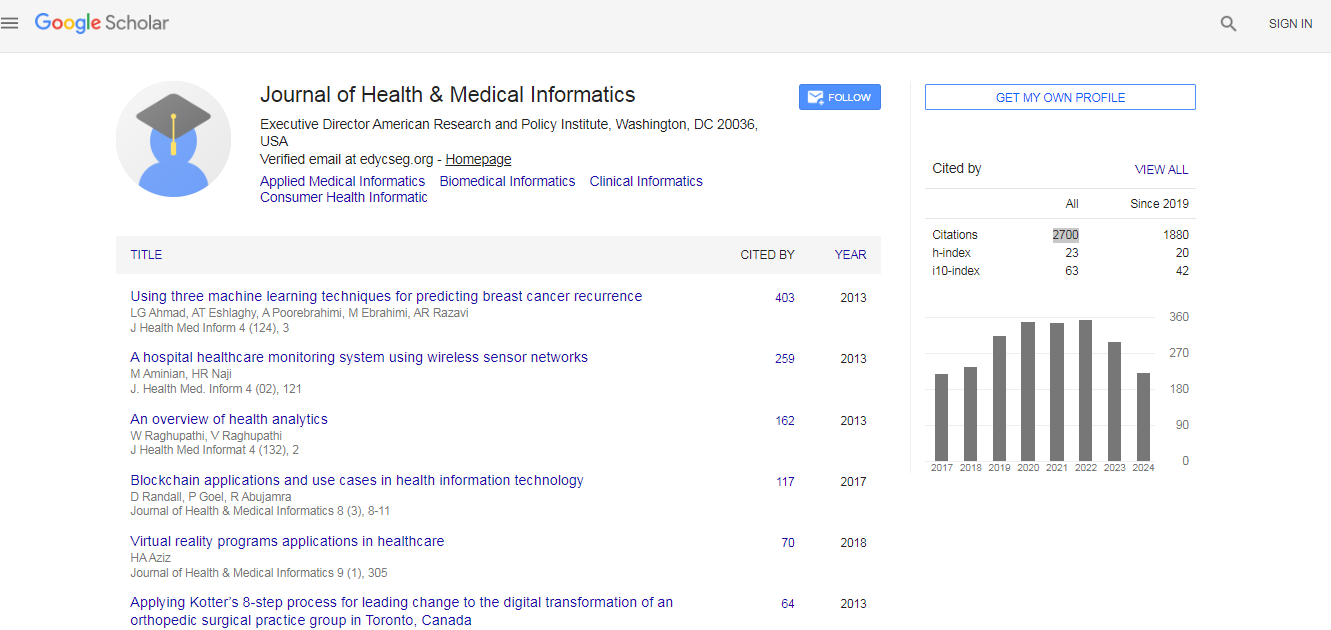
Journal of Health & Medical Informatics received 2700 citations as per Google Scholar report