Short Communication - (2025) Volume 14, Issue 5
Received: 02-Sep-2025, Manuscript No. pbt-25-173778;
Editor assigned: 04-Sep-2025, Pre QC No. P-173778;
Reviewed: 18-Sep-2025, QC No. Q-173778;
Revised: 23-Sep-2025, Manuscript No. R-173778;
Published:
30-Sep-2025
, DOI: 10.37421/2167-7689.2025.14.507
Citation: Grant, Chloe. ”Navigating Evolving MedTech & Pharma Regulations.” Pharmaceut Reg Affairs 14 (2025):507.
Copyright: © 2025 Grant C. This is an open-access article distributed under the terms of the Creative Commons Attribution License, which permits unrestricted use, distribution
and reproduction in any medium, provided the original author and source are credited.
Navigating digital health technologies demands a clear regulatory strategy. The landscape is complex, merging software, data, and medical devices. Understanding global variations, real-world data integration, and cybersecurity is crucial for timely market access and patient safety[1].
Integrating Artificial Intelligence (AI) into drug discovery presents unique regulatory hurdles. Stakeholders must consider data privacy, algorithm transparency, validation standards, and ethical implications. A proactive regulatory strategy is essential to leverage AI's potential while ensuring safety and efficacy[2].
The EU Medical Device Regulation (MDR) has significantly reshaped the regulatory landscape for medical devices, bringing stricter requirements for clinical evidence, post-market surveillance, and unique device identification. Manufacturers must strategically adapt their processes to ensure compliance and maintain market access[3].
Real-world evidence (RWE) is increasingly vital for regulatory decision-making, offering insights beyond traditional clinical trials. Developing a robust RWE strategy requires careful consideration of data quality, analytical methods, and regulatory acceptance criteria to support product development and market access[4].
Developing orphan drugs presents unique regulatory considerations due to small patient populations and limited clinical data. Effective strategies involve early engagement with regulatory bodies, leveraging expedited pathways, and adaptive trial designs to bring treatments for rare diseases to patients efficiently[5].
Developing biosimilars requires a sophisticated regulatory strategy, focusing on demonstrating similarity to reference products through comprehensive comparability studies. Understanding the nuanced guidelines of different regulatory bodies, like the Food and Drug Administration (FDA) and European Medicines Agency (EMA), is key to successful market entry[6].
Gene therapies represent a paradigm shift in medicine, necessitating unique regulatory strategies. Ensuring product quality, patient safety, and long-term efficacy requires careful consideration of manufacturing processes, clinical trial design, and post-market surveillance in a rapidly evolving scientific field[7].
Combination products, which merge drugs, devices, and biologics, require intricate regulatory strategies due to their hybrid nature. Harmonizing global guidelines and addressing jurisdictional complexities are critical for efficient development and market approval[8].
Advanced Therapy Medicinal Products (ATMPs), encompassing gene, cell, and tissue-engineered products, present complex regulatory challenges due to their innovative nature. A successful regulatory strategy in Europe involves early scientific advice, robust quality control, and adaptive clinical development to meet evolving guidelines and accelerate patient access[9].
Software as a Medical Device (SaMD) demands distinct regulatory strategies compared to traditional hardware. Key considerations include software lifecycle management, data security, clinical validation, and navigating classification differences between major regulatory bodies to ensure patient safety and market compliance[10].
The regulatory landscape for digital health technologies is inherently complex, demanding a clear and adaptable strategy. This complexity arises from the merging of software, data, and traditional medical devices. Critical elements for navigating this space include understanding global variations in regulatory requirements, effectively integrating real-world data, and ensuring robust cybersecurity measures. These considerations are paramount for achieving timely market access and guaranteeing patient safety [1]. In parallel, Software as a Medical Device (SaMD) calls for distinct regulatory strategies, differing significantly from those applied to traditional hardware. Essential factors here encompass comprehensive software lifecycle management, rigorous data security protocols, thorough clinical validation, and a nuanced understanding of classification differences across major regulatory bodies to ensure both patient safety and market compliance [10]. Similarly, integrating Artificial Intelligence (AI) into drug discovery introduces its own unique set of regulatory hurdles. Stakeholders must carefully consider issues such as data privacy, the transparency of algorithms, establishing clear validation standards, and addressing broader ethical implications. A forward-thinking and proactive regulatory strategy is absolutely essential to effectively leverage AI's immense potential while simultaneously ensuring both the safety and efficacy of new drug developments [2].
Beyond these cutting-edge innovations, traditional medical devices have also seen significant regulatory evolution. The European Union Medical Device Regulation (EU MDR) serves as a prime example, having profoundly reshaped the regulatory landscape for medical devices across Europe. This regulation imposes much stricter requirements concerning clinical evidence, mandating more rigorous post-market surveillance, and introducing enhanced unique device identification systems. As a direct consequence, manufacturers are compelled to strategically adapt their operational processes and quality management systems to ensure full compliance and, critically, to maintain market access within the EU [3].
Real-World Evidence (RWE) is increasingly recognized as a vital component for regulatory decision-making, offering valuable insights that often extend beyond the scope of traditional clinical trials. Crafting a robust RWE strategy requires meticulous consideration of data quality, selecting appropriate analytical methods, and understanding the specific regulatory acceptance criteria. All these elements are crucial for effectively supporting product development and facilitating market access [4]. Separately, the development of orphan drugs presents its own distinct regulatory considerations, primarily due to the inherently small patient populations involved and the often-limited availability of clinical data. To overcome these challenges, effective strategies typically involve early and proactive engagement with regulatory bodies, judiciously leveraging expedited review pathways, and employing adaptive trial designs. This approach aims to efficiently bring much-needed treatments for rare diseases to patients [5].
The development pathway for biosimilars demands a sophisticated and precise regulatory strategy. The core objective here is to clearly demonstrate similarity to established reference products through comprehensive and rigorous comparability studies. A deep understanding of the nuanced guidelines issued by various regulatory bodies, such as the Food and Drug Administration (FDA) in the US and the European Medicines Agency (EMA) in Europe, is absolutely critical for achieving successful market entry [6]. Meanwhile, gene therapies represent a true paradigm shift in modern medicine, consequently necessitating highly unique and tailored regulatory strategies. Ensuring paramount product quality, unwavering patient safety, and demonstrable long-term efficacy requires careful consideration of advanced manufacturing processes, innovative clinical trial designs, and robust post-market surveillance programs within this rapidly evolving scientific field [7]. Moreover, Advanced Therapy Medicinal Products (ATMPs), an umbrella term encompassing gene, cell, and tissue-engineered products, pose complex regulatory challenges precisely because of their groundbreaking and innovative nature. In a European context, a successful regulatory strategy for ATMPs often involves seeking early scientific advice, implementing stringent quality control measures, and adopting adaptive clinical development approaches to meet evolving guidelines and ultimately accelerate patient access to these transformative therapies [9].
Finally, combination products, defined by their merger of drugs, devices, and biologics, inherently require intricate regulatory strategies due to their hybrid nature and multi-component complexity. A significant challenge in this area involves harmonizing the often-disparate global guidelines and effectively addressing the jurisdictional complexities that arise from their multi-faceted composition. Successfully navigating these aspects is absolutely critical for the efficient development, streamlined review, and ultimate market approval of these innovative, integrated products [8].
The regulatory landscape across the medical and pharmaceutical sectors is undergoing rapid transformation, driven by innovative technologies and complex product categories. Digital health technologies, including Software as a Medical Device (SaMD), demand specific regulatory strategies focused on cybersecurity, data integration, and clinical validation for safe market access. Artificial Intelligence (AI) in drug discovery introduces hurdles around data privacy, algorithm transparency, and ethical considerations, necessitating proactive regulatory planning. The European Union Medical Device Regulation (EU MDR) has introduced stricter requirements for medical devices, emphasizing clinical evidence and post-market surveillance. Real-World Evidence (RWE) is increasingly important for regulatory decision-making, requiring careful attention to data quality and analytical methods. Developing orphan drugs involves unique challenges due to small patient populations, often requiring early regulatory engagement and adaptive trial designs. Biosimilars call for sophisticated strategies to demonstrate similarity to reference products through comparability studies. Gene therapies represent a new frontier, needing careful consideration of manufacturing, clinical trial design, and post-market surveillance to ensure product quality and patient safety. Advanced Therapy Medicinal Products (ATMPs) present complex challenges in Europe, often benefiting from early scientific advice and adaptive clinical development. Lastly, combination products, merging drugs, devices, and biologics, require intricate strategies to harmonize global guidelines and manage jurisdictional complexities. Across all these areas, strategic adaptation, adherence to evolving guidelines, and a strong focus on patient safety are paramount.
None
None
1. Ryan GL, Suraj KS, Abigail MJ. "Regulatory Pathways for Digital Health Technologies: Navigating the Evolving Landscape".Front Digit Health 5 (2023):1165183.
Indexed at, Google Scholar, Crossref
2. Agnes SL, Brenda GL, Adeline JSP. "Artificial intelligence in drug discovery and development: regulatory challenges and opportunities".Br J Pharmacol 180 (2023):2686-2703.
Indexed at, Google Scholar, Crossref
3. Sapna S, Anish A, Pushpendra KS. "Implementing the EU Medical Device Regulation (MDR) 2017/745: Challenges and Opportunities for Manufacturers".J Med Syst 45 (2021):71.
Indexed at, Google Scholar, Crossref
4. Kok MT, Jeremy HA, Ping CHL. "Real-World Evidence in Regulatory Decision-Making: Challenges and Opportunities for Drug Development".Pharmaceutics 14 (2022):638.
Indexed at, Google Scholar, Crossref
5. Nousheen MK, Raj KS, Akhilesh K. "Regulatory Pathways for Orphan Drug Development: A Global Perspective on Challenges and Strategies".J Clin Pharm Ther 45 (2020):1215-1223.
Indexed at, Google Scholar, Crossref
6. Jun MSL, Sung HK, Ha YP. "Regulatory Strategies for Biosimilar Development and Approval: A Comparative Analysis Across Major Jurisdictions".Front Pharmacol 12 (2021):722607.
Indexed at, Google Scholar, Crossref
7. Akanksha S, Rajeev BV, Preeti S. "Navigating the Regulatory Landscape for Gene Therapy Products: Challenges and Opportunities".Curr Gene Ther 22 (2022):219-228.
Indexed at, Google Scholar, Crossref
8. Surendra KG, Monika K, Aditi S. "Regulatory Framework for Combination Products: A Global Perspective on Challenges and Harmonization Efforts".AAPS PharmSciTech 20 (2019):161.
Indexed at, Google Scholar, Crossref
9. Smita S, Parul S, Karan S. "Regulatory Strategy for Advanced Therapy Medicinal Products (ATMPs): A European Perspective".J Pharm Sci 112 (2023):3009-3023.
Indexed at, Google Scholar, Crossref
10. Baptiste B, Pedro MSES, Sofia JTEF. "Regulatory challenges of software as a medical device (SaMD) in Europe and the USA".J Med Internet Res 23 (2021):e23743.
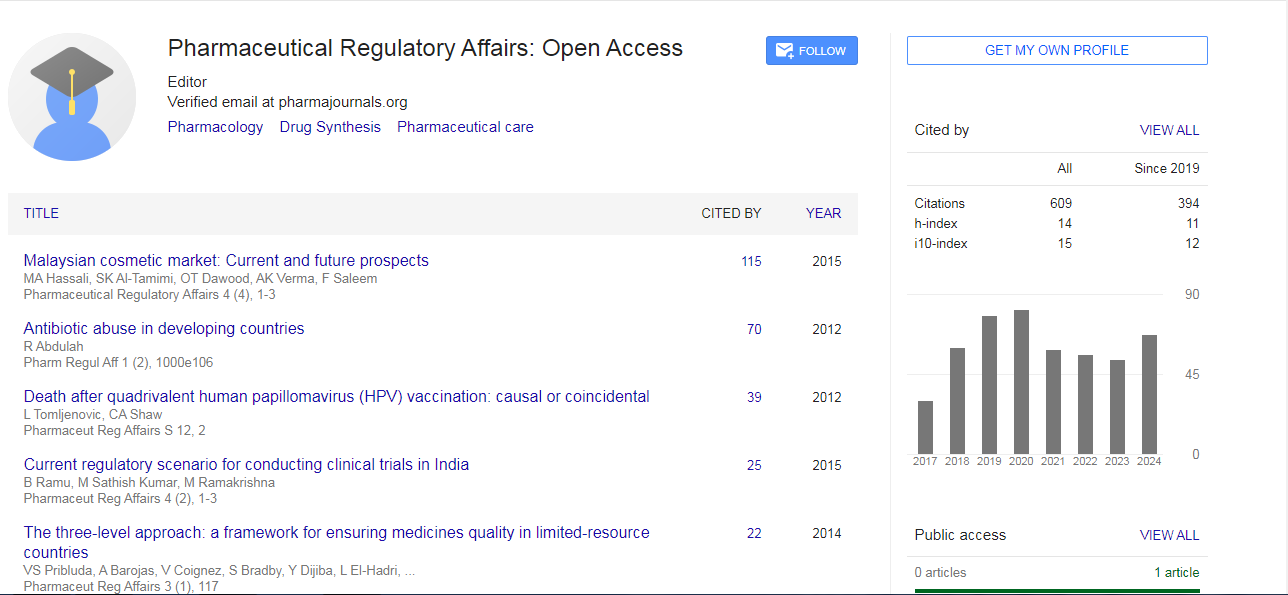
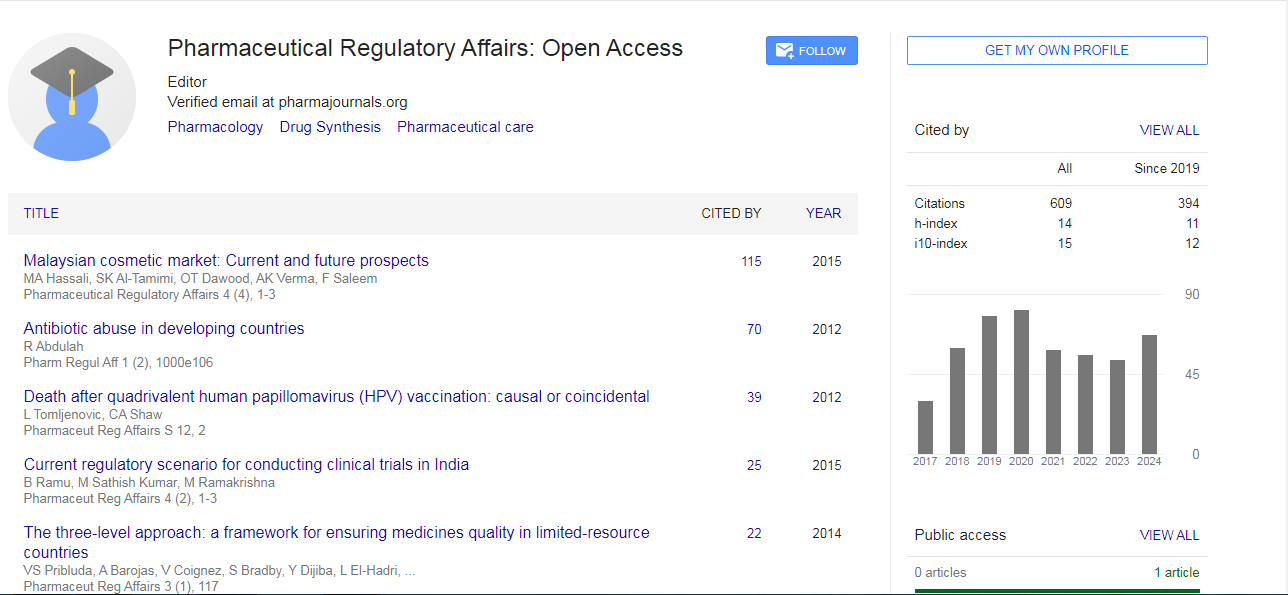
Pharmaceutical Regulatory Affairs: Open Access received 533 citations as per Google Scholar report