Opinion - (2025) Volume 14, Issue 6
Received: 01-Nov-2025, Manuscript No. pbt-25-178161;
Editor assigned: 03-Nov-2025, Pre QC No. P-178161;
Reviewed: 17-Nov-2025, QC No. Q-178161;
Revised: 24-Nov-2025, Manuscript No. R-178161;
Published:
29-Nov-2025
, DOI: 10.37421/2167-7689.2025.14.514
Citation: Wong, Daniel K.. ”Navigating Drug and Device Regulatory Submissions.” Pharmaceut Reg Affairs 14 (2025):514.
Copyright: © 2025 Wong K. Daniel This is an open-access article distributed under the terms of the Creative Commons Attribution License, which permits unrestricted use, distribution and reproduction in any medium, provided the original author and source are credited.
The regulatory submission landscape for pharmaceuticals and medical devices is a critical and evolving domain, essential for ensuring public health and facilitating access to innovative treatments [1].
This complex process involves the meticulous compilation and presentation of data to regulatory authorities, such as the Food and Drug Administration (FDA) in the United States or the European Medicines Agency (EMA) in Europe, demanding a profound understanding of scientific principles, manufacturing processes, and stringent regulatory guidelines to guarantee product safety and efficacy [1].
Navigating the intricacies of regulatory submissions for novel biologics necessitates a proactive and adaptable strategy, encompassing a deep comprehension of the specific data requirements for diverse biologic types, including monoclonal antibodies and gene therapies [2].
Early and consistent engagement with regulatory agencies is paramount for identifying potential challenges and ensuring that the submission adequately addresses critical concerns related to safety, immunogenicity, and efficacy [2].
The submission of a New Drug Application (NDA) represents a pivotal milestone in pharmaceutical development, requiring a comprehensive dossier that conclusively demonstrates a drug's safety and efficacy through meticulously designed clinical trials and robust manufacturing controls [3].
The adoption of the Common Technical Document (CTD) format has standardized this submission process globally, significantly facilitating its review by multiple regulatory agencies and emphasizing the need for meticulous attention to detail across all sections, from non-clinical data to quality control [3].
In parallel, medical device regulatory submissions have faced increasingly stringent requirements, particularly for innovative technologies, necessitating a thorough understanding of regulatory pathways such as Premarket Approval (PMA) or 510(k) clearance [4].
Demonstrating clinical utility, biocompatibility, and device safety through rigorous testing and comprehensive documentation is fundamental, with the underlying quality management system (QMS) playing a crucial role in the regulatory review process [4].
The pharmaceutical industry is experiencing a significant transformation driven by the rise of personalized medicine, compelling regulatory submissions to adapt accordingly by developing strategies for evaluating therapies that target specific genetic markers or patient subpopulations [5].
This evolution presents challenges in defining appropriate endpoints for smaller patient groups and ensuring the robustness of biomarker data, while regulatory agencies are actively developing frameworks to support the review of these highly targeted treatments [5].
The emergence of digital health technologies introduces novel challenges for regulatory submissions, particularly for devices incorporating software, artificial intelligence, or machine learning, which demand careful evaluation of validation processes, data integrity, and cybersecurity [6].
Regulatory bodies are actively engaged in establishing clear guidelines for assessing the safety and effectiveness of these rapidly evolving technologies to ensure patient safety in an increasingly digital healthcare landscape [6].
An ongoing global effort to harmonize regulatory submission requirements aims to streamline drug development and approval processes worldwide, with initiatives like the International Council for Harmonisation (ICH) providing essential guidelines that foster consistency across different regions [7].
Understanding these harmonized standards for quality, safety, and efficacy is vital for companies seeking international market access, enabling them to reduce redundant testing and accelerate their market entry [7].
The utilization of real-world data (RWD) and real-world evidence (RWE) in regulatory submissions is experiencing a significant surge in acceptance, offering valuable insights into drug effectiveness and safety in routine clinical practice from sources beyond traditional clinical trials [8].
Developing robust methodologies for collecting, analyzing, and presenting RWD/RWE is essential to ensure its acceptance by regulatory authorities and to effectively support decision-making throughout a product's lifecycle [8].
Pharmacovigilance and post-marketing surveillance are integral components of the regulatory submission continuum, extending well beyond initial product approval to encompass ongoing monitoring and reporting of adverse events to ensure sustained product safety [9].
The data generated through these activities can influence labeling updates, refine risk management plans, and even trigger further regulatory scrutiny, highlighting the dynamic and continuous nature of regulatory oversight throughout a product's entire lifespan [9].
Finally, the regulatory submission process for orphan drugs and therapies targeting rare diseases presents distinct challenges, primarily due to the inherent difficulties in clinical trial recruitment and the need for careful endpoint selection stemming from smaller patient populations [10].
Regulatory agencies frequently provide incentives and expedited review pathways to encourage the development of treatments for these unmet medical needs, making the demonstration of a favorable benefit-risk profile with limited data a key aspect of these specialized submissions [10].
The field of regulatory submissions is fundamental to bringing new pharmaceuticals and medical devices to market, requiring a meticulous approach to data compilation and presentation for regulatory bodies like the FDA and EMA [1].
This process hinges on a deep understanding of scientific principles, manufacturing intricacies, and regulatory guidelines to ensure that products are both safe and effective for patient use [1].
Navigating the complexities associated with regulatory submissions for novel biologics demands a strategic and adaptive mindset, which includes a thorough grasp of the specific data requirements pertinent to various types of biologics, such as monoclonal antibodies or gene therapies [2].
Proactive and continuous engagement with regulatory agencies is crucial for preemptively identifying potential obstacles and ensuring that the submitted documentation comprehensively addresses all concerns regarding safety, immunogenicity, and efficacy [2].
The submission of a New Drug Application (NDA) marks a critical juncture in the lifecycle of a pharmaceutical product, necessitating a comprehensive dossier that rigorously substantiates the drug's safety and efficacy through well-designed clinical trials and stringent manufacturing controls [3].
The standardization provided by the Common Technical Document (CTD) format has been instrumental in facilitating global review by multiple regulatory agencies, underscoring the importance of scrupulous attention to detail in every aspect of the submission, from preclinical data to quality assurance [3].
Medical device regulatory submissions have progressively become more stringent, especially for cutting-edge technologies, making it imperative to understand specific regulatory pathways like Premarket Approval (PMA) or 510(k) clearance [4].
The demonstration of clinical utility, biocompatibility, and device safety through rigorous testing and detailed documentation is paramount, with the overarching quality management system (QMS) playing a significant role in the success of the regulatory review [4].
A significant trend in the pharmaceutical industry is the increasing focus on personalized medicine, which requires regulatory submissions to evolve by developing strategic approaches for evaluating therapies tailored to specific genetic markers or patient subgroups [5].
This adaptation involves overcoming challenges related to defining appropriate endpoints for smaller patient populations and ensuring the scientific rigor of biomarker data, while regulatory agencies are actively developing frameworks to facilitate the review of these precision treatments [5].
The proliferation of digital health technologies presents novel challenges for regulatory submissions, particularly concerning devices that incorporate software, artificial intelligence, or machine learning, necessitating thorough validation of their development processes, data integrity, and cybersecurity measures [6].
Regulatory bodies are actively working to establish clear and comprehensive guidelines for evaluating the safety and effectiveness of these advanced technologies to safeguard patient well-being in an evolving digital health environment [6].
Efforts toward the global harmonization of regulatory submission requirements are continuously underway to streamline drug development and approval processes on an international scale, with initiatives such as the International Council for Harmonisation (ICH) providing crucial guidelines that promote consistency across different regulatory jurisdictions [7].
A thorough understanding of these harmonized standards concerning quality, safety, and efficacy is indispensable for companies aiming to market their products globally, enabling them to minimize redundant testing and expedite market entry [7].
The integration of real-world data (RWD) and real-world evidence (RWE) into regulatory submissions is gaining substantial momentum, offering valuable insights into a drug's performance and safety within the context of everyday clinical practice, derived from sources outside of traditional clinical trials [8].
The development of scientifically sound methodologies for the collection, analysis, and presentation of RWD/RWE is critical to ensure its acceptance by regulatory authorities and to effectively support decision-making throughout the entire product lifecycle [8].
Pharmacovigilance and post-marketing surveillance represent integral phases of the regulatory submission process, extending beyond initial approval to encompass continuous monitoring and reporting of adverse events to maintain product safety [9].
The data gathered from these ongoing activities can influence critical decisions such as labeling modifications, the implementation of risk management strategies, and may even trigger further regulatory review, emphasizing the dynamic and perpetual nature of regulatory oversight [9].
Lastly, regulatory submission strategies for orphan drugs and therapies targeting rare diseases present unique hurdles, including difficulties in recruiting sufficient patient numbers for clinical trials and the need for careful consideration in selecting appropriate endpoints due to limited patient populations [10].
Regulatory agencies often provide specific incentives and expedited review pathways to encourage the development of treatments for these underserved conditions, making the demonstration of a favorable benefit-risk profile with the available data a central aspect of these specialized submissions [10].
Regulatory submissions are crucial for market entry of new drugs and medical devices, requiring comprehensive data and understanding of scientific and regulatory guidelines. The process is evolving with advancements in biologics, personalized medicine, and digital health technologies, each presenting unique challenges and demanding specific strategies. Standardization through formats like CTD and global harmonization efforts via ICH aim to streamline the process. Real-world data and evidence are increasingly integrated, while pharmacovigilance and post-marketing surveillance ensure continued product safety. Specific considerations apply to orphan drugs and rare disease therapies due to small patient populations. Successful submissions depend on meticulous planning, robust data generation, clear documentation, and strategic engagement with regulatory authorities.
None
None
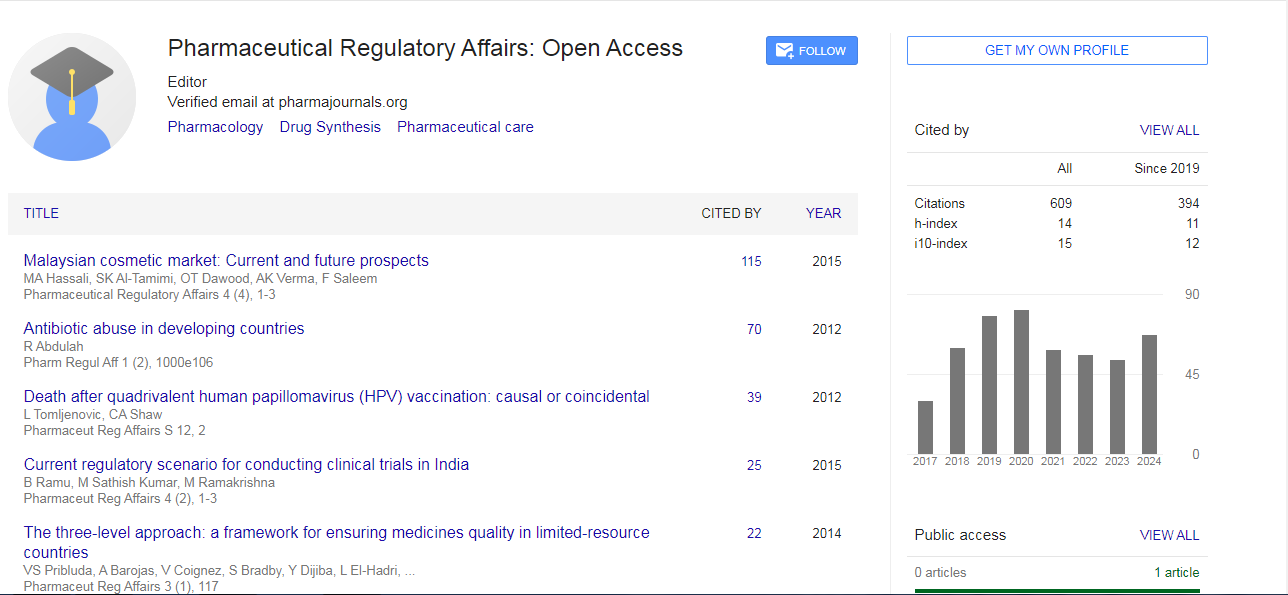
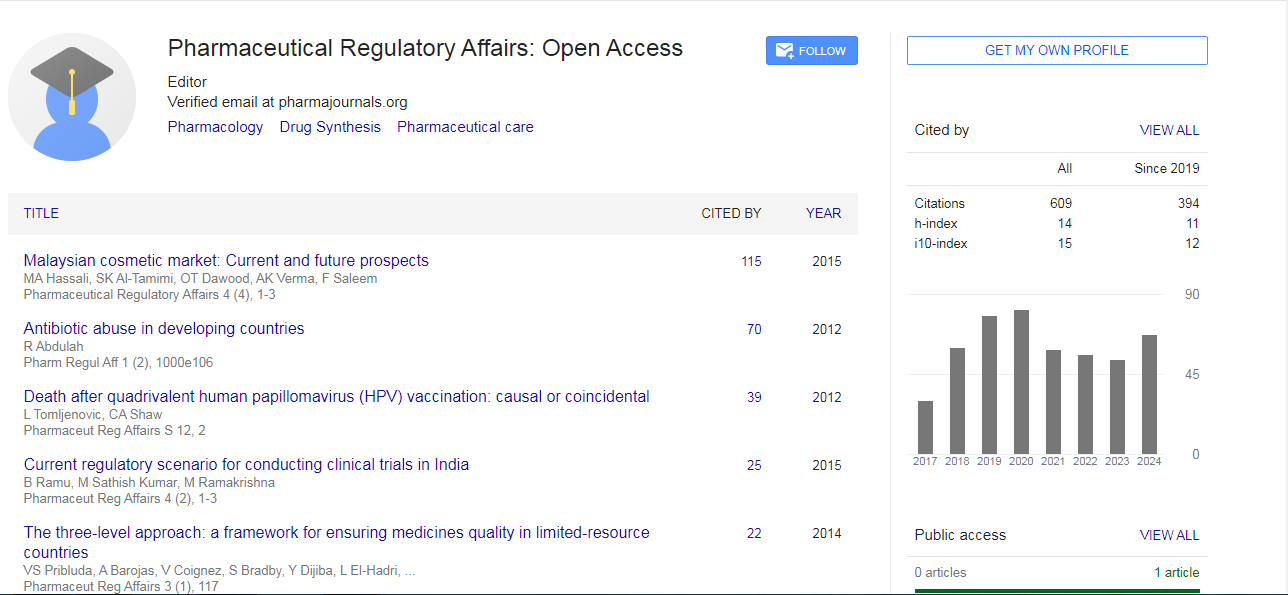
Pharmaceutical Regulatory Affairs: Open Access received 533 citations as per Google Scholar report