Opinion - (2025) Volume 10, Issue 4
Received: 01-Jul-2025, Manuscript No. apn-26-179158;
Editor assigned: 03-Jul-2025, Pre QC No. P-179158;
Reviewed: 14-Jul-2025, QC No. Q-179158;
Revised: 22-Jul-2025, Manuscript No. R-179158;
Published:
29-Jul-2025
, DOI: 10.37421/2573-0347.2025.10.444
Citation: Carter, Emily. âNavigating APN Legal Complexities: Practice, Liability, and Care.â J Adv Practice Nurs 10 (2025):444.
Copyright: © 2025 Carter E. This is an open-access article distributed under the terms of the Creative Commons Attribution License, which permits unrestricted use, distribution
and reproduction in any medium, provided the original author and source are credited.
The legal landscape surrounding advanced practice nursing (APN) is characterized by its escalating complexity, necessitating a profound understanding of the scope of practice, potential liabilities, and overarching regulatory frameworks. This evolving domain demands meticulous attention to detail to ensure both patient safety and professional adherence to legal standards [1].
Nurse practitioners (NPs), as a significant segment of APNs, face particular scrutiny regarding their capacity for independent practice. Varying state laws profoundly influence their ability to provide autonomous care, underscoring the critical need to comprehend specific legislative mandates and their implications for liability [2].
The authority granted to APNs for prescribing medications introduces a distinct set of legal risks. Rigorous adherence to regulatory guidelines, ethical principles, and comprehensive patient management protocols is paramount to mitigating these inherent risks effectively [3].
Certified nurse-midwives (CNMs) operate within a specialized area that, while highly rewarding, is also subject to specific legal challenges, particularly concerning malpractice litigation. Careful attention to established standards of care and robust risk management are crucial for navigating these complexities [4].
Clinical nurse specialists (CNSs) encounter unique legal considerations tied to their advanced roles in assessment, diagnosis, and treatment planning. Understanding the interplay of professional standards, state regulations, and institutional policies is vital for defining their legal obligations accurately [5].
The advent of telehealth has introduced new dimensions to the legal accountability of APNs. Navigating cross-state practice, virtual informed consent, and data security presents novel challenges that require careful consideration of evolving legal precedents and regulations [6].
At the core of legal defense for APNs lies the critical practice of documentation. Comprehensive, accurate, and timely medical records serve as indispensable evidence in the event of malpractice claims, forming the bedrock of professional accountability [7].
APNs themselves perceive the management of legal risks as a significant challenge, often stemming from the complexities of regulatory environments and the dynamics of interprofessional relationships. Enhanced legal education and clearer guidelines are frequently cited as essential for bolstering their confidence and competence [8].
Interprofessional collaboration, while beneficial for patient care, introduces its own set of legal considerations for APNs. Clearly defined roles, effective communication protocols, and well-established collaborative agreements are essential to minimize potential legal pitfalls within team-based care settings [9].
Upholding the legal standard of care is a fundamental obligation for all APNs. Staying abreast of evidence-based practices, maintaining professional competency through ongoing education, and understanding the legal nuances of their specialty are critical for protecting both patients and practitioners from adverse outcomes and legal repercussions [10].
The legal landscape for Advanced Practice Nurses (APNs) is increasingly intricate, requiring a thorough grasp of their practice scope, potential liabilities, and regulatory frameworks. This article delves into APN accountability, examining independent practice, prescriptive authority, and the influence of state and national regulations. It emphasizes the importance of robust documentation, adherence to standards of care, and continuous professional development to minimize legal risks and ensure patient safety. Furthermore, it highlights the necessity of understanding collegial relationships, referral patterns, and interprofessional communication to avert legal entanglements. Ultimately, effective legal accountability for APNs is grounded in informed practice, ethical conduct, and a proactive approach to risk management [1].
This study specifically investigates the legal implications for Nurse Practitioners (NPs) practicing independently, analyzing how diverse state laws affect their capacity for autonomous care. It scrutinizes case law and legislative trends, revealing that the degree of required physician oversight significantly impacts NP liability. The research underscores the vital importance of APNs being fully cognizant of their state's Nurse Practice Act and any existing collaborative practice agreements. Additionally, it addresses the ethical and legal facets of delegation and supervision, stressing that clear communication and established protocols are crucial for preventing malpractice claims. The paper concludes that legislative reforms aimed at expanding NP practice authority can improve access to care, provided they are accompanied by robust accountability measures [2].
The role of advanced practice nurses in prescribing medications carries inherent legal risks that necessitate strict adherence to regulations and ethical guidelines. This article reviews the legal frameworks governing prescriptive authority for various APN roles, noting variations in state laws and the impact of collaborative practice agreements. It underscores the importance of accurate patient assessment, detailed documentation of prescribing decisions, and ongoing monitoring of patient responses and potential adverse effects. The paper also discusses the legal ramifications of off-label prescribing and the responsibility to remain current with drug information and therapeutic guidelines, suggesting that comprehensive education on pharmacology and legal prescribing aspects is vital for minimizing liability [3].
This systematic review synthesizes current research on the legal challenges faced by Certified Nurse-Midwives (CNMs), with a particular focus on potential malpractice litigation. It identifies common grounds for litigation, such as failure to recognize fetal distress, inadequate labor management, and neonatal care errors. The article emphasizes the importance of meticulous medical record-keeping, clear communication with patients and families, and adherence to established midwifery standards of care. It also examines the influence of institutional policies and state regulations on CNM liability, concluding that robust risk management strategies, ongoing professional education, and strong interprofessional collaboration can significantly reduce legal disputes [4].
The evolving scope of practice for Clinical Nurse Specialists (CNSs) introduces specific legal considerations. This article explores CNS accountability in areas like advanced assessment, diagnosis, treatment planning, and patient education. It examines how professional standards, state Nurse Practice Acts, and employment contracts shape CNS legal obligations. The significance of maintaining accurate and comprehensive patient records, documenting all interventions and consultations, and adhering to evidence-based practices is highlighted. The paper also addresses the legal implications of the CNS role in quality improvement initiatives and potential liability in failing to identify or address systemic issues affecting patient care, offering recommendations for enhancing legal preparedness through continuous learning and robust practice protocols [5].
This research investigates the impact of telehealth on the legal accountability of advanced practice nurses, particularly concerning remote patient assessment and management. It addresses the complexities of establishing provider-patient relationships across state lines, challenges in obtaining virtual informed consent, and legal implications of patient privacy and data security. The article stresses the need for APNs to be aware of differing state licensing requirements and specific telehealth regulations. It also discusses potential liabilities related to diagnostic errors, medication management, and emergency response in a telehealth context, advocating for clear policies and guidelines to aid APNs in navigating the evolving legal landscape of virtual care [6].
This article focuses on the critical role of documentation in establishing legal accountability for advanced practice nurses. It highlights that comprehensive, accurate, and timely medical records are essential for defending against malpractice claims. The authors outline best practices for charting, including objective descriptions of patient encounters, clear documentation of assessments, diagnoses, treatment plans, patient education, and any consultations or referrals. The legal consequences of incomplete, altered, or illegible records are explored, emphasizing the importance of understanding and complying with organizational policies and legal record-keeping requirements. The paper concludes that robust documentation is fundamental to safe and legally defensible advanced practice nursing [7].
This qualitative study examines the lived experiences of advanced practice nurses regarding their understanding and management of legal risks in their practice settings. Through interviews with APNs from diverse specialties and states, the research identifies key challenges, including navigating complex regulatory environments, managing physician-nurse relationships, and perceived pressures of increased autonomy. The findings reveal a strong desire among APNs for clearer guidelines and more accessible legal education to enhance their confidence and competence in managing potential liabilities. The article underscores the need for healthcare institutions to provide adequate support and resources to promote legal awareness and risk mitigation strategies for their APN workforce [8].
This article addresses the legal implications of interprofessional collaboration for advanced practice nurses, particularly within team-based care models. It analyzes how shared decision-making, clear communication protocols, and defined roles and responsibilities among healthcare team members can affect APN liability. The authors discuss potential legal issues arising from unclear communication, role misinterpretation, or inadequate collaboration. They stress the importance of understanding the legal scope of practice for all team members and ensuring that collaborative agreements are well-defined and legally sound. The article advocates for proactive strategies to foster effective interprofessional relationships and minimize legal risks associated with team-based care delivery [9].
This comprehensive review explores the legal standards of care applicable to advanced practice nurses across various clinical settings. It identifies the sources of these standards, including state Nurse Practice Acts, professional organization guidelines, expert testimony, and institutional policies. The article discusses how deviations from the established standard of care can lead to allegations of negligence and malpractice. It emphasizes the importance of APNs staying current with evidence-based practices, maintaining professional competency through continuing education, and understanding the specific legal nuances of their specialty. The authors provide practical advice on how APNs can uphold the standard of care to protect themselves and their patients from adverse outcomes and legal repercussions [10].
Advanced practice nurses (APNs) face a complex legal environment requiring understanding of scope of practice, liabilities, and regulations. Key areas of focus include independent practice for nurse practitioners, prescriptive authority, and the specific legal challenges for certified nurse-midwives and clinical nurse specialists. The increasing use of telehealth introduces new legal considerations regarding cross-state practice and virtual care. Robust documentation is identified as a critical defense against malpractice claims. APNs often experience challenges navigating regulatory complexities and interprofessional relationships, highlighting a need for clearer legal guidance and education. Effective interprofessional collaboration is essential for minimizing legal risks in team-based care. Upholding the standard of care through continuous learning and adherence to evidence-based practices is paramount for legal accountability and patient safety. Healthcare institutions play a role in supporting APNs with resources and risk mitigation strategies.
None
None
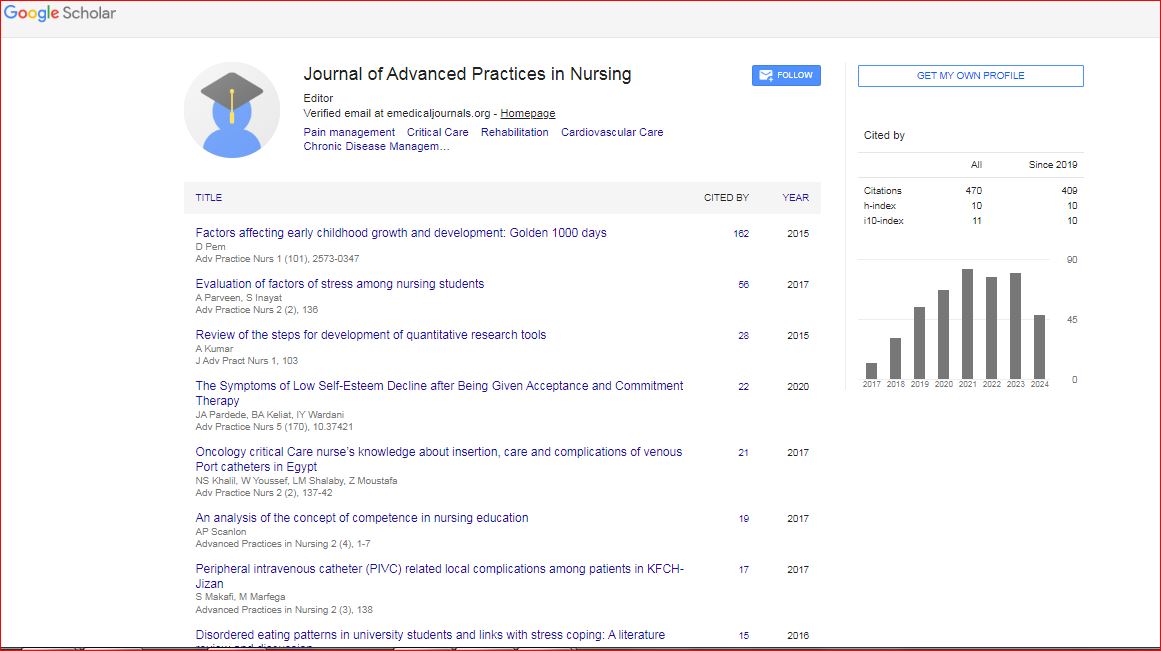
Journal of Advanced Practices in Nursing received 410 citations as per Google Scholar report