Perspective - (2025) Volume 15, Issue 4
Received: 01-Jul-2025, Manuscript No. jtese-26-184241;
Editor assigned: 03-Jul-2025, Pre QC No. P-184241;
Reviewed: 17-Jul-2025, QC No. Q-184241;
Revised: 22-Jul-2025, Manuscript No. R-184241;
Published:
29-Jul-2025
, DOI: 10.37421/2165-8064.2025.15.665
Citation: Bennett, Samuel. ”Natural Dyes: Sustainable Textile Coloration for Circular Economy.” J Textile Sci Eng 15 (2025):665.
Copyright: © 2025 Bennett S. This is an open-access article distributed under the terms of the Creative Commons Attribution License, which permits unrestricted use, distribution and reproduction in any medium, provided the original author and source are credited.
The textile industry is increasingly seeking sustainable alternatives to conventional synthetic dyes due to growing environmental concerns and regulatory pressures. Natural dyes, derived from various plant, animal, and mineral sources, offer a promising avenue for reducing the ecological footprint of textile coloration [1].
This research review delves into the multifaceted aspects of natural dyes, exploring their extraction, application, and performance properties in modern textile processing. The integration of natural dyes into textile manufacturing presents a viable pathway towards environmental sustainability, addressing issues of pollution and resource depletion associated with synthetic counterparts. This exploration covers a spectrum of natural dye sources, methods of extraction, and techniques for application on diverse textile fibers [1].
Research has highlighted the significant potential of natural dyes to produce a wide array of colors, achieving fastness properties comparable to synthetic dyes when optimal conditions are employed. Advancements in mordanting techniques and dye fixation processes are crucial for enhancing the efficiency and reproducibility of natural dyeing in industrial settings [1].
The economic viability and burgeoning consumer demand for eco-friendly textiles colored with natural dyes are also important considerations driving this research. The study acknowledges these market dynamics and their influence on the adoption of sustainable dyeing practices [1].
Furthermore, the investigation into plant-based dyes on various fibers, including cellulose and protein, aims to optimize parameters for superior color yield and wash fastness. The use of eco-friendly mordants and post-treatment processes is detailed to improve dye uptake and durability, presenting natural dyes as an environmentally sound choice for textile coloration [2].
Specific studies have evaluated the potential of natural colorants, such as anthocyanins from red cabbage, for dyeing protein fibers like wool. These investigations examine the influence of pH, dye concentration, and mordants on color intensity and fastness, proposing effective treatment combinations to overcome challenges in achieving consistent and durable coloration [3].
Beyond traditional plant sources, the application of microbial dyes derived from fungi and bacteria represents a novel and sustainable approach to textile coloration. Research in this area focuses on the extraction and characterization of pigments and their subsequent dyeing of cotton, demonstrating the feasibility of bio-based dyes as alternatives [4].
Another avenue of sustainable dyeing involves the valorization of waste materials, such as food industry byproducts, as sources for natural dyes. This approach emphasizes the dual benefit of waste reduction and the production of eco-friendly colorants for textiles, contributing to circular economy principles within the sector [5].
Advancements in nanotechnology are also playing a significant role in enhancing the performance of natural dyes. The application of nano-mordants and nano-encapsulation techniques can improve color yield, fastness, and even impart antimicrobial properties, boosting the commercial viability of natural dye-based textiles [6].
Overall, the exploration of diverse natural dye sources, from traditional plant barks and seeds to microbial pigments and waste materials, alongside technological innovations like nanotechnology, underscores the growing potential and practical applicability of natural dyes in the modern textile industry, paving the way for a greener future [7, 8, 9, 10].
The integration of natural dyes into modern textile processing is extensively explored as a sustainable alternative to synthetic dyes, addressing critical environmental concerns such as pollution and resource depletion. This research critically examines various natural dye sources, effective extraction methodologies, and diverse application techniques suitable for different textile fibers, aiming to achieve a broad spectrum of colors with comparable fastness properties to synthetic counterparts when optimized [1].
Key findings emphasize the potential of natural dyes to match synthetic dyes in color variety and fastness. Advancements in mordanting techniques and dye fixation processes are vital for improving the overall efficiency and reproducibility of natural dyeing in industrial settings. The study also acknowledges the economic viability and increasing consumer demand for eco-friendly textiles colored with natural dyes, reinforcing their market potential [1].
Further investigations delve into the dyeing performance of specific plant-based dyes on cellulose and protein fibers, with a focus on optimizing parameters for enhanced color yield and wash fastness. The research details the use of eco-friendly mordants and post-treatment processes designed to improve dye uptake and durability, presenting a strong case for natural dyes as a viable and environmentally sound choice for textile coloration [2].
Specific studies have evaluated the potential of natural colorants, such as anthocyanins extracted from red cabbage, for dyeing wool. These investigations meticulously examine the influence of pH, dye concentration, and different mordants on color intensity and fastness properties. While challenges in achieving consistent and durable coloration are noted, effective treatment combinations are proposed to mitigate these issues, offering practical insights into the application of anthocyanin dyes in wool processing [3].
The application of microbial dyes derived from fungi and bacteria represents a novel and sustainable frontier in textile coloration. This research focuses on the extraction and characterization of pigments from selected fungal strains and their subsequent dyeing of cotton, discussing the potential for large-scale production and their inherent environmental benefits, thereby providing evidence for their feasibility as alternatives to synthetic dyes [4].
Another significant area of exploration involves the utilization of waste materials, particularly food industry byproducts, as sources for natural dyes. This work details the extraction of colorants from sources like pomegranate peels and onion skins and their successful application on silk and cotton fabrics. The research highlights the dual advantages of waste valorization and sustainable dyeing, emphasizing the achieved color properties and fastness, and contributes to the principles of a circular economy within the textile sector [5].
Advancements in nanotechnology are also revolutionizing the application of natural dyes. This paper reviews the use of nano-mordants and nano-encapsulation techniques aimed at improving the color yield, fastness, and even introducing antimicrobial properties of natural dyes on textiles. The findings suggest that nanotechnology can significantly enhance the commercial viability and functional attributes of textiles colored with natural dyes [6].
Research into specific natural dye sources, such as the bark of the *Acacia nilotica* tree for dyeing silk fabric, explores different mordanting agents and dyeing conditions to achieve optimal color fastness and depth. A comparative analysis of various mordants and their impact on the dyeing process is presented, identifying *Acacia nilotica* bark as a promising source for sustainable textile dyeing [7].
The dyeing potential of seeds from *Bixa orellana* (annatto) on cotton fabric is also investigated. The study examines the effect of pH, temperature, and different mordants on color properties and fastness, concluding that annatto seeds offer a range of yellow to orange hues with acceptable fastness, serving as an eco-friendly alternative for cotton coloration [8].
Historically significant natural dyes, like madder root (*Rubia tinctorum*), are also being re-examined for their potential in modern applications, such as dyeing silk. This research investigates the impact of different mordants and dyeing processes on color intensity, hue, and fastness properties, providing detailed analysis and practical guidelines for reproducible dyeing outcomes, reaffirming madder as a sustainable natural dye [9, 10].
This collection of research explores the use of natural dyes in the textile industry as a sustainable alternative to synthetic dyes. Studies investigate various natural dye sources, including plants, microbial pigments, and food industry waste, examining their extraction methods, application techniques on different textile fibers, and resulting color fastness properties. Key findings highlight the potential of natural dyes to achieve a wide spectrum of colors comparable to synthetic dyes, especially when optimized through advanced mordanting and fixation processes. Research also points to the growing consumer demand for eco-friendly textiles and the economic viability of natural dyeing. Innovations in nanotechnology are further enhancing the performance and commercial appeal of natural dyes. Specific examples include the use of anthocyanins from red cabbage, pigments from *Acacia nilotica* bark and *Bixa orellana* seeds, and traditional dyes like madder root. The overarching theme is the advancement of sustainable textile coloration, contributing to environmental protection and circular economy principles.
None
None
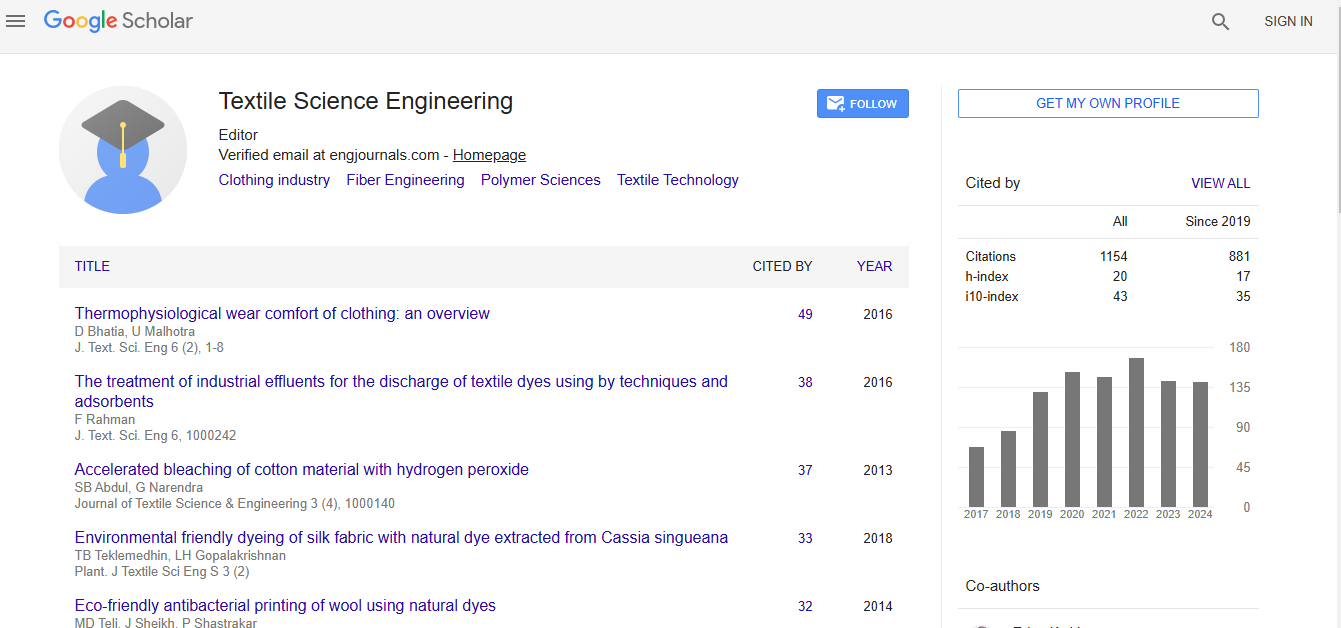
Journal of Textile Science & Engineering received 1008 citations as per Google Scholar report