Commentary - (127) Volume 16, Issue 5
Received: 01-Oct-2025, Manuscript No. jmbd-26-179575;
Editor assigned: 03-Oct-2025, Pre QC No. P-179575;
Reviewed: 15-Dec-0025, QC No. Q-179575;
Revised: 23-Oct-2025, Manuscript No. R-179575;
Published:
30-Oct-2025
, DOI: 10.37421/2155-9929.2025.16.721
Citation: Dijk, Emma van. ”Biomarkers: Precision Diagnosis, Personalized Therapy, Future Healthcare.” J Mol Biomark Diagn 16 (2025):721.
Copyright: © 2025 Dijk v. Emma This is an open-access article distributed under the terms of the Creative Commons Attribution License, which permits unrestricted use,
distribution and reproduction in any medium, provided the original author and source are credited.
Biomarker-guided diagnosis is revolutionizing healthcare by enabling a more precise and personalized approach. By identifying specific molecular signatures, clinicians can accurately diagnose diseases earlier, predict treatment responses, and monitor disease progression. This molecular diagnostic strategy is pivotal in advancing precision medicine, leading to optimized therapeutic interventions and improved patient outcomes. [1] The integration of advanced genomic and proteomic technologies allows for the discovery and validation of novel biomarkers. These biomarkers, ranging from specific gene mutations to protein expression levels, serve as crucial diagnostic and prognostic tools. The application of these molecular insights is fundamental to tailoring treatment regimens to individual patient profiles, thereby minimizing adverse effects and maximizing efficacy. [2] Liquid biopsies represent a paradigm shift in biomarker detection, offering a non-invasive method for obtaining diagnostic information. Circulating tumor DNA (ctDNA), RNA, and exosomes can be analyzed to detect cancer recurrence, assess treatment response, and identify resistance mechanisms. This approach streamlines patient monitoring and facilitates early intervention. [3] The application of artificial intelligence (AI) and machine learning (ML) is accelerating biomarker discovery and interpretation. AI/ML algorithms can analyze complex multi-omics datasets to identify subtle patterns and predict disease risk or treatment outcomes with high accuracy. This computational approach enhances the power of biomarker-guided diagnostics. [4] Personalized therapeutic strategies are increasingly informed by genetic and molecular profiling. Understanding the genomic landscape of a tumor, for instance, allows for targeted therapies that inhibit specific oncogenic pathways. This targeted approach significantly improves efficacy and reduces off-target toxicity compared to traditional chemotherapy. [5] The development of high-throughput screening technologies has been crucial for identifying and validating a vast array of potential biomarkers. These technologies, including next-generation sequencing (NGS) and mass spectrometry, enable comprehensive molecular profiling of biological samples, paving the way for more robust diagnostic assays. [6] Pharmacogenomics plays a vital role in precision medicine by predicting individual drug responses based on genetic variations. Identifying genetic markers that influence drug metabolism, efficacy, or toxicity allows for the selection of optimal drug dosages and regimens, thereby enhancing treatment safety and effectiveness. [7] The clinical utility of biomarkers is contingent upon their robust validation and integration into diagnostic workflows. Standardization of assays, rigorous clinical trials, and regulatory approval are essential steps to ensure that biomarker-guided diagnostics are reliable, reproducible, and clinically actionable. [8] Epigenetic modifications, such as DNA methylation and histone modifications, are increasingly recognized as important biomarkers for disease diagnosis and prognosis. These alterations can occur early in disease development and can be detected in various biological samples, offering a complementary approach to genetic biomarkers. [9] The future of biomarker-guided diagnosis lies in the development of multi-modal approaches that integrate diverse data types, including genomics, transcriptomics, proteomics, and clinical data. This holistic view will enable even more precise patient stratification and personalized treatment strategies, driving the evolution of precision healthcare. [10]
Biomarker-guided diagnosis is fundamentally reshaping healthcare through a more precise and personalized paradigm. By identifying specific molecular signatures, clinicians are empowered to achieve earlier and more accurate disease diagnoses, effectively predict therapeutic responses, and meticulously monitor disease progression. This sophisticated molecular diagnostic strategy is indispensable for the advancement of precision medicine, ultimately leading to optimized therapeutic interventions and significantly improved patient outcomes. [1] The convergence of advanced genomic and proteomic technologies is instrumental in both the discovery and validation of novel biomarkers. These biomarkers, which can encompass specific gene mutations or protein expression levels, function as critical tools for diagnosis and prognosis. The strategic application of these molecular insights is paramount for tailoring treatment regimens to the unique profiles of individual patients, thereby mitigating adverse effects and maximizing therapeutic efficacy. [2] Liquid biopsies are heralding a significant shift in biomarker detection methodologies, offering a non-invasive avenue for acquiring diagnostic information. Analyses of circulating tumor DNA (ctDNA), RNA, and exosomes are enabling the detection of cancer recurrence, the assessment of treatment efficacy, and the identification of resistance mechanisms. This innovative approach facilitates streamlined patient monitoring and expedites early therapeutic interventions. [3] The integration of artificial intelligence (AI) and machine learning (ML) is markedly accelerating the processes of biomarker discovery and interpretation. AI/ML algorithms possess the capability to analyze intricate multi-omics datasets, thereby identifying subtle patterns and accurately predicting disease risk or treatment outcomes. This advanced computational approach significantly amplifies the diagnostic power of biomarkers. [4] Personalized therapeutic strategies are increasingly being dictated by comprehensive genetic and molecular profiling. A thorough understanding of a tumor's genomic landscape, for instance, permits the application of targeted therapies designed to inhibit specific oncogenic pathways. This precise therapeutic strategy demonstrates substantially improved efficacy and a reduction in off-target toxicity when contrasted with conventional chemotherapy. [5] The evolution of high-throughput screening technologies has been a critical determinant in the identification and validation of a broad spectrum of potential biomarkers. Technologies such as next-generation sequencing (NGS) and mass spectrometry facilitate comprehensive molecular profiling of biological samples, thereby creating a foundation for more robust and reliable diagnostic assays. [6] Pharmacogenomics assumes a pivotal role within the framework of precision medicine by enabling the prediction of individual drug responses based on genetic variations. The identification of genetic markers that modulate drug metabolism, efficacy, or toxicity empowers clinicians to select optimal drug dosages and regimens, consequently enhancing both treatment safety and overall effectiveness. [7] The true clinical utility of biomarkers is fundamentally dependent on their rigorous validation and seamless integration into established diagnostic workflows. Essential steps include the standardization of assay methodologies, the execution of comprehensive clinical trials, and the attainment of regulatory approval, all of which are crucial to ensure the reliability, reproducibility, and clinical actionability of biomarker-guided diagnostics. [8] Epigenetic modifications, including but not limited to DNA methylation and histone alterations, are progressively being acknowledged for their significance as biomarkers in disease diagnosis and prognosis. These molecular changes can manifest early in the disease development process and are detectable in various biological samples, thus providing a valuable complementary approach to genetic biomarkers. [9] The trajectory of future biomarker-guided diagnosis is strongly aligned with the development of multi-modal strategies that adeptly integrate diverse data streams, encompassing genomics, transcriptomics, proteomics, and essential clinical data. This comprehensive and holistic perspective is poised to facilitate even finer patient stratification and the implementation of highly personalized treatment strategies, thereby propelling the continuous evolution of precision healthcare. [10]
Biomarker-guided diagnosis is revolutionizing healthcare by enabling precise and personalized approaches. By identifying specific molecular signatures, clinicians can achieve earlier diagnoses, predict treatment responses, and monitor disease progression. Advanced genomic and proteomic technologies facilitate the discovery and validation of novel biomarkers, crucial for tailoring treatments and minimizing adverse effects. Liquid biopsies offer a non-invasive method for biomarker detection, aiding in cancer diagnosis and monitoring. Artificial intelligence and machine learning are accelerating biomarker discovery and interpretation. Personalized therapies are informed by genetic and molecular profiling, leading to targeted treatments with improved efficacy and reduced toxicity. High-throughput screening technologies are vital for identifying potential biomarkers, while pharmacogenomics predicts individual drug responses based on genetic variations. Clinical validation and regulatory approval are essential for the reliable use of biomarkers. Epigenetic modifications are emerging as important diagnostic and prognostic biomarkers. The future involves integrating multi-modal data for even more precise patient stratification and personalized management.
None
None
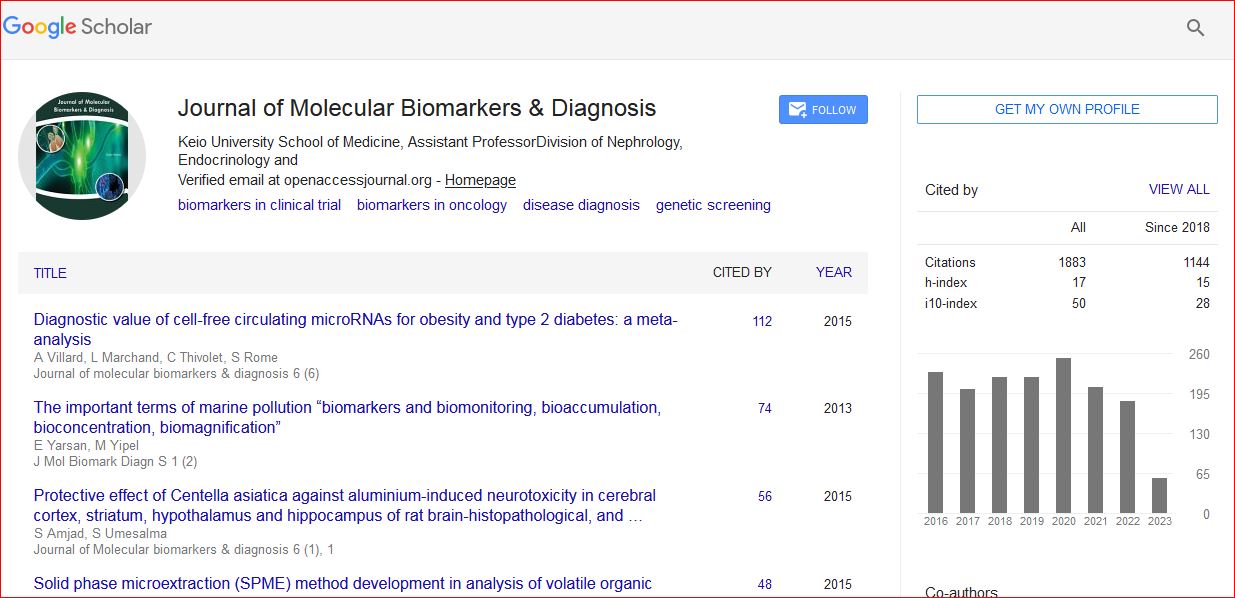
Journal of Molecular Biomarkers & Diagnosis received 2054 citations as per Google Scholar report