Commentary - (2025) Volume 16, Issue 5
Received: 01-Sep-2025, Manuscript No. assj-25-174790;
Editor assigned: 03-Sep-2025, Pre QC No. P-174790;
Reviewed: 17-Sep-2025, QC No. Q-174790;
Revised: 22-Sep-2025, Manuscript No. R-174790;
Published:
29-Sep-2025
, DOI: 10.37421/2151-6200.2025.16.684
Citation: Brandt, Anke. ”Narrative’s Aesthetic Functions: Structure, Ethics, Experience.” Arts Social Sci J 16 (2025):684
Copyright: © 2025 Brandt A. This is an open-access article distributed under the terms of the Creative Commons Attribution License, which permits unrestricted use, distribution and reproduction in any medium, provided the original author and source are credited.
Understanding the intricate relationship between narrative and aesthetic engagement is vital. It means considering a narrativeâ??s formal properties alongside the audienceâ??s cognitive processes. This helps us see how story structures evoke specific emotional and intellectual responses, shaping the overall aesthetic experience [1].
Narrative isn't just content; it's a formal structure that creates aesthetic experiences. We need to look beyond mere content analysis to understand how stories truly shape perception and understanding. Literary techniques and structural choices are key to how an audience feels and perceives a story [4].
When we talk about fictional narratives, weâ??re often looking at their cognitive and aesthetic dimensions. How do readers process complex structures and character developments to find pleasure? It's about the interplay between mental models, emotional responses, and the authorâ??s artistic choices, which together shape our understanding and subjective experience [6].
This leads us to narrative immersion and aesthetic pleasure. A cognitive approach shows how deeply readers get absorbed into a story, boosting their enjoyment. It digs into the psychological ways narratives build compelling worlds and bring emotional satisfaction, improving the whole aesthetic experience [10].
But let's be clear, purely cognitive approaches donâ??t tell the whole story. Aesthetic experience itself plays a crucial role. Narratives hit us not just intellectually but emotionally and sensually. These aesthetic parts are essential for conveying and absorbing meaning, moving us beyond just the words on a page [7].
Look at digital games, for example. Their aesthetics involve a â??poetics of play,â?? where interactive systems craft narrative meaning and aesthetic pleasure. Players engage uniquely with emergent narratives, showing how game mechanics and player agency dynamically shape the aesthetic experience [2].
Similarly, the aesthetic of interactivity shines in visual storytelling. Audience choices directly influence narrative paths and their aesthetic impact. Digital and interactive platforms open up new ways to engage, turning viewers into active co-creators of meaning and aesthetic experience [5].
Then there's narrative medicine, exploring aesthetic and ethical dimensions. Stories in healthcare don't just share info; they shape understanding, empathy, and moral reasoning. Engaging with patient narratives aesthetically can deepen clinical insight and encourage compassionate care [3].
And in representations of suffering, aesthetics and ethics intertwine complexly. How suffering is depicted aesthetically deeply impacts its ethical reception. Narrative choices in form, style, and perspective can either dignify or exploit suffering, swaying viewer empathy and moral judgment [8].
This brings us back to narrative structure. Its aesthetic function isn't just decorative; formal choices are integral to meaning-making and reader engagement. Plot, pacing, and focalization all contribute to the overall aesthetic impact and influence how we interpret a story [9].
The study of narrative and aesthetic engagement is a complex domain. It hinges on the idea that to truly grasp how stories work aesthetically, one must consider both their inherent formal qualities and the cognitive processes of the audience involved [1]. This perspective emphasizes that narrative structures are carefully designed to elicit particular emotional and intellectual responses, which then profoundly shape the overall aesthetic experience. Narrative isn't merely about conveying content; it operates as a fundamental formal structure that actively produces aesthetic experiences. Looking beyond a superficial content analysis, we find that narrative deeply shapes perception and understanding, with literary techniques and specific structural choices making a unique contribution to how a story is felt and perceived by its audience [4].
Venturing into the cognitive aspects, researchers examine how fictional narratives engage the mind and emotions. They analyze how readers process intricate narrative structures and develop characters, leading to pleasure. This involves understanding the dynamic interplay between mental models, emotional responses, and the artistic decisions authors make. Ultimately, fiction shapes both intellectual understanding and subjective experience [6]. Building on this, a cognitive approach explores the vital link between narrative immersion and aesthetic pleasure. It investigates how readers' deep absorption into a story directly contributes to their enjoyment. This research uncovers the psychological mechanisms through which narratives create compelling worlds and evoke emotional satisfaction, thereby significantly enhancing the overall aesthetic experience [10].
However, relying solely on cognitive approaches misses a crucial element: the sheer aesthetic experience. Narratives don't just engage us intellectually; they connect with us emotionally and sensorially. These aesthetic dimensions are fundamental to how meaning is conveyed and absorbed, moving beyond a narrow focus on propositional content [7]. This expanded view is particularly relevant in contemporary digital contexts. In digital games, for instance, a 'poetics of play' framework investigates how interactive systems generate narrative meaning and aesthetic pleasure [2]. This highlights the unique ways players interpret emergent narratives, emphasizing the dynamic interplay of game mechanics and player agency in shaping the aesthetic experience. The aesthetic of interactivity is also pivotal in visual storytelling, where audience choices directly influence narrative pathways and their resulting aesthetic impact. Digital and interactive platforms truly transform the viewerâ??s role from passive recipient to active co-creator of meaning and aesthetic experience [5].
The ethical implications of narrative are equally significant, especially in sensitive domains like healthcare. Narrative medicine explores both the aesthetic and ethical dimensions of stories in healthcare. These narratives don't just provide information; they also shape understanding, empathy, and moral reasoning. Engaging with patient narratives aesthetically can deepen clinical insight and cultivate more compassionate care [3]. Similarly, the complex interplay between aesthetics and ethics is evident in narrative representations of suffering. The aesthetic choices made in depicting suffering profoundly impact its ethical reception. How narrative choices regarding form, style, and perspective are made can either dignify or exploit suffering, directly influencing viewer empathy and moral judgment [8].
Finally, it's essential to recognize that narrative structure itself possesses inherent aesthetic qualities. Formal choices are not merely decorative but are integral to the meaning-making process and how readers engage with a story. Elements like plot, pacing, and focalization all contribute significantly to the overall aesthetic impact and influence interpretation [9]. This reinforces the idea that the very architecture of a narrative is a powerful aesthetic tool, shaping our journey through the story world and our understanding of its deeper meanings.
The inherent connection between narrative and aesthetic engagement is a core area of study. Understanding how stories move us involves looking at their formal qualities and how audiences think and feel. This field explores how narrative structures evoke specific emotional and intellectual responses, profoundly shaping the aesthetic experience. The discussion considers narrative both as a formal structure and a source of aesthetic experience, going beyond simple content. It includes how digital games create meaning and pleasure through interactive systems, and how players engage with emergent narratives. Interactivity in visual storytelling also plays a role, with audience choices influencing narrative paths and their aesthetic impact. Ethics within narrative is another vital dimension. Narrative medicine, for instance, uses stories in healthcare to foster empathy and guide moral reasoning. Engaging with patient narratives aesthetically can deepen clinical insight. Similarly, how suffering is depicted aesthetically in stories significantly impacts its ethical reception, influencing empathy and judgment. Cognitive aspects of fictional narratives are also key, examining how readers process and enjoy complex story structures. This highlights the psychological elements of narrative immersion and aesthetic pleasure, showing how compelling worlds lead to emotional satisfaction. It also challenges purely cognitive views, arguing that narratives engage us emotionally and sensorially, beyond just intellectual content. Finally, the aesthetic function of narrative structure itself is paramount. Formal choices like plot, pacing, and focalization aren't just decorative; they are integral to meaning-making and reader engagement. This broad perspective confirms that narratives, whether in books, games, or medical contexts, are powerful aesthetic tools that shape understanding, emotion, and experience.
None
None
Indexed at, Google Scholar, Crossref
Indexed at, Google Scholar, Crossref
Indexed at, Google Scholar, Crossref
Indexed at, Google Scholar, Crossref
Indexed at, Google Scholar, Crossref
Indexed at, Google Scholar, Crossref
Indexed at, Google Scholar, Crossref
Indexed at, Google Scholar, Crossref
Indexed at, Google Scholar, Crossref
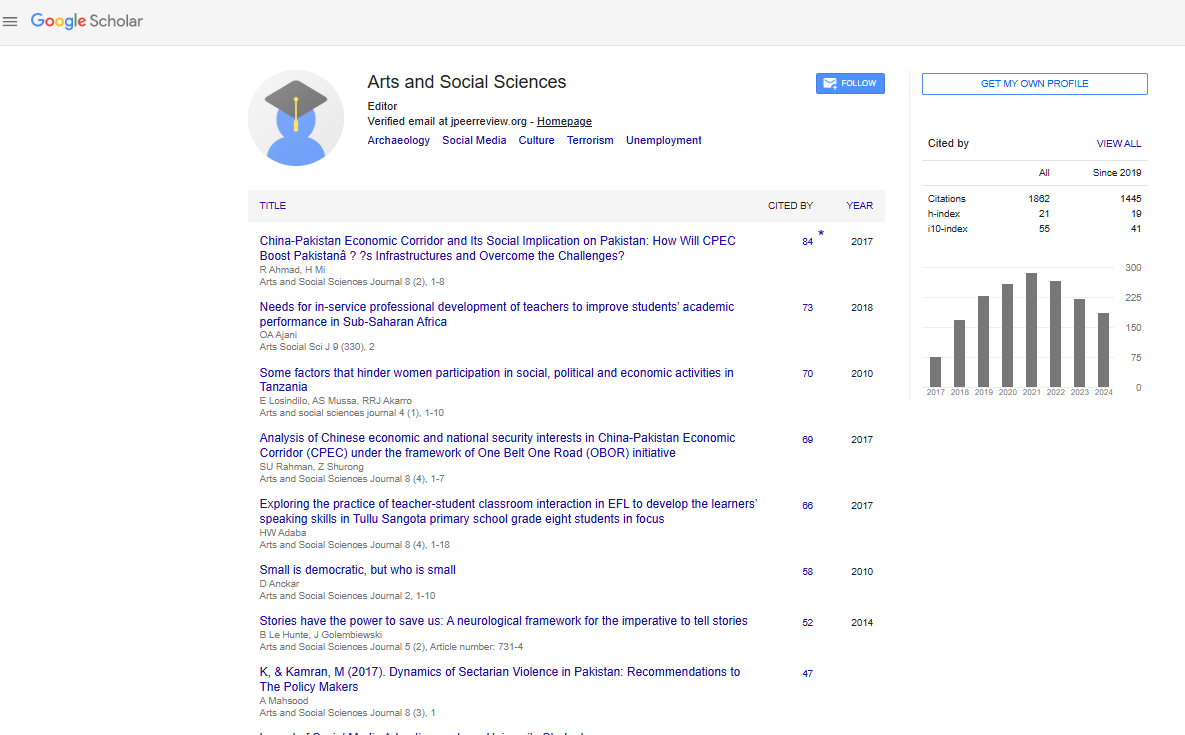
Arts and Social Sciences Journal received 1413 citations as per Google Scholar report