Perspective - (2025) Volume 9, Issue 6
Received: 02-Nov-2025, Manuscript No. hps-26-184500;
Editor assigned: 04-Nov-2025, Pre QC No. P-184500;
Reviewed: 18-Nov-2025, QC No. Q-184500;
Revised: 24-Nov-2025, Manuscript No. R-184500;
Published:
29-Nov-2025
, DOI: 10.37421/2573-4563.2025.9.377
Citation: Lee, Kwon J.. ”Nanocarriers Revolutionize Liver, Pancreatic Disease Treatment.” J Hepatol Pancreat Sci 09 (2025):377.
Copyright: © 2025 Lee J. Kwon This is an open-access article distributed under the terms of the Creative Commons Attribution License, which permits unrestricted use, distribution and reproduction in any medium, provided the original author and source are credited.
Recent advancements in targeted drug delivery for liver and pancreatic diseases are revolutionizing treatment paradigms by leveraging novel nanocarriers to enhance therapeutic efficacy and minimize systemic toxicity. Strategies encompass a diverse array of nanocarrier systems, including liposomes, polymeric nanoparticles, and exosome-based platforms, all meticulously designed for specific cellular uptake and controlled drug release [1].
These sophisticated approaches are instrumental in improving drug concentration at diseased sites, thereby offering renewed hope for the management of complex and challenging conditions such as hepatocellular carcinoma and chronic pancreatitis. This review delves into the sophisticated application of nanotechnology within the realm of pancreatic cancer treatment. It critically highlights how engineered nanoparticles can effectively overcome various biological barriers inherent in tumor progression, significantly improve the solubility of chemotherapeutic agents, and facilitate targeted delivery of these potent drugs directly to the tumor microenvironments. Key insights emerging from this research include the immense potential of stimuli-responsive nanoparticles and the strategic implementation of combination therapies to combat this aggressive disease [2].
Exosomes are rapidly emerging as powerful and highly versatile natural nanocarriers for drug delivery applications in the context of liver diseases. This particular line of research meticulously details how engineered exosomes can be effectively loaded with therapeutic agents and subsequently directed to specific target liver cells, thereby substantially improving treatment outcomes for a range of conditions, including fibrosis and viral hepatitis, through a significant reduction in off-target effects [3].
The unique and often challenging tumor microenvironment characteristic of pancreatic cancer presents considerable obstacles for effective drug delivery. This article undertakes an in-depth exploration of innovative strategies specifically designed to surmount these challenges, including the use of antibody-drug conjugates (ADCs) and advanced liposomal formulations engineered to penetrate the dense stromal tissue and efficiently reach cancer cells, ultimately enhancing the therapeutic efficacy of chemotherapy [4].
Focusing specifically on the critical areas of liver regeneration and the treatment of liver diseases, this study undertakes a thorough investigation into how encapsulated growth factors within advanced hydrogel scaffolds can effectively promote tissue repair and regeneration. The inherent controlled release mechanism of these specialized scaffolds presents a particularly promising avenue for the effective treatment of liver injury and failure [5].
This seminal research explores the groundbreaking potential of small interfering RNA (siRNA) delivered via highly efficient lipid nanoparticles (LNPs) as a novel therapeutic modality for treating a spectrum of liver diseases. The precise and targeted delivery of siRNA molecules can effectively silence disease-causing genes, thereby offering a completely novel therapeutic approach for debilitating conditions such as hepatitis B and various genetic liver disorders [6].
The article importantly highlights the exciting development of theranostic nanoparticles, which ingeniously combine both diagnostic and therapeutic capabilities specifically for the management of pancreatic cancer. These advanced systems are designed to allow for real-time monitoring of drug delivery processes and treatment response, thus paving the way for the widespread adoption of truly personalized medicine approaches in oncology [7].
This critical paper comprehensively discusses the significant challenges and outlines effective strategies for overcoming the notoriously immunosuppressive tumor microenvironment commonly found in pancreatic cancer through the application of targeted drug delivery. It particularly emphasizes the crucial role that nanoparticles play in modulating immune responses within the tumor and significantly enhancing the delivery of immunotherapeutic agents for more effective treatment [8].
This particular study undertakes a comprehensive review of the application of advanced polymer-based nanoparticles for the targeted treatment of liver fibrosis. It meticulously details how these sophisticated nanocarriers can efficiently deliver potent antifibrotic agents specifically to hepatic stellate cells, thereby offering a highly targeted and effective approach to inhibit the progression of liver scarring and fibrosis [9].
This significant paper thoroughly explores the innovative use of aptamer-functionalized nanoparticles for the precise and targeted delivery of therapeutics directly to liver cancer cells. Aptamers, renowned for their remarkable high specificity and strong affinity, enable exceptionally precise targeting, which in turn substantially improves drug efficacy and significantly reduces the incidence of undesirable side effects, leading to better patient outcomes [10].
Recent scientific literature highlights the significant progress in targeted drug delivery for liver and pancreatic diseases, emphasizing the utilization of novel nanocarriers to boost treatment effectiveness and reduce side effects. These strategies involve various nanocarrier types such as liposomes, polymeric nanoparticles, and exosome-based systems, all engineered for specific cellular uptake and controlled drug release, aiming to increase drug concentration at disease sites for conditions like hepatocellular carcinoma and chronic pancreatitis [1].
The application of nanotechnology in pancreatic cancer treatment is a focal point in a recent review. It illustrates how nanoparticles can overcome biological barriers, enhance drug solubility, and enable targeted delivery of chemotherapeutics to tumor microenvironments. The review underscores the promise of stimuli-responsive nanoparticles and combination therapies [2].
Exosomes are emerging as natural nanocarriers for drug delivery in liver disease therapy. This research explains how engineered exosomes can be loaded with drugs and directed to specific liver cells, improving treatment for conditions such as fibrosis and viral hepatitis by minimizing off-target effects [3].
The unique tumor microenvironment of pancreatic cancer poses significant challenges for drug delivery. This article examines strategies employing antibody-drug conjugates (ADCs) and liposomal formulations designed to penetrate dense stroma and reach cancer cells, thereby improving chemotherapy efficacy [4].
Investigating liver regeneration and disease, this study focuses on how encapsulated growth factors within hydrogel scaffolds can promote tissue repair. The controlled release nature of these scaffolds offers a promising approach for treating liver injury and failure [5].
This research explores the use of small interfering RNA (siRNA) delivered via lipid nanoparticles (LNPs) for liver disease treatment. The targeted delivery of siRNA can silence disease-causing genes, presenting a novel therapeutic option for conditions like hepatitis B and genetic liver disorders [6].
The development of theranostic nanoparticles, which integrate diagnostic and therapeutic functions for pancreatic cancer, is a key highlight. These systems facilitate real-time monitoring of drug delivery and treatment response, paving the way for personalized medicine [7].
This paper addresses the challenges and strategies for overcoming the immunosuppressive tumor microenvironment in pancreatic cancer through targeted drug delivery. It emphasizes the role of nanoparticles in modulating immune responses and improving the delivery of immunotherapies [8].
The application of polymer-based nanoparticles for treating liver fibrosis is reviewed. The study details how these nanocarriers can deliver antifibrotic agents specifically to hepatic stellate cells, offering a targeted method to inhibit liver scarring [9].
This paper investigates the use of aptamer-functionalized nanoparticles for targeted drug delivery to liver cancer cells. Aptamers' high specificity and affinity allow for precise targeting, enhancing drug efficacy and reducing side effects [10].
Targeted drug delivery systems utilizing nanocarriers are revolutionizing the treatment of liver and pancreatic diseases. These advanced nanotechnologies, including liposomes, polymeric nanoparticles, and exosomes, aim to enhance therapeutic efficacy and minimize systemic toxicity by ensuring drugs reach disease sites specifically. For pancreatic cancer, nanoparticles are crucial for overcoming tumor microenvironment barriers and delivering chemotherapeutics effectively. Theranostic nanoparticles are also being developed to combine diagnosis and treatment monitoring. In liver diseases, engineered exosomes and lipid nanoparticles are used for targeted delivery of therapeutic agents and gene silencing. Hydrogel scaffolds and polymer-based nanoparticles show promise for liver regeneration and fibrosis treatment, respectively. Aptamer-functionalized nanoparticles offer precise targeting for liver cancer therapy. These innovations collectively represent a significant step towards more effective and personalized treatments for these complex conditions.
None
None
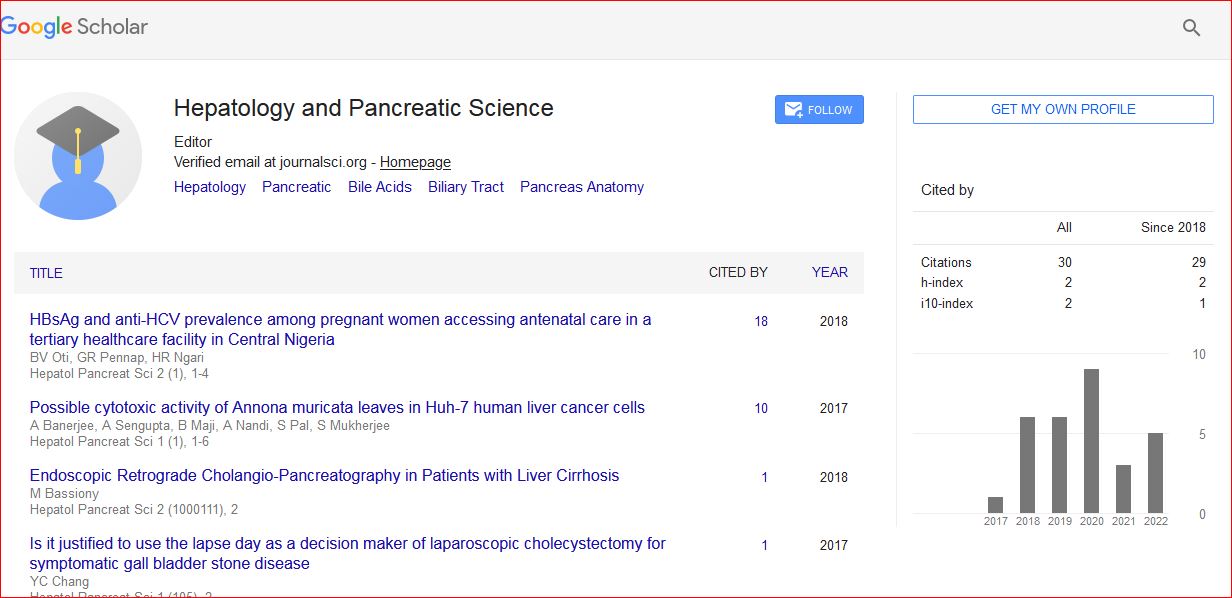
Hepatology and Pancreatic Science received 34 citations as per Google Scholar report