Perspective - (2025) Volume 10, Issue 3
Received: 02-Jun-2025, Manuscript No. jomp-26-185092;
Editor assigned: 04-Jun-2025, Pre QC No. P-185092;
Reviewed: 18-Jun-2025, QC No. Q-185092;
Revised: 23-Jun-2025, Manuscript No. R-185092;
Published:
30-Jun-2025
, DOI: 10.37421/2576-3857.2025.10.310
Citation: Nguyen, Rachel. ”Multi-Omics Insights into Hepatocellular Carcinoma Progression.” J Oncol Med and Pract 10 (2025):310.
Copyright: © 2025 Nguyen R. This is an open-access article distributed under the terms of the Creative Commons Attribution License, which permits unrestricted use, distribution and reproduction in any medium, provided the original author and source are credited.
Hepatocellular carcinoma (HCC) remains a significant global health challenge, necessitating a deeper understanding of its complex progression. Recent advancements in multi-omics technologies have provided unprecedented insights into the molecular underpinnings of this disease. This review synthesizes findings from several key studies that have employed sophisticated multi-omic approaches to dissect HCC pathogenesis. The integration of genomic, transcriptomic, and proteomic data has revealed distinct molecular subtypes that are associated with different stages of tumor development and patient outcomes, highlighting novel therapeutic targets and biomarkers for early detection and personalized treatment strategies in HCC [1].
Further investigation into the regulatory mechanisms driving HCC initiation and advancement has been facilitated by the integration of transcriptomic and epigenomic data. This research elucidates critical gene expression alterations and epigenetic modifications that contribute to tumor heterogeneity and drug resistance, providing a deeper understanding of HCC pathogenesis and pointing towards epigenetic-based therapeutic interventions [2].
The intricate cellular landscape of HCC tumors during progression has been a focus of recent studies utilizing single-cell multi-omics. This approach has revealed distinct cell states and their dynamic transitions, shedding light on the clonal evolution and microenvironmental interactions that fuel tumor growth and metastasis. The insights gained are crucial for developing targeted therapies that address this complexity [3].
The interplay between the tumor microenvironment and HCC progression is another critical area being explored through multi-omics. Key cellular and molecular components of the microenvironment that promote immune evasion and resistance to therapy have been identified, emphasizing the vital role of understanding these interactions in designing immunotherapeutic strategies and combination therapies for HCC [4].
In parallel, the potential of liquid biopsies, including circulating tumor DNA (ctDNA) and other biomarkers, for tracking HCC progression and treatment response via multi-omics is being explored. This approach highlights the promise of non-invasive monitoring of disease dynamics and early detection of relapse, potentially revolutionizing the clinical management of HCC [5].
Metabolic reprogramming is a hallmark of cancer, and multi-omics data has been instrumental in uncovering these changes during HCC progression. Key metabolic pathways and enzymes that are altered, contributing to tumor growth and survival, have been identified, suggesting these metabolic vulnerabilities as promising targets for novel therapeutic strategies [6].
Identifying drivers of early-stage HCC progression and potential therapeutic targets is crucial for improving patient outcomes. Multi-omics data has been leveraged to pinpoint molecular alterations that promote the transition from precancerous lesions to invasive carcinoma, offering critical insights for early intervention and prevention strategies [7].
The role of non-coding RNAs (ncRNAs) in HCC progression has also come under scrutiny through multi-omics. Key long non-coding RNAs (lncRNAs) and microRNAs (miRNAs) that regulate gene expression and influence tumor development have been identified, opening new avenues for ncRNA-based diagnostics and therapeutics [8].
The integration of proteomics and genomics is proving essential for understanding the molecular underpinnings of HCC progression. This approach highlights specific protein alterations that correlate with genomic changes and drive malignant behavior, offering insights into protein-driven therapeutic targets [9].
Finally, the tumor mutational burden (TMB) and its association with multi-omics features in HCC progression are being investigated. Understanding how TMB influences gene expression and pathway activity provides a more comprehensive view of genomic instability and its impact on disease development and therapeutic response [10].
The multi-omic profiling of hepatocellular carcinoma (HCC) has significantly advanced our understanding of its progression by integrating diverse data types, including genomic, transcriptomic, and proteomic information. This comprehensive approach has led to the identification of distinct molecular subtypes, each characterized by specific progression pathways and associated with differential patient outcomes. The findings are pivotal for the development of novel therapeutic targets and more effective biomarkers for early detection and personalized treatment strategies in HCC [1].
Furthermore, the integration of transcriptomic and epigenomic data has been instrumental in elucidating the intricate regulatory mechanisms that govern HCC initiation and advancement. This research has pinpointed critical gene expression alterations and epigenetic modifications that are central to tumor heterogeneity and the development of drug resistance. This deeper understanding of HCC pathogenesis is paving the way for innovative epigenetic-based therapeutic interventions [2].
The cellular heterogeneity within HCC tumors during progression is being dissected with high resolution through single-cell multi-omics. This cutting-edge technology has revealed distinct cell states and their dynamic interplays, offering profound insights into the clonal evolution and the complex microenvironmental interactions that drive tumor growth and metastasis. These discoveries are essential for the design of targeted therapies that can effectively address the multifaceted cellular landscape of HCC [3].
The dynamic interplay between the tumor microenvironment and HCC progression is a crucial area of focus, investigated through various multi-omics approaches. The identification of key cellular and molecular components within the microenvironment that foster immune evasion and therapeutic resistance underscores the importance of understanding these interactions. Such knowledge is vital for the development of effective immunotherapeutic strategies and combination therapies for HCC [4].
In the realm of non-invasive diagnostics and monitoring, multi-omic analysis of circulating tumor DNA (ctDNA) and other liquid biopsy markers is showing immense promise for tracking HCC progression and treatment response. This approach holds the potential to revolutionize the clinical management of HCC by enabling non-invasive monitoring of disease dynamics and facilitating early detection of relapse [5].
Metabolic reprogramming is a fundamental characteristic of cancer, and multi-omics has been crucial in characterizing these shifts during HCC progression. By identifying key metabolic pathways and enzymes that undergo alterations, researchers are uncovering metabolic vulnerabilities that can be exploited for novel therapeutic strategies aimed at inhibiting tumor growth and survival [6].
Identifying the molecular drivers of early-stage HCC progression is paramount for intervention. Multi-omics data has been instrumental in this regard, revealing molecular alterations that facilitate the transition from precancerous lesions to invasive carcinoma. This knowledge is critical for developing effective early intervention and prevention strategies [7].
The role of non-coding RNAs (ncRNAs) in the complex processes of HCC progression is also being illuminated by multi-omics. Studies have identified key long non-coding RNAs (lncRNAs) and microRNAs (miRNAs) that exert regulatory control over gene expression and significantly influence tumor development, opening promising avenues for ncRNA-based diagnostics and therapeutics [8].
An integrated approach combining proteomics and genomics is essential for a complete understanding of the molecular underpinnings of HCC progression. This proteogenomic analysis highlights specific protein alterations that are directly linked to genomic changes and drive the malignant behavior of the tumor, thereby identifying promising protein-driven therapeutic targets [9].
Lastly, the investigation into tumor mutational burden (TMB) and its correlation with multi-omics features in HCC progression is providing a more holistic view. Understanding how TMB impacts gene expression and pathway activity offers a deeper comprehension of genomic instability and its consequences for disease development and therapeutic efficacy [10].
This collection of research utilizes multi-omics approaches to investigate hepatocellular carcinoma (HCC) progression. Studies integrate genomic, transcriptomic, epigenomic, and proteomic data to identify molecular subtypes, regulatory networks, cellular heterogeneity, and tumor microenvironment interactions. Key findings highlight the role of epigenetic modifications, single-cell dynamics, immune evasion mechanisms, and metabolic reprogramming in HCC. The research also explores the potential of liquid biopsies for monitoring disease and the involvement of non-coding RNAs and tumor mutational burden. These insights collectively aim to uncover novel therapeutic targets, biomarkers for early detection, and strategies for personalized treatment, ultimately improving the clinical management of HCC.
None
None
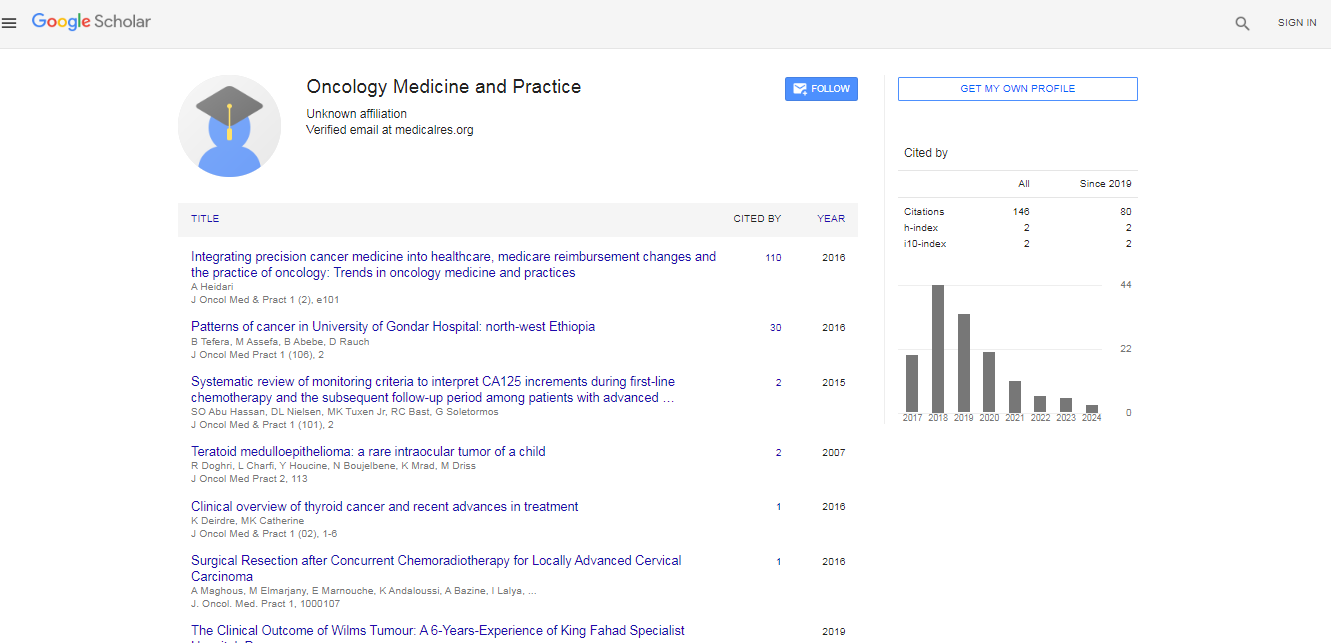
Journal of Oncology Medicine & Practice received 142 citations as per Google Scholar report