Perspective - (2025) Volume 13, Issue 3
Received: 01-May-2025, Manuscript No. economics-26-186052;
Editor assigned: 05-May-2025, Pre QC No. P-186052;
Reviewed: 19-May-2025, QC No. Q-186052;
Revised: 22-May-2025, Manuscript No. R-186052;
Published:
29-May-2025
, DOI: 10.37421/2375-4389.2025.13.528
Citation: Lombardi, Chiara. ”Monetary Policy’s Role in Sustained
Economic Growth.” J Glob Econ 13 (2025):528.
Copyright: © 2025 Lombardi C. This is an open-access article distributed under the terms of the Creative Commons Attribution License, which permits unrestricted use,
distribution and reproduction in any medium, provided the original author and source are credited.
The intricate nexus between interest rate policies and their profound, enduring influence on long-term economic growth forms the bedrock of modern macroeconomic discourse. These monetary policy decisions, particularly concerning the adjustment of benchmark interest rates, wield substantial power in shaping critical economic variables such as investment propensity, national savings rates, and the overall accumulation of capital. Consequently, they directly mold the trajectory of economic expansion over extended periods, a phenomenon meticulously examined in the extant literature [1].
The transmission mechanisms through which these policies exert their influence are multifaceted, encompassing the availability of credit to businesses and individuals, the formation of inflation expectations within the economy, and the prevailing cost of capital for investment projects [1].
Central to the efficacy of interest rate policies is the concept of central bank credibility. A monetary authority perceived as reliable and committed to its stated objectives can effectively anchor inflation expectations and cultivate a more stable environment conducive to investment, which is paramount for sustainable long-term economic development. Conversely, a deficiency in such credibility can sow seeds of policy uncertainty, thereby impeding the prospects for sustained growth [2].
Moreover, the impact of interest rate policy is not uniform across different economic landscapes. Research has illuminated the divergent effects observed in developed versus developing economies. While generally, lower interest rates can act as a stimulus for investment across the board, emerging markets may confront unique challenges, including the potential for capital flight and significant exchange rate volatility, necessitating the adoption of tailored policy approaches to foster long-term growth [3].
Beyond traditional interest rate adjustments, unconventional monetary policies, such as quantitative easing, have also garnered significant attention for their long-term consequences on economic growth. These policies, often deployed in conjunction with interest rate modifications, play a role in influencing investment decisions, maintaining financial stability, and ultimately, fostering the sustained growth of an economy [4].
The synergy between interest rate policies and structural reforms presents another crucial avenue for understanding long-term economic growth. While monetary policy can provide short-to-medium term stimulus, achieving sustained growth critically depends on complementary structural adjustments within labor markets, product markets, and institutional frameworks [5].
Furthermore, the interplay between fiscal policy and monetary management is vital. Fiscal policy responses to economic shocks can significantly influence the effectiveness of interest rate policies. Coordinated fiscal and monetary strategies can enhance economic stability and promote an environment more conducive to sustained economic expansion [6].
Financial innovation and inclusion also emerge as moderating factors in the relationship between interest rate policies and long-term economic growth. Broader access to financial services can amplify the positive effects of accommodative monetary policy on investment and overall productivity [7].
In exploring the frontiers of monetary policy, the long-term impact of negative interest rate policies has become a subject of intense scrutiny. These unconventional measures, often implemented when traditional tools are nearing their limits, present both potential benefits and unintended consequences for economic growth and financial stability [8].
The global economic landscape is also shaped by international capital flows, which are inherently influenced by global interest rate differentials. Managing these flows effectively is crucial for harnessing their growth potential while simultaneously mitigating associated risks, thereby impacting long-term economic growth trajectories [9].
Finally, demographic trends exert a discernible influence on the effectiveness of interest rate policies in fostering long-term economic growth. Aging populations and evolving labor force dynamics can significantly alter savings behavior and investment demand, necessitating adaptive monetary policy strategies to navigate these demographic shifts [10].
The fundamental impact of interest rate policies on long-term economic growth is characterized by their influence on investment, savings, and capital accumulation. Monetary policy decisions concerning interest rates directly shape these variables, thereby dictating the pace and sustainability of economic expansion over extended horizons. The transmission channels through which these policies operate are complex, involving factors such as credit accessibility, inflation expectations, and the cost of capital [1].
A key determinant of successful interest rate policy implementation is the credibility of the central bank. When a central bank is perceived as trustworthy and predictable, it can effectively manage inflation expectations and create a stable investment climate, which is essential for fostering long-term economic development. Conversely, a lack of credibility can introduce policy uncertainty, thereby undermining growth prospects [2].
The differential impact of interest rate policies across various economic contexts is a significant area of study. While lower interest rates generally stimulate investment, emerging markets face distinct challenges, including the risk of capital flight and exchange rate instability, which require bespoke policy interventions to ensure sustainable growth [3].
Unconventional monetary policies, such as quantitative easing, have also demonstrated a capacity to influence long-term economic growth. These strategies, often used alongside conventional interest rate adjustments, affect investment behavior, financial system stability, and the overall trajectory of economic advancement [4].
Furthermore, the interaction between interest rate policies and structural reforms is vital for achieving sustained economic growth. Monetary policy can provide short-to-medium term impetus, but enduring growth necessitates complementary structural adjustments in labor, product, and institutional markets [5].
The alignment of fiscal and monetary policies plays a critical role in economic stability and growth. Fiscal measures enacted in response to economic shocks can either complement or counteract the effectiveness of interest rate policies. Coordinated approaches enhance stability and foster an environment conducive to sustained economic expansion [6].
Financial innovation and increased financial inclusion can significantly moderate the impact of interest rate policies on long-term economic growth. Greater access to financial services can amplify the positive effects of accommodative monetary policies on investment and productivity levels [7].
The exploration of negative interest rate policies reveals their long-term effects on economic growth and financial stability. These unconventional measures, employed when traditional tools are exhausted, present a unique set of benefits and drawbacks that warrant careful consideration [8].
Global interest rate differentials critically influence international capital flows, which in turn shape long-term economic growth patterns. Effective management of these capital flows is imperative to maximize their growth-enhancing potential while mitigating associated risks [9].
Demographic shifts, including aging populations and changing labor force dynamics, also impact the effectiveness of interest rate policies. These trends influence saving and investment behaviors, requiring monetary policy strategies to be adaptive to evolving demographic landscapes for promoting long-term growth [10].
Interest rate policies are crucial drivers of long-term economic growth, influencing investment, savings, and capital accumulation. Central bank credibility is paramount for policy effectiveness, while the impact varies across developed and developing economies. Unconventional monetary policies and structural reforms, alongside coordinated fiscal and monetary strategies, also play significant roles. Financial innovation, inclusion, negative interest rates, international capital flows, and demographic trends further shape the relationship between monetary policy and sustained economic expansion. Adaptive and context-specific approaches are essential for navigating these complexities and fostering robust, long-term growth.
None
None
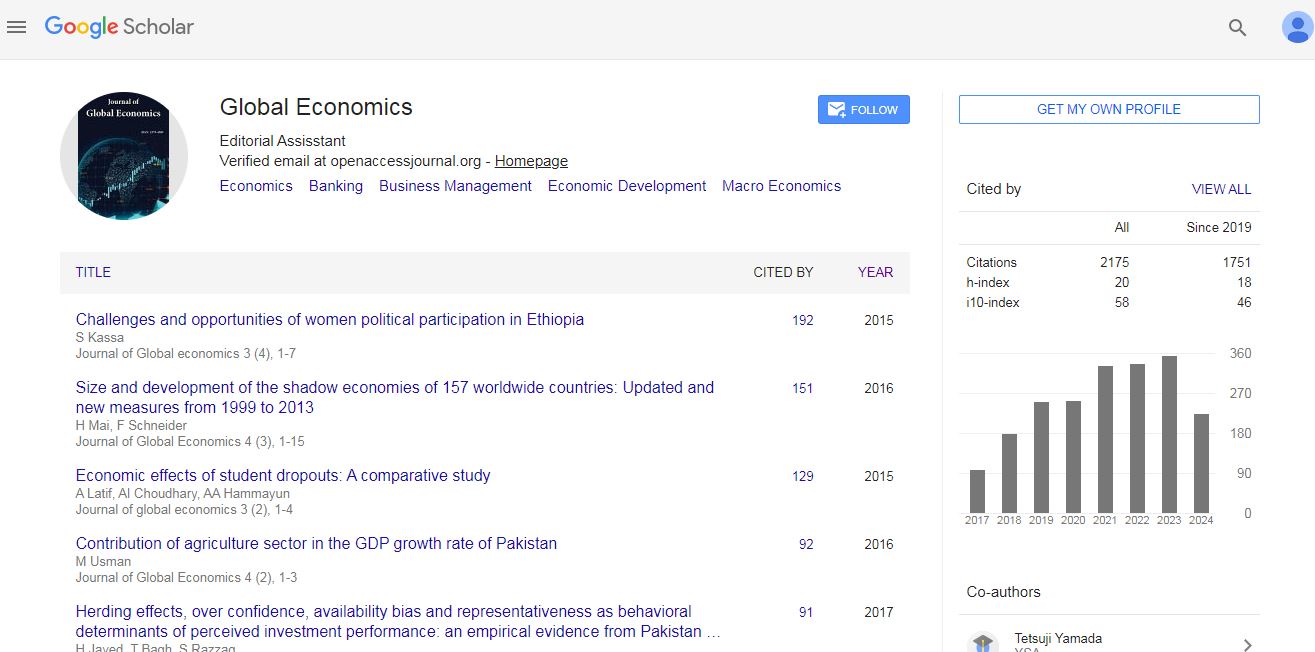
Journal of Global Economics received 2175 citations as per Google Scholar report