Perspective - (2025) Volume 16, Issue 4
Received: 01-Aug-2025, Manuscript No. jmbd-26-179477;
Editor assigned: 04-Aug-2025, Pre QC No. P-179477;
Reviewed: 14-Aug-2025, QC No. Q-179477;
Revised: 21-Aug-2025, Manuscript No. R-179477;
Published:
29-Aug-2025
, DOI: 10.37421/2155-9929.2025.16.714
Citation: Popescu, Daniela. ”Molecular Imaging: Precision Diagnosis, Personalized Treatment, Future Frontiers.” J Mol Biomark Diagn 16 (2025):714.
Copyright: © 2025 Popescu D. This is an open-access article distributed under the terms of the Creative Commons Attribution License, which permits unrestricted use,
distribution and reproduction in any medium, provided the original author and source are credited.
Molecular biomarkers have emerged as indispensable tools in the early and accurate detection of diseases, fundamentally transforming diagnostic approaches. These measurable indicators, encompassing elements such as DNA mutations, proteins, and metabolites, facilitate non-invasive or minimally invasive diagnostic methods, often preceding the manifestation of clinical symptoms. This capability is pivotal for enabling prompt therapeutic interventions, enhancing patient outcomes, and the development of personalized treatment regimens [1].
Liquid biopsies, a groundbreaking advancement, utilize circulating tumor DNA (ctDNA) and other cell-free nucleic acids to significantly improve the early detection and monitoring of cancers. Offering a less invasive alternative to traditional tissue biopsies, they provide real-time insights into tumor evolution and the patient's response to therapeutic interventions [2].
Proteomic biomarkers play a critical role in unraveling the intricate biological pathways associated with disease development. Recent advancements in mass spectrometry and antibody-based techniques are accelerating the identification and validation of specific protein signatures, which are crucial for the early diagnosis and prognosis of a wide spectrum of diseases [3].
Metabolomic profiling offers a dynamic perspective on cellular metabolism, thereby providing invaluable insights into the earliest stages of disease. Alterations in small molecule metabolites can serve as highly sensitive indicators of physiological disturbances, often detectable even before overt pathological changes become apparent [4].
Epigenetic modifications, including DNA methylation and histone modifications, are increasingly recognized for their significant involvement in disease initiation and progression. The analysis of these epigenetic signatures holds substantial promise for the development of novel biomarkers for early disease detection, particularly in the context of cancer [5].
MicroRNAs (miRNAs), small non-coding RNA molecules, exert substantial regulatory control over gene expression. Their inherent stability in biological fluids positions them as highly attractive candidates for non-invasive biomarkers, facilitating the early detection of various diseases, including cardiovascular conditions and cancers [6].
The integration of multi-omics data, which synergistically combines genomics, transcriptomics, proteomics, and metabolomics, provides an exceptionally comprehensive understanding of disease pathogenesis. This holistic analytical approach is instrumental in identifying complex biomarker signatures that enable more accurate and earlier disease detection [7].
Artificial intelligence (AI) and machine learning (ML) are revolutionizing the analysis of complex biomarker datasets. These sophisticated computational tools possess the capability to discern subtle patterns and correlations that might elude traditional analytical methods, thereby enhancing diagnostic accuracy and improving the predictive capabilities for disease onset [8].
Single-cell technologies are paving the way for the detailed analysis of biomarkers at the individual cell level. This high-resolution analytical approach allows for the identification of cell-specific alterations that can serve as crucial early indicators of disease, especially within intricate tissue environments [9].
The successful clinical translation of molecular biomarkers hinges on the development and rigorous validation of robust assay methodologies. Ensuring standardization, reproducibility, and meticulous statistical analysis are paramount for the reliable and accurate deployment of these diagnostic tools in clinical practice [10].
Molecular biomarkers have become fundamental to advancing early and accurate disease detection, leading to a paradigm shift in diagnostic capabilities. These identifiable indicators, such as DNA alterations, protein expressions, or metabolic profiles, enable diagnostic approaches that are often non-invasive or minimally invasive, allowing for detection even before clinical symptoms emerge. This early identification is critical for timely therapeutic interventions, improving patient prognoses, and tailoring personalized treatment strategies [1].
Liquid biopsies, a significant innovation in medical diagnostics, leverage circulating tumor DNA (ctDNA) and other cell-free nucleic acids for enhanced early cancer detection and monitoring. They provide a less invasive alternative to traditional tissue biopsies, enabling continuous assessment of tumor dynamics and therapeutic response [2].
Proteomic biomarkers are essential for comprehending the complex biological processes underlying disease states. Advances in analytical techniques like mass spectrometry and antibody-based methods are significantly improving the identification and validation of protein signatures that are key to early diagnosis and prognosis across diverse diseases [3].
Metabolomic profiling provides a dynamic snapshot of cellular metabolic activities, offering critical insights into the initial phases of disease. Changes in the concentrations of small molecule metabolites can act as sensitive indicators of physiological imbalance, even before pathological changes are clinically evident [4].
Epigenetic modifications, including alterations in DNA methylation and histone patterns, are increasingly understood as crucial factors in disease development and progression. The examination of these epigenetic markers is leading to the discovery of novel biomarkers for early diagnosis, particularly within the field of oncology [5].
MicroRNAs (miRNAs), small regulatory RNA molecules, play vital roles in controlling gene expression. Due to their stability in bodily fluids, they are highly suitable for use as non-invasive biomarkers for the early detection of a range of conditions, including cardiovascular diseases and various cancers [6].
The synergistic integration of multi-omics data, encompassing genomics, transcriptomics, proteomics, and metabolomics, offers a comprehensive view of disease mechanisms. This integrated approach is crucial for uncovering complex biomarker patterns that facilitate earlier and more precise disease detection [7].
Artificial intelligence (AI) and machine learning (ML) are revolutionizing how complex biomarker data is analyzed. These computational methods can identify subtle patterns and interrelationships that are often imperceptible through conventional analysis, thereby enhancing diagnostic accuracy and enabling earlier disease prediction [8].
Single-cell technologies facilitate the detailed analysis of biomarkers at the level of individual cells. This high-resolution methodology allows for the identification of cell-specific molecular changes that can serve as early signals of disease, particularly in complex biological tissues [9].
The successful implementation of molecular biomarkers in clinical settings relies heavily on the development and rigorous validation of reliable assay platforms. Standardization, reproducibility, and robust statistical analysis are indispensable for ensuring the accuracy and dependability of these diagnostic tools [10].
Molecular biomarkers are crucial for early and accurate disease detection, revolutionizing diagnostics. These measurable indicators, including DNA mutations, proteins, metabolites, epigenetic modifications, and microRNAs, enable non-invasive detection, often before symptoms appear. Liquid biopsies, multi-omics integration, single-cell technologies, and AI/ML are advancing these capabilities. Proteomic and metabolomic profiling offer insights into disease pathways and early physiological disturbances. Epigenetic and miRNA analysis holds promise for early diagnosis, particularly in cancer and cardiovascular diseases. The successful translation of these biomarkers into clinical practice depends on robust assay development, standardization, and validation.
None
None
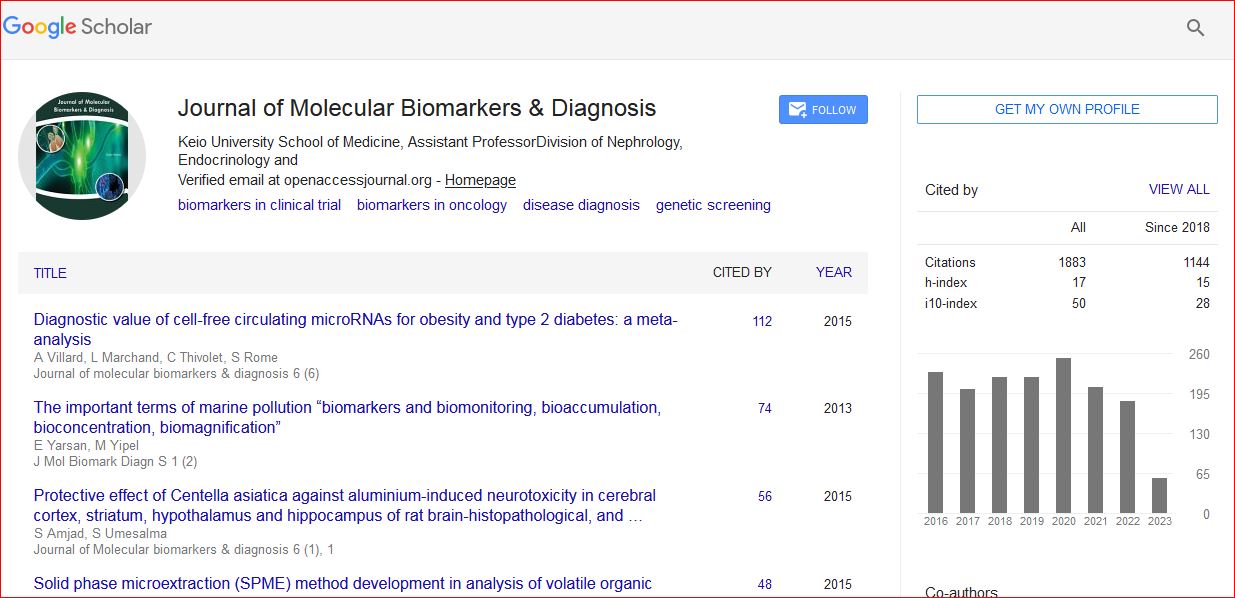
Journal of Molecular Biomarkers & Diagnosis received 2054 citations as per Google Scholar report