Short Communication - (2025) Volume 14, Issue 4
Received: 01-Jul-2025, Manuscript No. mcce-26-190180;
Editor assigned: 03-Jul-2025, Pre QC No. P-190180;
Reviewed: 17-Jul-2025, QC No. Q-190180;
Revised: 22-Jul-2025, Manuscript No. R-190180;
Published:
29-Jul-2025
, DOI: 10.37421/2470-6965.2025.14.414
Citation: Clarke, Benjamin. ”Digital Health Revolutionizing Malaria Monitoring And Reporting.” Malar Contr Elimination 14 (2025):414.
Copyright: © 2025 Clarke B. This is an open-access article distributed under the terms of the Creative Commons Attribution License, which permits unrestricted use, distribution and reproduction in any medium, provided the original author and source are credited.
Digital health solutions are fundamentally transforming the landscape of malaria monitoring and reporting, ushering in an era of enhanced data accuracy, timeliness, and accessibility. These innovative technologies are instrumental in overcoming the limitations of traditional, paper-based systems, which were often prone to errors and delays. By enabling real-time data collection from even the most remote areas, digital platforms facilitate quicker detection and response to malaria outbreaks, thereby improving the efficiency of surveillance efforts. This shift is crucial for implementing more targeted and effective malaria control interventions, as it provides public health officials with up-to-date information on disease prevalence and distribution. Mobile health (mHealth) platforms, in particular, are significantly improving the reporting and management of malaria cases within public health programs. These tools empower community health workers to directly record patient data, track treatment adherence, and document follow-up information. The subsequent transmission of this data to central databases creates an immediate feedback loop, which is invaluable for identifying treatment failures, monitoring the emergence of drug resistance, and optimizing the allocation of resources to ensure better patient outcomes. Geographic Information Systems (GIS) and remote sensing technologies are providing powerful new capabilities for malaria surveillance. By enabling the mapping of mosquito breeding sites, the analysis of environmental factors that influence malaria transmission, and the visualization of case distributions, GIS offers a critical spatial understanding of malaria risk. This spatial data is essential for developing targeted vector control strategies and for accurately predicting potential outbreak hotspots, ultimately enhancing the efficiency of malaria control efforts. Electronic health records (EHRs) are being integrated into national malaria surveillance systems to provide a standardized and comprehensive approach to patient data management. EHRs facilitate the longitudinal tracking of malaria cases, including treatment history and patient outcomes. This comprehensive data is vital for monitoring drug resistance patterns and for evaluating the effectiveness of ongoing malaria control programs. The interoperability of EHRs across different healthcare facilities is a key factor in building a robust national surveillance network. The application of big data analytics in malaria monitoring holds immense potential for identifying complex transmission patterns and for accurately predicting future outbreaks. By integrating diverse data sources, such as climate data, human mobility patterns, and epidemiological information, advanced algorithms can generate early warnings and inform strategic decision-making processes aimed at malaria elimination efforts. Despite the numerous benefits, the implementation of digital health solutions for malaria surveillance in resource-limited settings presents unique challenges. These include limitations in existing infrastructure, gaps in digital literacy among healthcare workers and communities, and concerns regarding data security. Addressing these challenges requires tailored implementation strategies, robust capacity-building initiatives, and strong, collaborative partnerships between technology providers and public health organizations. Integrating laboratory data with digital surveillance systems is a critical step towards ensuring accurate malaria diagnosis and reporting. The use of point-of-care diagnostic tools that can digitally transmit results streamlines the reporting process, reduces delays in diagnosis, and ultimately improves patient management, especially in remote areas with limited laboratory infrastructure. Community engagement plays a vital role in the successful implementation of digital health solutions for malaria monitoring. Empowering communities to actively participate in data collection and reporting through user-friendly digital tools fosters a sense of local ownership and significantly improves the quality and completeness of the surveillance data gathered. The adoption of blockchain technology in malaria reporting offers enhanced data security, transparency, and immutability. This innovative approach can significantly improve the integrity of reported malaria data, foster trust among all stakeholders involved in malaria control programs, and facilitate more reliable, evidence-based decision-making processes. Achieving interoperability between different digital health systems is a critical prerequisite for the success of comprehensive national malaria monitoring and reporting initiatives. The development and adoption of standardized data formats and protocols are essential to ensure that information flows seamlessly between various platforms, enabling a holistic view of the malaria landscape and facilitating integrated disease surveillance efforts.
Digital health technologies are revolutionizing malaria surveillance and reporting by significantly improving the accuracy, timeliness, and accessibility of data. Mobile applications, electronic health records, and Geographic Information Systems (GIS) are at the forefront of this transformation, enabling real-time data collection from even the most geographically dispersed areas. This capability is crucial for the rapid detection of malaria outbreaks and for implementing swift, effective response measures. The move away from traditional paper-based systems not only reduces the incidence of errors but also substantially enhances the efficiency of surveillance operations, leading to the deployment of more precise and impactful malaria control interventions. The integration of mobile health (mHealth) platforms into existing malaria control programs has demonstrably improved the processes for case reporting and patient management. These digital tools empower community health workers by allowing them to directly record vital patient information, monitor treatment adherence, and document crucial follow-up details. This information is then promptly transmitted to central databases, establishing an immediate feedback mechanism. This continuous flow of data is indispensable for identifying instances of treatment failure, tracking the development of drug resistance, and optimizing the allocation of essential resources to achieve superior patient outcomes. Geographic Information Systems (GIS) and advanced remote sensing technologies are providing unparalleled capabilities for effective malaria surveillance. By facilitating the precise mapping of mosquito breeding grounds, enabling the analysis of environmental variables that influence malaria transmission dynamics, and allowing for the visualization of disease case distributions, GIS offers a profound spatial understanding of malaria risk. This spatially-explicit data is fundamental for designing and implementing targeted vector control strategies and for predicting areas with a high potential for malaria outbreaks, thereby augmenting the overall efficiency of control initiatives. Electronic health records (EHRs), when integrated into national malaria surveillance frameworks, offer a standardized and comprehensive methodology for managing patient data. EHRs are essential for the longitudinal tracking of individual malaria cases, detailing their treatment history and subsequent outcomes. This detailed historical data is paramount for monitoring the emergence and spread of drug resistance and for rigorously evaluating the effectiveness of national malaria control programs. The ability of EHRs to interoperate across various healthcare facilities is a cornerstone for establishing a robust and interconnected national surveillance network. The strategic application of big data analytics within malaria monitoring systems provides powerful tools for discerning complex transmission patterns and for forecasting the occurrence of future outbreaks. By synthesizing diverse datasets, including meteorological, mobility, and epidemiological information, sophisticated analytical algorithms can generate crucial early warnings and provide essential insights for strategic decision-making aimed at achieving malaria elimination goals. The successful implementation of digital health solutions for malaria surveillance in settings with limited resources is accompanied by a unique set of challenges. These obstacles include deficiencies in essential infrastructure, disparities in digital literacy among the target populations, and critical concerns surrounding data privacy and security. Effectively navigating these hurdles necessitates the development of context-specific implementation approaches, comprehensive capacity-building programs, and the cultivation of strong, synergistic partnerships between technology developers and public health organizations. The seamless integration of laboratory diagnostic data with sophisticated digital surveillance systems is absolutely critical for ensuring the accuracy of malaria diagnoses and for the reliability of reporting mechanisms. The deployment of point-of-care diagnostic devices that possess the capability to digitally transmit results significantly streamlines the reporting workflow, minimizes diagnostic delays, and ultimately enhances patient care, particularly in remote regions where laboratory infrastructure is often underdeveloped. Active community engagement represents a cornerstone for the successful adoption and sustained impact of digital health strategies in malaria monitoring. By empowering local communities to actively participate in the process of data collection and reporting through the use of intuitive and user-friendly digital tools, a sense of local ownership is fostered, which in turn leads to substantial improvements in both the quality and completeness of the gathered surveillance data. The prospective adoption of blockchain technology in the domain of malaria reporting presents a compelling pathway towards significantly enhanced data security, improved transparency, and the assurance of data immutability. This innovative technological approach has the potential to substantially bolster the integrity of reported malaria data, cultivate a higher degree of trust among all involved stakeholders, and ultimately enable more dependable, evidence-based strategic planning for malaria control initiatives. Ensuring robust interoperability among the diverse array of digital health systems currently in use is a critical determinant for the overall success of comprehensive national malaria monitoring and reporting initiatives. The widespread adoption of standardized data formats and communication protocols is indispensable for facilitating the seamless flow of information across various platforms, thereby enabling the creation of a holistic perspective on the malaria epidemiological landscape and supporting the development of integrated disease surveillance systems.
Digital health solutions are revolutionizing malaria monitoring and reporting through enhanced data accuracy, timeliness, and accessibility. Technologies like mobile applications, EHRs, and GIS enable real-time data collection, facilitating quicker outbreak detection and response. mHealth platforms improve case reporting and management, providing immediate feedback for better patient outcomes and resource allocation. GIS and remote sensing offer spatial insights for targeted vector control and outbreak prediction. EHRs standardize patient data management for tracking and program evaluation. Big data analytics helps identify transmission patterns and predict outbreaks. Challenges in resource-limited settings include infrastructure and digital literacy gaps, requiring tailored solutions and partnerships. Integrating laboratory data with digital systems via point-of-care tools improves diagnosis and reporting. Community engagement is vital for data quality and ownership. Blockchain technology enhances data security and transparency. Interoperability between digital systems is crucial for a holistic view and integrated surveillance.
None
None
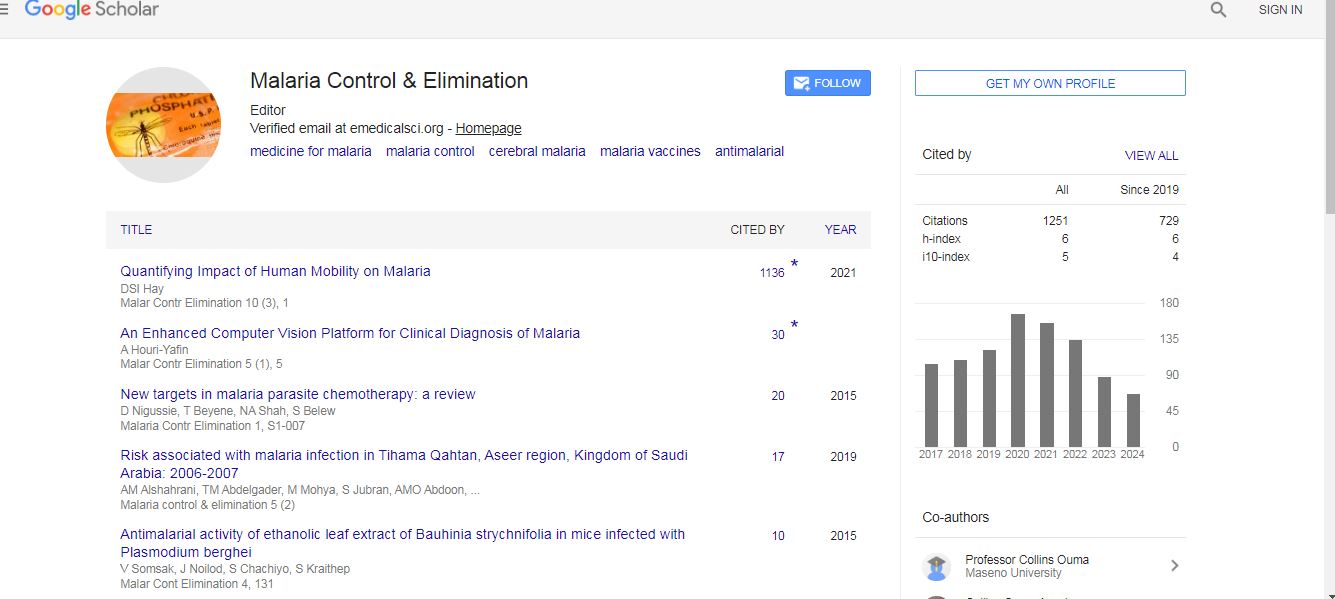
Malaria Control & Elimination received 1187 citations as per Google Scholar report