Brief Report - (2025) Volume 14, Issue 5
Received: 01-Sep-2025, Manuscript No. jmmd-26-184697;
Editor assigned: 03-Sep-2025, Pre QC No. P-184697;
Reviewed: 17-Sep-2025, QC No. Q-184697;
Revised: 22-Sep-2025, Manuscript No. R-184697;
Published:
29-Sep-2025
, DOI: 10.37421/2161-0703.2025.14.541
Citation: Khatib, Farah. ”Molecular Diagnostics: A Revolution in Microbiology.” J Med Microb Diagn 14 (2025):541.
Copyright: © 2025 Khatib F. This is an open-access article distributed under the terms of the Creative Commons Attribution License, which permits unrestricted use, distribution and reproduction in any medium, provided the original author and source are credited.
The field of diagnostic microbiology is undergoing a significant transformation, marked by the progressive integration of advanced molecular techniques alongside traditional culture-based methodologies. This evolution is driven by the persistent need for more rapid, accurate, and comprehensive pathogen identification and characterization, ultimately aiming to improve patient outcomes and combat infectious diseases effectively. The shift from solely relying on microbial growth on culture media to exploiting molecular signatures of pathogens represents a paradigm change in how laboratories approach infectious disease diagnostics. Traditional culture-based methods, while foundational, are often time-consuming and may not be suitable for all microorganisms, particularly those that are difficult to culture or require specialized growth conditions. The inherent limitations of these methods have spurred the development and adoption of molecular diagnostic tools that can detect microbial nucleic acids or specific genetic markers with high sensitivity and specificity. These molecular approaches offer a significant advantage in scenarios where rapid turnaround times are critical for timely clinical decision-making. The advent of techniques such as Polymerase Chain Reaction (PCR) and various sequencing technologies has revolutionized the ability to identify pathogens and assess their genetic relatedness. PCR, in its various forms including real-time PCR and multiplex PCR, allows for the amplification of specific DNA or RNA sequences, enabling the rapid detection of target organisms. This has direct implications for the diagnosis of a wide range of infectious conditions, from common respiratory tract infections to life-threatening sepsis. Further advancements in molecular diagnostics have introduced more sophisticated platforms like Whole-Genome Sequencing (WGS) and Metagenomic Next-Generation Sequencing (mNGS). WGS provides a comprehensive genetic blueprint of a pathogen, offering unparalleled resolution for antimicrobial resistance profiling, outbreak investigations, and understanding the evolutionary dynamics of microbial populations. This level of detail far surpasses what can be achieved with conventional culture or targeted molecular assays alone. In parallel, mNGS has emerged as a powerful tool for unbiased detection of microbial agents in complex samples. Unlike targeted methods, mNGS can identify a broad spectrum of pathogens without prior assumptions, making it particularly valuable for diagnosing unusual or polymicrobial infections where the causative agent may not be readily apparent. Its broad detection capability offers a significant leap beyond the limitations of hypothesis-driven diagnostic approaches. The utility of molecular diagnostics extends to the detection of antimicrobial resistance (AMR) genes, a critical concern in the era of rising antibiotic resistance. Molecular methods can rapidly identify specific resistance determinants, providing crucial information to guide antimicrobial therapy and inform infection control strategies. This contrasts sharply with traditional phenotypic susceptibility testing, which can be time-consuming and may not always accurately reflect the underlying genetic basis of resistance. Beyond PCR and sequencing, other molecular amplification techniques, such as isothermal amplification methods, have gained traction due to their simplicity, speed, and minimal equipment requirements. These methods, like Loop-mediated Isothermal Amplification (LAMP), offer a promising alternative for point-of-care diagnostics, enabling rapid microbial detection in resource-limited settings or at the patient's bedside, thus complementing traditional laboratory-based assays. While the advantages of molecular diagnostics are clear, their implementation in routine laboratory workflows is not without challenges. These include the need for specialized equipment, trained personnel for data interpretation, cost considerations, and validation of assays for clinical use. However, ongoing efforts are focused on streamlining these processes and integrating molecular diagnostics seamlessly into existing laboratory infrastructure. The integration of rapid molecular diagnostics for bloodstream infections, for instance, has shown a significant impact on clinical management and antimicrobial stewardship. By shortening the time to pathogen identification and resistance gene detection, these assays facilitate more informed empirical therapy decisions, potentially reducing the duration of broad-spectrum antibiotic use and improving patient outcomes. Looking ahead, novel biosensor technologies are being developed to offer even faster, more sensitive, and field-deployable microbial detection capabilities. While still in their early stages of development for widespread clinical application, these technologies hold the potential to further augment or even supplant current diagnostic paradigms, representing a frontier in the continuous quest for enhanced infectious disease diagnostics.
Diagnostic microbiology has historically relied on culture-based methods for the identification and characterization of microbial pathogens. These traditional techniques involve growing microorganisms on various media, followed by morphological and biochemical analysis. While fundamental, culture methods are often characterized by lengthy incubation periods and may fail to detect or identify fastidious or non-culturable organisms, posing limitations in timely diagnosis and treatment [1].
In contrast, molecular diagnostic assays have emerged as powerful tools, offering enhanced speed, sensitivity, and specificity for pathogen detection. Techniques such as Polymerase Chain Reaction (PCR) amplify specific genetic material of microorganisms, enabling rapid identification even at low concentrations. This has been particularly impactful in diagnosing bacterial infections, where molecular methods often provide results much faster than conventional cultures, allowing for earlier therapeutic interventions [2].
Multiplex PCR represents a significant advancement, allowing for the simultaneous detection of multiple respiratory pathogens from a single sample. This approach dramatically improves diagnostic yield and reduces the time to diagnosis compared to sequential testing with traditional sputum cultures. By identifying a broader range of targets efficiently, multiplex PCR aids in guiding more targeted and effective therapy for respiratory infections [3].
Whole-Genome Sequencing (WGS) has introduced a paradigm shift in antimicrobial resistance (AMR) profiling. Unlike phenotypic testing or targeted molecular methods, WGS provides a comprehensive genetic analysis of a bacterium, revealing all resistance genes present. This high-resolution data is invaluable for tracking outbreaks, understanding resistance mechanisms, and making informed treatment decisions, offering a level of detail unobtainable from culture alone [4].
Real-time PCR has proven to be a valuable tool for the rapid diagnosis of sepsis, a life-threatening condition where timely intervention is critical. Comparative studies show that real-time PCR significantly shortens the time to pathogen detection compared to blood cultures. While blood cultures remain the gold standard for confirmation, real-time PCR serves as a vital adjunctive diagnostic tool for prompt initiation of antimicrobial therapy in critically ill patients [5].
Metagenomic Next-Generation Sequencing (mNGS) offers a broad, hypothesis-independent approach to microbial detection in infectious diseases. Unlike targeted methods like culture or PCR, mNGS can identify a wide array of pathogens simultaneously from complex samples. This capability holds immense potential for revolutionizing the diagnostics of challenging or unknown infections, though cost and data interpretation remain areas for development [6].
Isothermal amplification techniques, such as LAMP, present an attractive alternative to traditional PCR and culture for microbial detection. These methods operate at a constant temperature, requiring minimal equipment, making them highly suitable for point-of-care settings. Their speed and simplicity allow them to effectively complement or, in certain scenarios, replace conventional diagnostic methods for specific microbial targets [7].
Advances in automated culture systems have focused on improving laboratory efficiency and detection rates compared to manual methods. While automation enhances throughput and standardization, the core principle remains microbial growth. This is in contrast to molecular methods that detect genetic material directly, providing faster results and the ability to identify non-culturable pathogens or resistance genes that might be missed by culture [8].
The integration of rapid molecular diagnostics for bloodstream infections has demonstrated a substantial impact on clinical management and antimicrobial stewardship. These assays significantly reduce the time to pathogen and resistance gene identification, enabling more precise empirical therapy. Challenges related to workflow integration and the interpretation of complex molecular data are being addressed to maximize their clinical utility [9].
Novel biosensor technologies are emerging as promising tools for point-of-care microbial detection, offering potential advantages in speed, sensitivity, and portability over established culture and molecular methods. While these technologies are still evolving for widespread clinical adoption, they represent a significant future direction that could profoundly augment current diagnostic practices and potentially supplant existing paradigms in certain applications [10].
This collection of research highlights the transformative impact of molecular diagnostic techniques in microbiology, contrasting them with traditional culture-based methods. Molecular approaches such as PCR, WGS, mNGS, and isothermal amplification offer enhanced speed, sensitivity, and specificity for pathogen identification and antimicrobial resistance profiling. These advancements are crucial for rapid diagnosis of infections like sepsis and respiratory illnesses, guiding timely and targeted therapy, and improving patient outcomes. While challenges in implementation and interpretation exist, molecular diagnostics, alongside emerging biosensor technologies, are revolutionizing the field, offering a significant leap beyond conventional diagnostic paradigms.
None
None
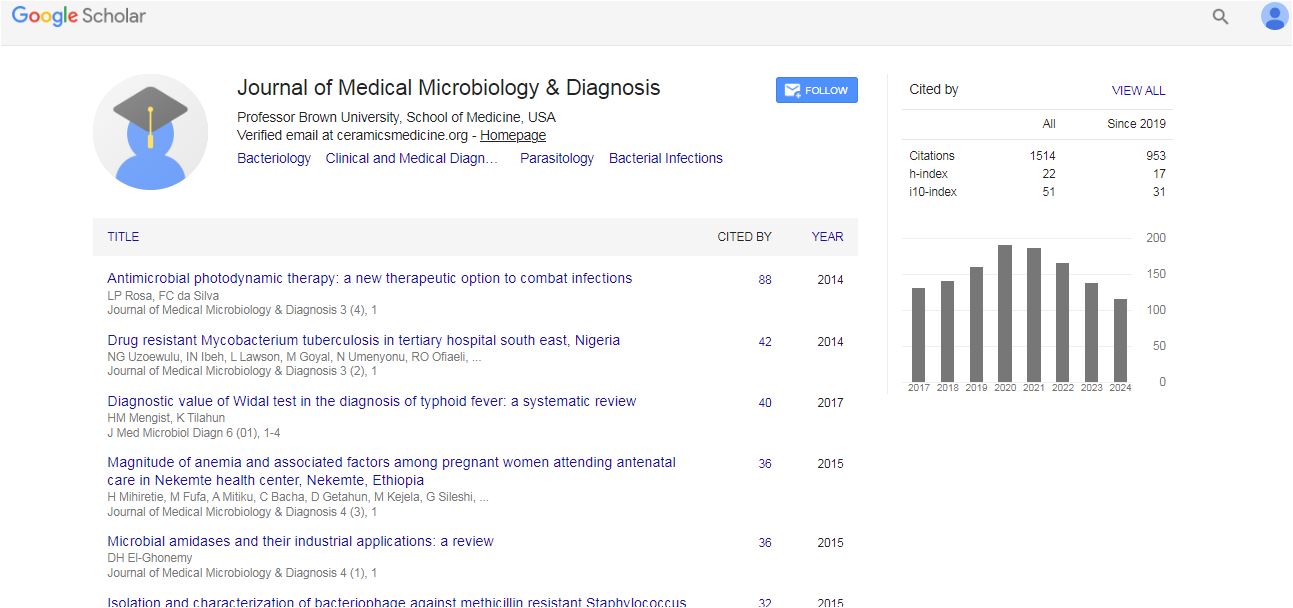
Medical Microbiology & Diagnosis received 14 citations as per Google Scholar report