Perspective - (2025) Volume 14, Issue 5
Received: 02-Sep-2025, Manuscript No. pbt-25-173776;
Editor assigned: 04-Sep-2025, Pre QC No. P-173776;
Reviewed: 18-Sep-2025, QC No. Q-173776;
Revised: 23-Sep-2025, Manuscript No. R-173776;
Published:
30-Sep-2025
, DOI: 10.37421/2167-7689.2025.14.505
Citation: Romero, Lucas. ”Modernizing Drug Labels: Safety, Digital, AI.” Pharmaceut Reg Affairs 14 (2025):505.
Copyright: © 2025 Romero L. This is an open-access article distributed under the terms of the Creative Commons Attribution License, which permits unrestricted use,
distribution and reproduction in any medium, provided the original author and source are credited.
This article investigates the concept of patient-friendly drug labeling, assessing current practices and outlining future directions for improving the clarity and usability of medication information for consumers. It emphasizes the need for simplified language, visual aids, and interactive digital platforms to enhance patient comprehension and adherence. The authors suggest that regulatory bodies and pharmaceutical companies should collaborate more closely to develop standardized, patient-centric labeling guidelines [1].
This paper examines the increasing integration of real-world evidence (RWE) into drug labeling updates and post-marketing surveillance activities. It highlights how RWE can provide crucial insights into drug safety and effectiveness in diverse patient populations, leading to more precise and relevant label information. The authors discuss methodological challenges in RWE generation and interpretation, urging for robust regulatory frameworks to ensure the reliability and validity of RWE-driven label changes [2].
This article delves into the regulatory science behind drug labeling for special populations, such as pediatric, geriatric, and pregnant patients. It addresses the inherent challenges in generating sufficient data for these groups and how regulations are evolving to ensure appropriate and safe drug information. The authors advocate for innovative study designs and better data extrapolation methods to strengthen label accuracy and relevance for these vulnerable populations [3].
This article traces the historical progression of drug product labeling from traditional paper inserts to modern digital formats, and looks ahead at future innovations. It discusses the drivers for these changes, including patient accessibility, environmental considerations, and the need for dynamic updates. The authors analyze the regulatory challenges in transitioning to fully digital labeling, emphasizing the importance of standardization and interoperability across global health systems [4].
This study focuses on the specific regulatory trends concerning patient information leaflets and labeling for orphan drugs, which treat rare diseases. It highlights the unique challenges in labeling these products due to limited patient populations and often specialized administration. The authors review global regulatory approaches aimed at ensuring clear, concise, and accessible information for patients and caregivers, despite the inherent complexities of orphan drug development and usage [5].
This article examines the critical link between adverse drug reaction (ADR) reporting and subsequent changes to drug labeling. It analyzes how pharmacovigilance data, collected through various reporting systems, informs regulatory decisions to update safety information on medication labels. The authors discuss the challenges in timely data collection and analysis, emphasizing the importance of robust pharmacovigilance systems to ensure labels accurately reflect the latest safety profiles of drugs [6].
This study applies human factors principles to assess and improve the usability of drug labels specifically for older adults. It identifies common readability and comprehension issues faced by this population and proposes design modifications, such as larger fonts, clearer language, and standardized formats, to enhance their ability to correctly understand and follow medication instructions. The authors highlight the need for regulations to incorporate age-friendly design principles in drug labeling [7].
This article explores the complex legal and ethical considerations surrounding off-label drug use and its relationship to official drug labeling. It discusses the responsibilities of prescribers, pharmaceutical companies, and regulatory bodies in situations where drugs are used for indications not approved on their labels. The authors debate the balance between clinical freedom and patient safety, advocating for clearer guidelines and increased transparency regarding off-label prescribing practices [8].
This paper examines the interplay between regulatory oversight of pharmaceutical promotion and the accurate representation of drug information on labels. It highlights how promotional activities can sometimes misrepresent or overstate the benefits of drugs, leading to potential discrepancies with official label claims. The authors propose stricter enforcement mechanisms and greater synergy between advertising regulations and labeling requirements to ensure that promotional materials align consistently with approved drug information [9].
This article discusses the transformative potential of Artificial Intelligence (AI) and Machine Learning (ML) in revolutionizing pharmacovigilance processes and the efficiency of drug labeling updates. It explores how AI/ML can rapidly analyze vast amounts of data from diverse sources to identify emerging safety signals and adverse drug reactions, thereby enabling more timely and accurate label revisions. The authors also address the regulatory challenges of integrating AI-driven insights, emphasizing the need for robust validation frameworks and ethical considerations [10].
The multifaceted domain of drug labeling is undergoing significant evolution, driven by the need for enhanced patient safety, clarity, and accessibility. A primary thrust involves transforming labels to be more patient-friendly, moving beyond complex jargon to simplified language, incorporating intuitive visual aids, and developing interactive digital platforms. These initiatives are critical for improving patient comprehension and adherence to medication regimens, with a strong call for collaboration between regulatory bodies and pharmaceutical companies to establish standardized, patient-centric guidelines [C001]. This focus on user-centric design extends specifically to older adults, where applying human factors principles reveals common readability and comprehension issues. Proposed design modifications, such as larger fonts, clearer language, and standardized formats, are advocated to significantly enhance their ability to correctly understand and follow medication instructions, emphasizing the need for regulations to embrace age-friendly design principles [C007].
Regulatory science plays a pivotal role in ensuring appropriate drug information for diverse patient populations, particularly those considered special groups. This includes pediatric, geriatric, and pregnant patients, where inherent challenges exist in generating sufficient clinical data. Regulations are continually evolving to address these gaps, promoting innovative study designs and improved data extrapolation methods to bolster label accuracy and relevance for these vulnerable groups [C003]. Similarly, the labeling of orphan drugs, which target rare diseases, presents unique complexities. Limited patient populations and specialized administration methods necessitate specific global regulatory approaches focused on delivering clear, concise, and accessible information for both patients and caregivers, effectively navigating the intricacies of orphan drug development and usage [C005].
The reliability and accuracy of drug labeling are increasingly informed by robust data sources and ongoing surveillance. Real-world evidence (RWE) has become an indispensable tool, providing crucial insights into drug safety and effectiveness within diverse patient populations. This leads to more precise and relevant label information, though generating and interpreting RWE comes with methodological challenges, necessitating robust regulatory frameworks to ensure its validity and reliability [C002]. Integral to maintaining up-to-date safety profiles is adverse drug reaction (ADR) reporting. Pharmacovigilance data, collected through various reporting systems, directly informs regulatory decisions for updating safety information on medication labels. The challenges in timely data collection and analysis underscore the critical importance of strong pharmacovigilance systems to ensure labels consistently reflect the most current safety information [C006].
The history of drug product labeling illustrates a notable progression from traditional paper inserts to advanced digital formats, with a clear trajectory toward future innovations. This evolution is spurred by factors such as improved patient accessibility, environmental sustainability, and the necessity for dynamic updates. However, the transition to fully digital labeling faces significant regulatory challenges, especially concerning standardization and interoperability across global health systems [C004]. Looking ahead, Artificial Intelligence (AI) and Machine Learning (ML) are poised to revolutionize pharmacovigilance and streamline drug labeling updates. These technologies can rapidly analyze vast amounts of data from various sources to identify emerging safety signals and adverse drug reactions, thereby facilitating more timely and accurate label revisions. Integrating AI-driven insights, however, introduces regulatory challenges, emphasizing the need for robust validation frameworks and careful ethical considerations [C010].
Beyond the direct scientific data and technological advancements, the integrity of drug labeling is also shaped by legal, ethical, and commercial factors. The complex legal and ethical implications surrounding off-label drug use, where medications are prescribed for unapproved indications, require careful consideration of the responsibilities of prescribers, pharmaceutical companies, and regulatory bodies. This involves balancing clinical freedom with patient safety, advocating for clearer guidelines and increased transparency regarding these prescribing practices [C008]. Furthermore, stringent regulatory oversight of pharmaceutical promotion is essential to ensure that promotional activities accurately represent drug information and do not misstate or overstate benefits. Addressing potential discrepancies between promotional claims and official label information requires stricter enforcement mechanisms and greater synergy between advertising regulations and labeling requirements to maintain consistent and approved drug information [C009].
The landscape of drug labeling is undergoing significant transformation, driven by the imperative to enhance patient understanding and safety. A central theme involves making drug labels more patient-friendly through simplified language, visual aids, and the adoption of interactive digital platforms, all aimed at boosting comprehension and adherence [C001]. This evolution is particularly crucial for special populations, including pediatric, geriatric, and pregnant patients, where generating sufficient data poses unique challenges, necessitating innovative study designs and data extrapolation methods for accurate labeling [C003]. Furthermore, orphan drugs for rare diseases present specific regulatory hurdles, highlighting the need for clear, concise, and accessible information despite their inherent complexities [C005]. The integration of real-world evidence is increasingly vital for updating labels and improving post-marketing surveillance, providing deep insights into drug safety and effectiveness across varied patient groups [C002]. Historically, labeling has moved from traditional paper to modern digital formats, driven by accessibility, environmental concerns, and the need for dynamic updates, although this transition faces regulatory and standardization issues [C004]. Robust pharmacovigilance systems, including adverse drug reaction reporting, are essential for informing regulatory decisions and ensuring labels accurately reflect the latest safety profiles [C006]. The legal and ethical implications of off-label drug use demand clearer guidelines and transparency [C008], while stringent regulatory oversight is necessary to ensure pharmaceutical promotion aligns with approved label information [C009]. Looking forward, Artificial Intelligence (AI) and Machine Learning (ML) are set to revolutionize pharmacovigilance by enabling rapid analysis of vast data for safety signals, paving the way for more timely and accurate label revisions, though this introduces new regulatory and ethical considerations [C010].
None
None
1. Anna BJ, Carl LP, Ingrid SN. "Patient-Friendly Drug Labeling: Current Status and Future Perspectives".Eur J Clin Pharmacol 79 (2023):345-353.
Indexed at, Google Scholar, Crossref
2. David RS, Emily TC, Michael WJ. "The Role of Real-World Evidence in Drug Labeling and Post-Marketing Surveillance".Clin Ther 44 (2022):1493-1502.
Indexed at, Google Scholar, Crossref
3. Laura JT, Steven AR, Olivia NM. "Regulatory Science for Modern Drug Labeling: A Focus on Special Populations".Clin Pharmacol Ther 114 (2023):234-242.
Indexed at, Google Scholar, Crossref
4. Sarah JA, Thomas KM, Jessica RG. "Evolution of Drug Product Labeling: From Paper to Digital and Beyond".J Pharm Sci 111 (2022):1269-1277.
Indexed at, Google Scholar, Crossref
5. Olivia MW, Benjamin SH, Sophie AC. "Global Regulatory Trends in Patient Information Leaflets and Labeling for Orphan Drugs".Orphanet J Rare Dis 16 (2021):340.
Indexed at, Google Scholar, Crossref
6. Fiona PC, Andrew MD, Louise TE. "Adverse Drug Reaction Reporting and Its Impact on Drug Labeling Changes".Br J Clin Pharmacol 86 (2020):1993-2002.
Indexed at, Google Scholar, Crossref
7. Carol BJ, Peter AM, Jessica LW. "Improving the Usability of Drug Labels for Older Adults: A Human Factors Approach".J Am Geriatr Soc 67 (2019):1499-1505.
Indexed at, Google Scholar, Crossref
8. Michael JA, Rebecca LC, Thomas PW. "The Legal and Ethical Implications of Off-Label Drug Use and Labeling".Am J Bioeth 20 (2020):4-15.
Indexed at, Google Scholar, Crossref
9. Susan EW, David PK, Emily MC. "Regulatory Oversight of Pharmaceutical Promotion and Its Influence on Drug Labeling".Health Aff (Millwood) 40 (2021):1058-1066.
Indexed at, Google Scholar, Crossref
10. Kevin JT, Maria CS, Paul AG. "Artificial Intelligence and Machine Learning in Pharmacovigilance and Drug Labeling Updates".Clin Pharmacol Ther 115 (2024):13-21.
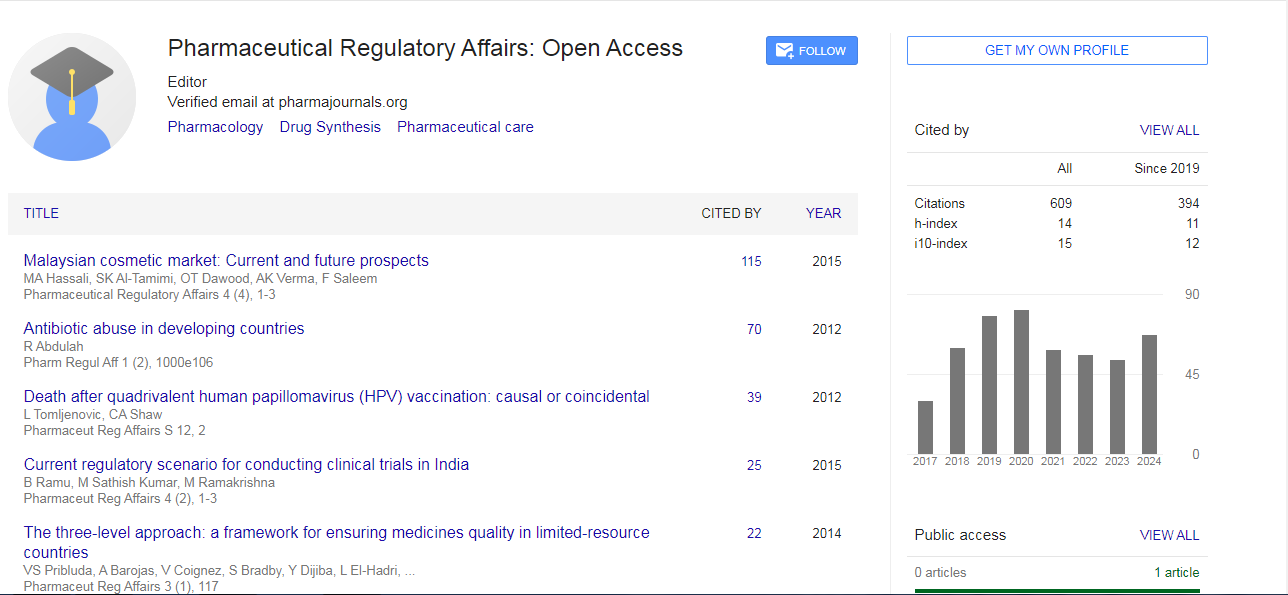
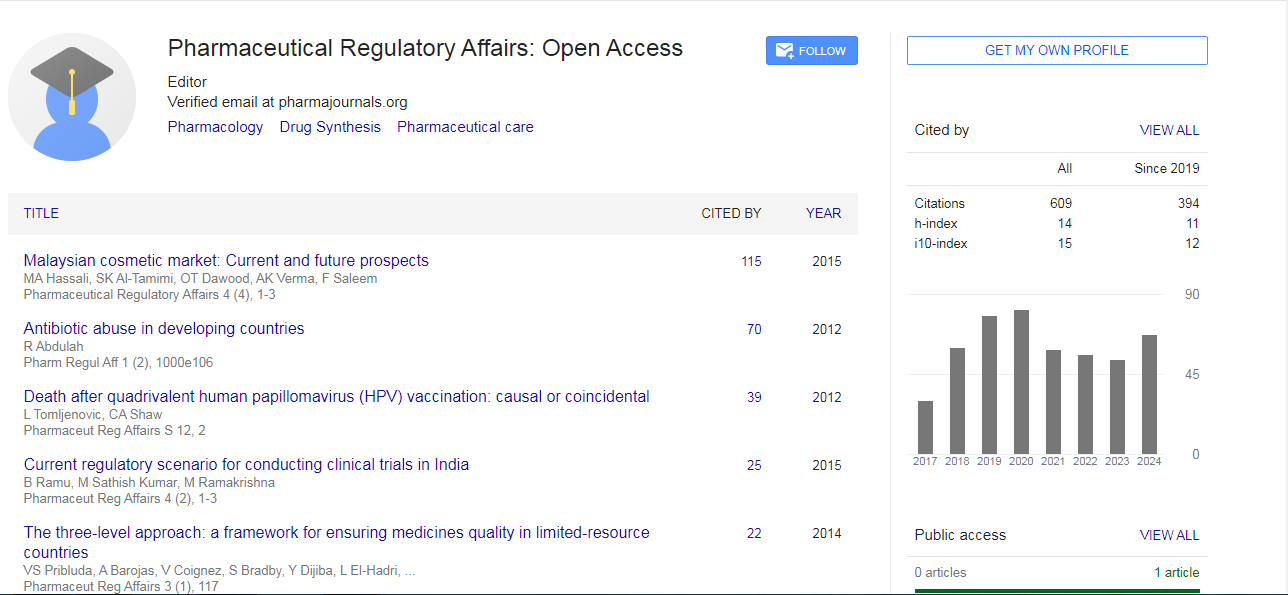
Pharmaceutical Regulatory Affairs: Open Access received 533 citations as per Google Scholar report