Short Communication - (2025) Volume 14, Issue 6
Received: 01-Dec-2025, Manuscript No. jbfa-25-176846;
Editor assigned: 03-Dec-2025, Pre QC No. P-176846;
Reviewed: 17-Dec-2025, QC No. Q-176846;
Revised: 22-Dec-2025, Manuscript No. R-176846;
Published:
29-Dec-2025
, DOI: 10.37421/2161-0673.2025.14.559
Citation: Carlos Henrique. "Modern Economic Modeling and Policy Toolkit." J Bus Fin Aff 14 (2025):559.
Copyright: © 2025 H. Carlos This is an open-access article distributed under the terms of the Creative Commons Attribution License, which permits unrestricted use, distribution and reproduction in any medium, provided the original author and source are credited.
Modern macroeconomic analysis heavily relies on Dynamic Stochastic General Equilibrium (DSGE) models, which offer a thorough guide to understanding economic fluctuations and evaluating policy interventions. These models involve detailed steps in construction, estimation, and simulation, proving indispensable for central banks and research institutions [1].
Alongside traditional approaches, machine learning (ML) techniques are increasingly enhancing economic policy analysis. These models improve handling high-dimensional data, identifying complex non-linear relationships, and boosting forecasting accuracy, presenting a powerful tool for robust policy design [2].
In climate change economics, Integrated Assessment Models (IAMs) are evolving, with Artificial Intelligence (AI) poised to transform them. AI can make IAMs more sophisticated in representing intricate feedback loops, uncertainty, and behavioral aspects, leading to improved climate policy insights despite methodological and ethical challenges [3].
Agent-based modeling (ABM) offers a distinct methodology, especially relevant in financial markets. By simulating heterogeneous agent interactions, ABMs capture emergent macroeconomic phenomena not easily handled by traditional equilibrium models, offering benefits in understanding market dynamics, systemic risk, and policy impacts in complex adaptive systems [4].
For regional economic analysis, novel Computable General Equilibrium (CGE) models, like one developed for the United States, provide insights into inter-regional and inter-sectoral impacts of economic shocks and policy changes. These models help analyze trade agreements or infrastructure investments, shedding light on spatial economic interactions [5].
Forecasting methods also see continuous advancement, particularly with factor models. A review of literature highlights how these models handle large datasets and capture common drivers of economic variables, ultimately offering improved accuracy and robustness in macroeconomic and financial forecasting [6].
Challenging assumptions of rational homogeneity, research explores modeling behavioral heterogeneity within economic networks. By incorporating diverse decision-making rules and social learning, a more realistic understanding of complex economic phenomena, such as opinion dynamics and market inefficiencies, emerges from local agent interactions [7].
Empirical macroeconomic models are vital for policy guidance, as seen in a study investigating fiscal multipliers in a small open economy like Italy. This work estimates the impact of government spending and tax changes on economic activity, offering crucial insights into fiscal policy effectiveness given specific economic structures and international linkages [8].
Addressing environmental sustainability, integrated ecological-economic models are developed to assess agricultural production alongside ecosystem services. These models explore trade-offs and synergies between maximizing output and maintaining environmental health, informing land-use planning for a balanced rural economy [9].
Finally, network economic models serve as critical tools for assessing the impacts of natural disasters on supply chains. By analyzing disruption propagation through complex networks, these models quantify economic losses and identify critical vulnerabilities, providing a framework for disaster preparedness and resilience planning in global supply chains [10].
Economic modeling has evolved significantly, encompassing both established frameworks and innovative computational approaches. Dynamic Stochastic General Equilibrium (DSGE) models remain a core component of modern macroeconomic analysis, providing a structured way to understand economic fluctuations and evaluate policy interventions. These models detail how to build, estimate, and simulate them, proving their value for central banks and research institutions [1]. Beyond these foundational methods, machine learning (ML) techniques are increasingly enhancing economic policy analysis. ML models demonstrate a clear capacity to improve traditional econometric approaches, particularly in managing vast datasets, uncovering complex non-linear relationships, and refining forecasting accuracy. This shift offers significant potential for designing more effective and resilient economic policies [2]. Furthermore, the realm of climate change economics is witnessing a transformation with the advent of Artificial Intelligence (AI) in Integrated Assessment Models (IAMs). AI integration is enabling IAMs to represent complex feedback loops, uncertainties, and behavioral dimensions with greater sophistication, thereby generating deeper insights for climate policy, even as it introduces new methodological and ethical considerations [3].
Specialized modeling paradigms continue to expand the analytical toolkit available to economists. Agent-based modeling (ABM) stands out for its application in financial markets, where it effectively simulates the interactions of diverse agents to capture emergent macroeconomic phenomena that equilibrium models often miss. ABMs are valuable for understanding market dynamics, assessing systemic risk, and evaluating policy impacts within complex adaptive systems [4]. Region-specific economic analysis also benefits from advanced modeling techniques. For instance, new regional Computable General Equilibrium (CGE) models, such as those developed for the United States, meticulously detail their structural components, data sources, and calibration. These models are essential for analyzing the inter-regional and inter-sectoral consequences of various economic shocks and policy changes, like trade agreements or infrastructure investments, providing crucial insights into spatial economic interactions and policy implications [5]. Improving forecasting capabilities is another central theme in economic research. Factor models, for example, have seen significant advances, as highlighted by a review of the literature. These models excel at handling large datasets and identifying common drivers of economic variables, leading to more accurate and robust macroeconomic and financial forecasts [6].
Addressing the nuances of human behavior within economic systems offers a more realistic perspective. Research into modeling behavioral heterogeneity within economic networks, which focuses on local agent interactions, challenges traditional assumptions of rational homogeneity. By incorporating diverse decision-making rules and social learning mechanisms, economists can gain a more profound understanding of complex phenomena like opinion dynamics and market inefficiencies [7]. On a more direct policy application front, studies are conducted to quantify the effectiveness of government interventions. An investigation into fiscal multipliers within a small open economy, specifically Italy, employed an empirical macroeconomic model. This research estimated the impact of government spending and tax adjustments on economic activity over different periods, providing valuable guidance for policymakers by considering specific economic structures and international linkages [8].
Economic models are also pivotal in addressing critical global challenges such as environmental sustainability and disaster resilience. Integrated ecological-economic models are being developed to assess agricultural production in conjunction with the provision of ecosystem services. These models meticulously explore the trade-offs and potential synergies between maximizing agricultural output and maintaining environmental sustainability, offering a scientific basis for land-use planning and policy decisions aimed at fostering a more balanced and sustainable rural economy [9]. Furthermore, in an increasingly interconnected world, understanding and mitigating the economic impacts of natural disasters is paramount. Network economic models are specifically designed to assess how such disruptions propagate through complex supply chains, affecting various economic sectors and regions. By providing a framework to quantify economic losses and pinpoint critical nodes and vulnerabilities, these models become invaluable tools for enhancing disaster preparedness and resilience planning across global supply chains [10].
This collection of papers highlights the diverse and evolving landscape of economic modeling and policy analysis. It covers foundational macroeconomic tools like Dynamic Stochastic General Equilibrium (DSGE) models, which are crucial for understanding economic fluctuations and policy evaluation. Beyond traditional methods, the research explores the integration of advanced computational techniques. For example, machine learning (ML) is applied to enhance econometric approaches, handle complex data, and improve forecasting in economic policy. Artificial Intelligence (AI) also plays a transformative role in Integrated Assessment Models (IAMs) for climate change economics, offering more sophisticated representations of feedback loops, uncertainty, and behavioral aspects. Other papers delve into specialized modeling approaches. Agent-based modeling (ABM) is examined for its utility in financial markets, capturing emergent macroeconomic phenomena through agent interactions and assessing systemic risk. Regional Computable General Equilibrium (CGE) models are introduced for analyzing inter-regional and inter-sectoral impacts of economic shocks and policy changes within specific geographies like the United States. Forecasting is further refined through factor models, which efficiently manage large datasets and identify common economic drivers.
None
None
Indexed at, Google Scholar, Crossref
Indexed at, Google Scholar, Crossref
Indexed at, Google Scholar, Crossref
Indexed at, Google Scholar, Crossref
Indexed at, Google Scholar, Crossref
Indexed at, Google Scholar, Crossref
Indexed at, Google Scholar, Crossref
Indexed at, Google Scholar, Crossref
Indexed at, Google Scholar, Crossref
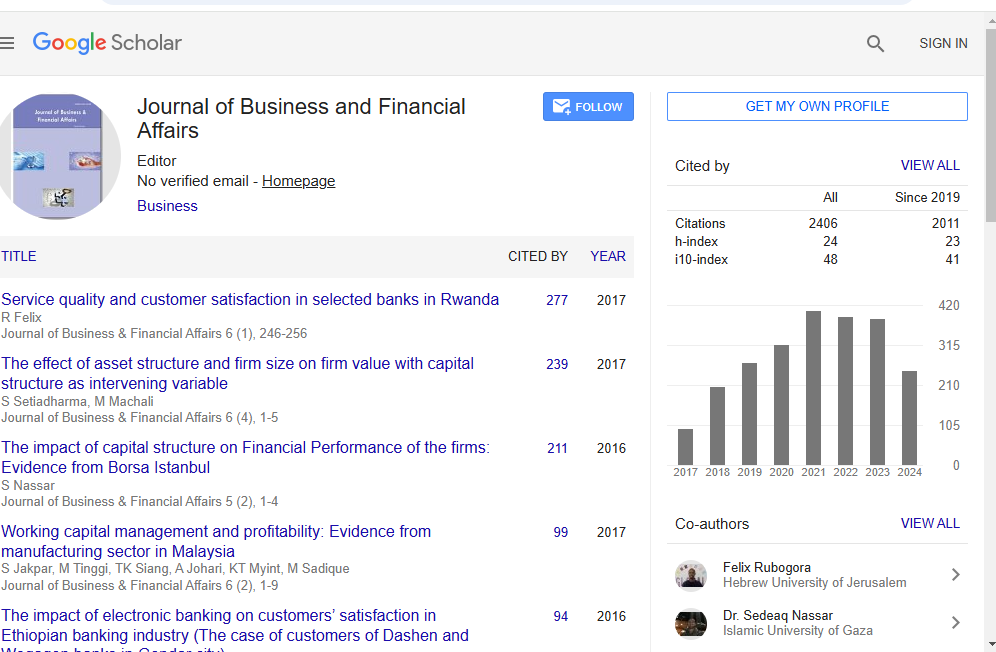
Journal of Business & Financial Affairs received 1726 citations as per Google Scholar report