Short Communication - (2025) Volume 14, Issue 4
Received: 03-Aug-2025, Manuscript No. jsp-26-182270;
Editor assigned: 05-Aug-2025, Pre QC No. P-182270;
Reviewed: 19-Aug-2025, QC No. Q-182270;
Revised: 21-Aug-2025, Manuscript No. R-182270;
Published:
30-Aug-2025
, DOI: 10.37421/2165-7939.2025.14.739
Citation: Nowak, Katarzyna M.. ”Minimally Invasive Spine Surgery: A Revolution in Care.” J Spine 14 (2025):739.
Copyright: © 2025 Nowak M. Katarzyna This is an open-access article distributed under the terms of the Creative Commons Attribution License, which permits unrestricted use, distribution and reproduction in any medium, provided the original author and source are credited.
Percutaneous and endoscopic spine surgery techniques herald a significant paradigm shift in the management of various spinal pathologies, offering a less invasive alternative to traditional open surgical methods [1].
These advanced approaches are characterized by smaller incisions, minimized disruption of surrounding tissues, and consequently, accelerated patient recovery times compared to their open counterparts [1].
A critical factor enabling this evolution is the development of specialized surgical instruments and sophisticated visualization systems, which empower surgeons to navigate and operate within narrow anatomical corridors with remarkable precision and control [1].
This advancement directly addresses the growing patient preference for less invasive interventions and contributes to improved clinical outcomes, including a reduction in hospital stays and a quicker return to daily activities [1].
Endoscopic discectomy, particularly for the treatment of lumbar disc herniation, has emerged as a preeminent percutaneous technique in modern spine surgery [2].
This method employs an endoscope introduced through a minuscule skin incision, allowing surgeons direct visual access to the affected nerve root for precise decompression and removal of herniated disc material, all while preserving adjacent healthy structures [2].
The efficacy of this technique is well-documented, providing significant pain relief and functional restoration, often enabling same-day discharge for patients [2].
Percutaneous pedicle screw fixation presents a valuable alternative to open spinal fusion procedures, facilitating the accurate placement of instrumentation through small stab incisions [3].
This approach significantly reduces muscle stripping and perioperative morbidity, thereby enhancing patient recovery [3].
While the technical demands are considerable, continuous advancements in navigation systems and implant design have demonstrably improved the accuracy and safety profiles of these procedures, establishing them as a viable option for spinal stabilization in cases of instability or deformity [3].
The application of endoscopic techniques has been extended to address spinal canal decompression, most notably for lumbar spinal stenosis [4].
Through transforaminal or interlaminar endoscopic approaches, surgeons can precisely target and excise hypertrophic ligamentum flavum and osteophytes, effectively alleviating neurogenic claudication with minimal perturbation of spinal biomechanics [4].
Careful patient selection and an understanding of long-term efficacy are paramount considerations for the successful implementation of this modality [4].
Percutaneous kyphoplasty and vertebroplasty represent minimally invasive interventions specifically designed for the treatment of vertebral compression fractures, commonly associated with osteoporosis [5].
These procedures involve the precise injection of bone cement into the fractured vertebra, aimed at restoring vertebral height and alleviating associated pain [5].
Despite their effectiveness, meticulous patient selection is crucial to mitigate potential complications and ensure the attainment of optimal clinical results [5].
The integration of robotic technology and advanced navigation systems into percutaneous and endoscopic spine surgery is significantly enhancing surgical precision and concurrently reducing patient exposure to ionizing radiation [6].
Robotic assistance provides surgeons with superior trajectory planning and instrument guidance, particularly beneficial in technically challenging procedures such as pedicle screw insertion, leading to improved accuracy and potentially superior clinical outcomes [6].
While generally associated with lower complication rates than traditional open procedures, percutaneous and endoscopic spine surgeries are not entirely devoid of risks [7].
Potential complications can include, but are not limited to, nerve root injury, surgical site infections, incorrect implant positioning, and dural tears [7].
A thorough understanding of spinal anatomy, the application of meticulous surgical technique, and careful patient selection are indispensable elements in minimizing these potential risks [7].
The progressive development of endoscopic spine surgery has paved the way for advanced techniques in managing degenerative conditions of the cervical spine [8].
Endoscopic cervical discectomy and foraminotomy offer a compelling alternative to open surgical approaches, potentially reducing the risk of recurrent laryngeal nerve injury and facilitating a faster recovery for patients [8].
However, the confined anatomical space of the cervical spine presents unique challenges in terms of visualization and instrument manipulation, necessitating specialized training and expertise [8].
The economic ramifications of percutaneous and endoscopic spine surgery are substantial and increasingly recognized [9].
These benefits are primarily driven by shorter hospital stays, a diminished requirement for postoperative pain management, and a more rapid return to gainful employment [9].
Although the initial investment in specialized instruments and comprehensive training can be considerable, the long-term cost-effectiveness of these minimally invasive techniques for both healthcare systems and patients is becoming increasingly evident [9].
Future advancements in percutaneous and endoscopic spine surgery are poised to encompass further refinement of existing instrumentation, enhanced integration of advanced imaging modalities, and the development of novel techniques capable of addressing more complex spinal pathologies [10].
The unwavering pursuit of enhanced precision, improved safety, and ultimately, superior patient outcomes will undoubtedly continue to fuel innovation within this rapidly evolving and dynamic field of spine care [10].
Percutaneous and endoscopic spine surgery represent a transformative leap in the treatment of spinal disorders, characterized by their minimally invasive nature [1].
These techniques prioritize smaller incisions and reduced soft tissue disruption, leading to significantly faster recovery periods for patients compared to conventional open surgical procedures [1].
The advent of specialized surgical instruments and advanced visualization technologies has been instrumental in enabling surgeons to operate through confined anatomical spaces with exceptional precision [1].
This progress aligns with growing patient demand for less invasive treatment options and demonstrably contributes to better clinical results and shorter hospitalizations [1].
Endoscopic discectomy stands out as a leading percutaneous technique, particularly for addressing lumbar disc herniation [2].
This procedure utilizes an endoscope inserted through a small skin opening, granting surgeons direct visualization of the affected nerve root for decompression and herniated disc material removal with minimal damage to surrounding neural and musculoskeletal structures [2].
The procedure is associated with substantial pain relief and functional improvement, often allowing for same-day patient discharge [2].
Percutaneous pedicle screw fixation provides a viable alternative to open spinal fusion, allowing for the placement of spinal instrumentation through small skin punctures [3].
This method reduces the extensive muscle dissection inherent in open surgery and lowers perioperative morbidity [3].
Despite the technical complexities, advancements in navigation systems and implant designs have enhanced accuracy and safety, establishing it as a reliable option for stabilizing the spine in cases of instability or deformity [3].
The utility of endoscopic techniques extends to the decompression of the spinal canal, specifically for managing lumbar spinal stenosis [4].
Employing transforaminal or interlaminar endoscopic approaches, surgeons can precisely remove hypertrophied ligamentum flavum and bone spurs that cause nerve compression, thereby alleviating neurogenic claudication with minimal impact on spinal mechanics [4].
Crucial to successful outcomes are careful patient selection and a thorough understanding of the long-term efficacy of this approach [4].
Percutaneous kyphoplasty and vertebroplasty are minimally invasive procedures employed to treat vertebral compression fractures, frequently resulting from osteoporosis [5].
These techniques involve injecting bone cement into the fractured vertebral body to restore its height and alleviate pain [5].
While effective, judicious patient selection is paramount to prevent complications and ensure optimal therapeutic results [5].
The incorporation of robotics and navigation technologies into percutaneous and endoscopic spine surgery is a significant development, enhancing surgical precision and reducing radiation exposure for both patients and staff [6].
Robotic systems offer improved trajectory planning and instrument guidance, particularly valuable in intricate procedures like pedicle screw insertion, leading to greater accuracy and potentially improved clinical outcomes [6].
Although generally associated with a lower incidence of complications compared to open spine surgery, percutaneous and endoscopic techniques are not without potential risks [7].
These may include nerve root injury, infection, malposition of implants, and dural tears [7].
A deep anatomical knowledge, meticulous surgical technique, and appropriate patient selection are critical factors in minimizing these adverse events [7].
The evolution of endoscopic spine surgery has led to sophisticated techniques for treating degenerative cervical spine conditions [8].
Endoscopic cervical discectomy and foraminotomy offer a compelling alternative to open surgery, potentially decreasing the risk of recurrent laryngeal nerve injury and accelerating patient recovery [8].
However, the limited space and unique anatomical challenges of the cervical spine require specialized surgical expertise and training for effective visualization and instrument manipulation [8].
The economic impact of percutaneous and endoscopic spine surgery is considerable, largely due to shorter hospital stays, reduced reliance on postoperative analgesics, and a quicker return to work [9].
While the initial costs of specialized equipment and training can be substantial, the long-term cost-effectiveness for healthcare systems and patients is increasingly recognized and documented [9].
Future advancements in percutaneous and endoscopic spine surgery are anticipated to focus on further refining instrumentation, improving imaging integration, and developing novel techniques for addressing complex spinal pathologies [10].
The continuous drive for enhanced precision, safety, and improved patient outcomes will undoubtedly propel further innovation in this rapidly advancing field [10].
Percutaneous and endoscopic spine surgery techniques are transforming spinal care by offering minimally invasive approaches with smaller incisions, less tissue disruption, and faster recovery times. Key advancements include specialized instruments and visualization systems. Endoscopic discectomy is a leading percutaneous technique for lumbar disc herniation, providing significant pain relief and rapid recovery. Percutaneous pedicle screw fixation offers an alternative to open fusion, reducing morbidity. Endoscopic decompression is effective for lumbar spinal stenosis. Kyphoplasty and vertebroplasty treat vertebral compression fractures. Robotics and navigation enhance precision. While complications exist, they are generally lower than open surgery. Endoscopic techniques are also advancing for cervical spine conditions. These minimally invasive procedures offer significant economic benefits through shorter hospital stays and faster return to work. Future innovations will continue to drive progress in precision, safety, and patient outcomes.
None
None
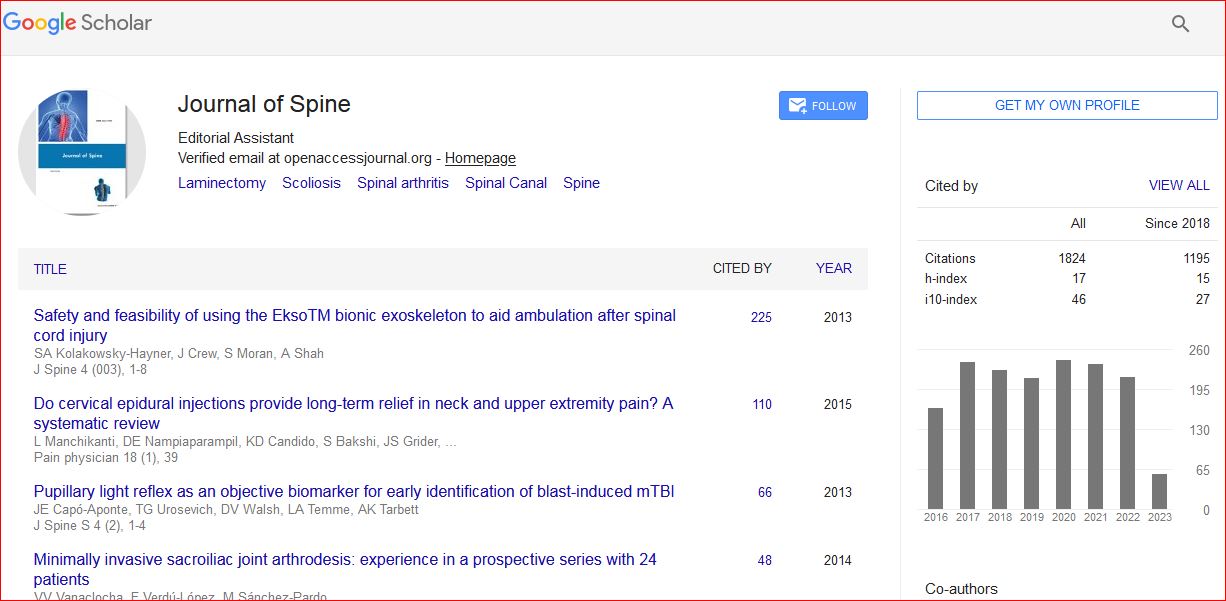
Journal of Spine received 2022 citations as per Google Scholar report