Perspective - (2025) Volume 15, Issue 6
Received: 03-Nov-2025, Manuscript No. jcde-25-177554;
Editor assigned: 05-Nov-2025, Pre QC No. P-177554;
Reviewed: 19-Nov-2025, QC No. Q-177554;
Revised: 24-Nov-2025, Manuscript No. R-177554;
Published:
01-Dec-2025
, DOI: 10.37421/2165-784X.2025.15.638
Citation: Carson, Zoe. ”Microplastic Remediation: Strategies for
Removal and Degradation.” J Civil Environ Eng 15 (2025):638.
Copyright: © 2025 Carson Z. This is an open-access article distributed under the terms of the Creative Commons Attribution License, which permits unrestricted use,
distribution and reproduction in any medium, provided the original author and source are credited.
Microplastic pollution presents a pervasive environmental challenge, contaminating aquatic environments, soil, and even drinking water sources. Addressing this widespread issue requires innovative and effective remediation strategies. Research has explored various approaches, ranging from advanced physical separation techniques to biological degradation and chemical oxidation processes. One significant area of focus involves the use of biochar and modified biochar materials, which demonstrate considerable potential in removing microplastics from aquatic environments [1].
Their inherent porous structure and specific surface chemistry facilitate efficient adsorption, with modifications offering further enhancements in both efficiency and selectivity. Biological methods also present a promising, environmentally sound pathway for tackling microplastics. Enzymes, particularly those sourced from microorganisms, can effectively degrade diverse types of plastic polymers, laying the groundwork for viable biological remediation strategies [2].
This enzymatic degradation offers a natural breakdown mechanism that could be scaled for wider application. Advanced membrane technologies stand out for their effectiveness in removing microplastics from various water sources, including both potable water and wastewater [3].
Techniques such as microfiltration, ultrafiltration, nanofiltration, and reverse osmosis each possess distinct removal efficiencies, which are largely influenced by pore size and specific operating conditions. Another innovative approach to degradation is nanomaterial-based photocatalysis. This method leverages light energy to break down plastic polymers into simpler, less harmful compounds, thereby offering a sustainable solution for microplastic remediation [4].
This technology holds significant promise for future development in environmental cleanup. For drinking water safety, conventional treatment processes are critical. Coagulation-flocculation, followed by sedimentation and filtration, demonstrates varying success rates in microplastic removal from potable water [5].
Optimizing these traditional steps is essential to boost their efficiency and ensure the delivery of safe drinking water to communities. Phycoremediation, an eco-friendly strategy utilizing algae, offers a sustainable method for addressing microplastic pollution [6].
Algae can effectively adsorb or physically entangle microplastics, thereby facilitating their subsequent removal from contaminated aquatic systems. Advanced Oxidation Processes (AOPs) are recognized for their capability to degrade microplastics in aquatic environments [7].
Processes like Fenton, ozonation, and photocatalysis generate highly reactive species that attack and break down the complex polymer chains of microplastics into smaller, less harmful molecules. These methods provide robust chemical solutions for persistent plastic fragments. Magnetic separation technology represents an efficient and specialized technique for removing microplastics from water [8].
This method employs magnetic particles or ferrofluids that bind to plastic fragments, allowing for their subsequent separation. It proves especially useful for smaller microplastics that are typically challenging to remove using other means. Furthermore, plant-based technologies, encompassing various forms of phytoremediation, offer a natural solution for mitigating microplastic pollution in both soil and water [9].
Plants can actively contribute to the breakdown of microplastics or sequester these particles within their tissues, providing a sustainable and natural remediation pathway. Finally, ultrasonic degradation offers a distinct physical method for breaking down microplastics through cavitation [10].
This process generates intense localized forces, capable of fragmenting plastic particles. Such a technique holds potential as a treatment solution for microplastic-contaminated waters, complementing other degradation strategies. Collectively, these varied approaches underscore the complexity and the urgent need for comprehensive solutions to the global microplastic crisis.
The escalating global concern over microplastic pollution has spurred extensive research into diverse mitigation strategies. These efforts broadly categorize into methods aimed at physical removal and those focusing on the degradation of plastic polymers into less harmful substances. Each approach offers unique advantages and challenges, contributing to a comprehensive understanding of microplastic remediation.
Physical removal techniques include the application of biochar and modified biochar materials, which demonstrate significant efficacy in adsorbing microplastics from aquatic environments [1]. The enhanced porosity and tailored surface chemistry of these materials make them effective for capturing fine plastic particles. Similarly, advanced membrane technologies, such as microfiltration, ultrafiltration, nanofiltration, and reverse osmosis, are highly capable of separating microplastics from both water and wastewater streams [3]. The selection and performance of these membrane systems depend critically on factors like pore size and operational parameters. Furthermore, conventional drinking water treatment processes, particularly coagulation-flocculation followed by sedimentation and filtration, play a role in microplastic removal from potable water, though their efficiencies can vary [5]. Optimizing these traditional steps is essential to maximize their effectiveness. Magnetic separation technology also offers a precise method, utilizing magnetic particles or ferrofluids to bind and separate microplastics, proving especially valuable for smaller particles that are difficult to isolate otherwise [8].
Biological and nature-based solutions are gaining traction for their eco-friendly profiles. Enzymes, often sourced from microorganisms, represent a promising avenue for the enzymatic degradation of various plastic polymers, indicating a strong potential for biological remediation [2]. This enzymatic action effectively breaks down the complex plastic structures. Phycoremediation, which involves the use of algae, is another sustainable approach; algae can effectively adsorb or physically entangle microplastics, thereby facilitating their removal from aquatic systems [6]. Building on this, plant-based technologies, or phytoremediation, contribute to microplastic mitigation in both soil and water by aiding in their breakdown or sequestering them within plant structures [9]. These natural processes harness biological mechanisms to address pollution.
Chemical and advanced degradation processes provide powerful means to break down microplastics. Nanomaterial-based photocatalysis, for instance, utilizes light energy to transform plastic polymers into simpler, less toxic compounds, offering a sustainable degradation pathway [4]. This method is particularly attractive for its potential to leverage renewable energy. Advanced Oxidation Processes (AOPs), including Fenton, ozonation, and photocatalysis, are highly effective in degrading microplastics in aquatic environments by generating potent reactive species that dismantle polymer chains [7]. These processes are critical for breaking down stubborn plastic fragments. In parallel, ultrasonic degradation employs cavitation to physically fragment microplastic particles, producing intense localized forces that break them down into smaller pieces [10]. This physical degradation method offers another tool in the arsenal against microplastic contamination, complementing the chemical approaches. The combined application and further development of these diverse strategies are crucial for addressing the pervasive and complex issue of microplastic pollution globally.
The widespread issue of microplastic pollution in aquatic and terrestrial environments has prompted significant research into effective remediation strategies. Various physical, chemical, and biological methods are being explored for both the removal and degradation of these persistent pollutants. For removal, biochar and modified biochar materials show promise due to their porous structure and surface chemistry, enabling effective adsorption of microplastics. Advanced membrane technologies, including microfiltration, ultrafiltration, nanofiltration, and reverse osmosis, are also highly effective, with their efficiency dependent on pore size and operating conditions. Conventional drinking water treatment processes, like coagulation-flocculation, sedimentation, and filtration, offer varying degrees of success, highlighting the need for optimization to ensure potable water safety. Furthermore, phycoremediation, leveraging algae's ability to adsorb or entangle microplastics, provides an eco-friendly removal approach. Magnetic separation technology offers an efficient way to remove smaller microplastics by binding them to magnetic particles. In terms of degradation, enzymes, often derived from microorganisms, present an environmentally friendly solution by breaking down plastic polymers. Nanomaterial-based photocatalysis utilizes light energy to degrade microplastics into less harmful compounds, representing a sustainable remediation option. Advanced Oxidation Processes (AOPs), encompassing Fenton, ozonation, and photocatalysis, generate reactive species that effectively break down polymer chains. Ultrasonic degradation employs cavitation to fragment plastic particles, offering a physical method for breakdown. Plant-based technologies, such as phytoremediation, also contribute by influencing microplastic breakdown or sequestering them within plant structures, providing a natural pathway for remediation in both soil and water. These diverse approaches collectively demonstrate the multidisciplinary effort to combat microplastic contamination.
1. Xiao M, Lin L, Guosheng L. "Biochar-based materials for microplastic removal: a review".Chemosphere 329 (2023):138865.
Indexed at, Google Scholar, Crossref
2. Mian H, Peng L, Rui L. "Enzymatic degradation of microplastics: A review".Journal of Cleaner Production 411 (2023):137452.
Indexed at, Google Scholar, Crossref
3. Rakesh K, Lovejeet S, Dong WK. "Advanced membrane technologies for microplastic removal from water and wastewater: A comprehensive review".Chemosphere 349 (2024):140816.
Indexed at, Google Scholar, Crossref
4. Xin Y, Meng Z, Jing L. "Nanomaterial-based photocatalysis for microplastic degradation: A review".Science of The Total Environment 899 (2023):167086.
Indexed at, Google Scholar, Crossref
5. Peng M, Hui W, Yuhao L. "Microplastic removal from drinking water: A comprehensive review on coagulation-flocculation, sedimentation, and filtration processes".Journal of Environmental Chemical Engineering 11 (2023):110594.
Indexed at, Google Scholar, Crossref
6. Rayees AB, Jameel AD, Showkat HW. "Phycoremediation of microplastics: A sustainable approach for environmental cleanup".Journal of Cleaner Production 428 (2023):139415.
Indexed at, Google Scholar, Crossref
7. Wei Z, Baobao W, Yihua Z. "Application of advanced oxidation processes for microplastic degradation in aquatic environments: A review".Journal of Cleaner Production 419 (2023):137839.
Indexed at, Google Scholar, Crossref
8. Peng L, Xiang L, Xueli W. "Magnetic separation technology for microplastic removal from aqueous solutions: Recent advances and future perspectives".Science of The Total Environment 897 (2023):166708.
Indexed at, Google Scholar, Crossref
9. Muhammad A, Muhammad U, Muhammad R. "Plant-based technologies for microplastic remediation in soil and water: A review".Environmental Pollution 335 (2023):121960.
Indexed at, Google Scholar, Crossref
10. Chuan Z, Zhiyong W, Guang C. "Ultrasonic degradation of microplastics: Mechanisms, influencing factors, and challenges".Chemical Engineering Journal 472 (2023):143642.
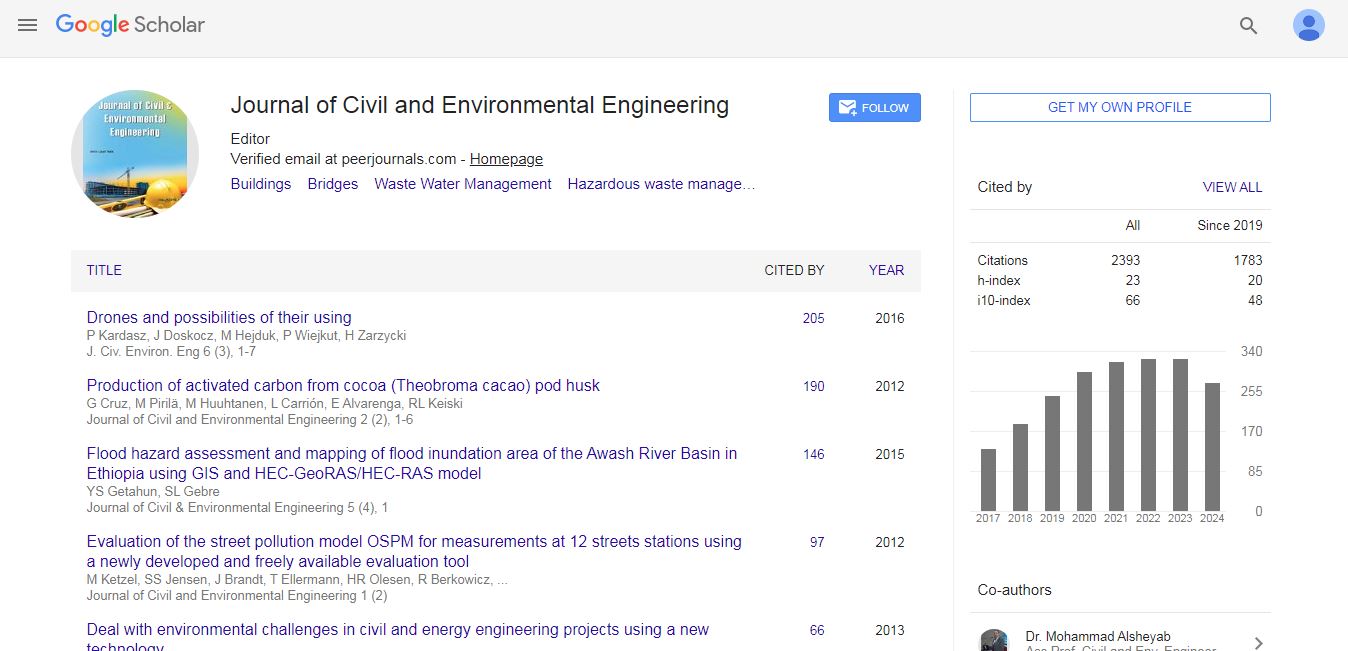
Journal of Civil and Environmental Engineering received 1798 citations as per Google Scholar report