Commentary - (2025) Volume 10, Issue 6
Received: 02-Nov-2025, Manuscript No. apn-26-179351;
Editor assigned: 04-Nov-2025, Pre QC No. P-179351;
Reviewed: 16-Nov-2025, QC No. Q-179351;
Revised: 23-Nov-2025, Manuscript No. R-179351;
Published:
30-Nov-2025
, DOI: 10.37421/2573-0347.2025.10.461
Citation: Haddad, Leila. âMentorship: Pillars For Advanced Nursing Excellence.â J Adv Practice Nurs 10 (2025):461.
Copyright: © 2025 Haddad L. This is an open-access article distributed under the terms of the Creative Commons Attribution License, which permits unrestricted use, distribution and reproduction in any medium, provided the original author and source are credited.
Mentorship is a cornerstone for the advancement of nursing practice, playing a pivotal role in the cultivation of sophisticated competencies required by advanced practice nurses. It serves as a dynamic vehicle for fostering critical thinking abilities, a skill set indispensable for navigating the complexities of modern healthcare environments. Furthermore, mentorship actively promotes the integration and utilization of evidence-based practice, ensuring that patient care is informed by the latest research and best available evidence [1].
The journey of competency development for advanced nurses is inherently a continuous and multifaceted process. It necessitates a structured approach that integrates formal educational pursuits with invaluable hands-on practical experience, supplemented by a commitment to ongoing professional development. The identification of core competencies and the establishment of clear developmental pathways are paramount for advanced practice nurses (APNs) to effectively address the increasingly intricate healthcare needs of diverse patient populations [2].
The influence of mentorship on the job satisfaction and professional retention of advanced practice nurses is a subject of considerable significance within the nursing profession. A robust and supportive mentorship relationship has the demonstrable capacity to mitigate the debilitating effects of burnout, bolster a nurse's professional identity, and cultivate a profound sense of belonging within their clinical setting. These factors collectively contribute to a heightened commitment to their roles and a stronger allegiance to their employing organizations, a critical consideration in the face of persistent workforce shortages in advanced nursing [3].
Evidence-based practice (EBP) stands as a fundamental pillar upon which advanced nursing is built, representing a critical element of high-quality patient care. Within this framework, mentorship assumes a vital role in equipping advanced practice nurses with the requisite skills to meticulously appraise scientific research, effectively synthesize complex findings, and seamlessly integrate this knowledge into their daily clinical decision-making processes. This iterative cycle of continuous learning is absolutely essential for the consistent delivery of superior patient care [4].
Developing strong leadership competencies represents a key and integral aspect of advanced nursing practice. Mentorship offers invaluable guidance and support, enabling nurses to effectively navigate the intricate and often challenging landscape of modern healthcare systems. It empowers them to become more effective advocates for their patients and the nursing profession as a whole, and to lead interprofessional teams with confidence and skill. This deliberate cultivation fosters the growth of nurses into influential and impactful leaders within their fields [5].
When considering the spectrum of mentorship approaches available to advanced practice nurses, a distinction emerges between formal and informal methodologies, each possessing unique strengths. Formal mentorship programs are characterized by their structured frameworks and inherent accountability mechanisms, providing a predictable and organized path for development. Conversely, informal mentorship relationships often offer greater flexibility and the potential for organic, emergent growth, driven by immediate needs and developing connections [6].
The enhancement of critical thinking skills is of paramount importance for advanced practice nurses, forming the bedrock of their ability to provide sophisticated care. Effective mentorship provides fertile ground for this development, offering opportunities to engage with challenging clinical scenarios, to practice reflective self-assessment, and to receive expert guidance in complex problem-solving situations. These experiences collectively serve to sharpen and refine these essential cognitive abilities, enabling nurses to think more analytically and strategically [7].
Interprofessional collaboration is recognized as a key competency that advanced practice nurses must possess to effectively function within contemporary healthcare teams. Mentorship can play a significant role in facilitating the development of these crucial collaborative skills. Experienced mentors can guide newer APNs in the art and science of building effective and productive working relationships with physicians, therapists, and a wide array of other healthcare professionals, ultimately leading to improved patient care coordination and enhanced patient outcomes [8].
Self-efficacy, defined as an individual's belief in their capacity to execute behaviors necessary to produce specific performance attainments, is notably enhanced through supportive mentorship experiences within advanced nursing practice. When mentors consistently provide constructive and actionable feedback, offer genuine encouragement, and create meaningful opportunities for skill development, nurses become increasingly confident in their abilities. This heightened confidence enables them to more capably manage complex patient cases and to readily assume greater professional responsibilities [9].
Robust evaluation of mentorship programs specifically designed for advanced nursing practice is an indispensable component of their ongoing refinement and effectiveness. The utilization of well-defined metrics, such as mentee satisfaction surveys, objective measures of skill acquisition, tracking of career progression, and ultimately, the assessment of patient outcomes, serves as a crucial means to gauge program impact. This data-driven approach is essential for informing future program development and ensuring continued relevance and efficacy [10].
The development of advanced nursing competencies is significantly bolstered by the presence and practice of mentorship, a process that not only hones critical thinking skills but also champions the integration of evidence-based practice into daily clinical routines. Effective mentorship programs, specifically within the context of advanced nursing roles, have been shown to accelerate skill acquisition, elevate job satisfaction, and positively influence nurse retention rates, ultimately yielding substantial benefits for patient care outcomes and the broader healthcare system. This holistic approach encompasses structured guidance, the collaborative sharing of expertise, and the cultivation of supportive interpersonal relationships, all meticulously tailored to address the unique and demanding requirements inherent in advanced practice nursing [1].
The continuous journey of competency development in advanced nursing practice is a dynamic continuum that demands a confluence of formal education, extensive practical experience, and unwavering dedication to ongoing professional growth. A critical prerequisite for advanced practice nurses (APNs) to adeptly meet the multifaceted and evolving healthcare needs of patient populations involves the precise identification of core competencies and the meticulous establishment of clear, actionable pathways for their acquisition and mastery. These essential areas encompass a wide spectrum, including but not limited to, sophisticated clinical judgment, effective leadership strategies, informed research utilization, and seamless interprofessional collaboration [2].
The profound impact that mentorship exerts on both job satisfaction and the retention of advanced practice nurses is a widely acknowledged and significant factor within the nursing profession. The presence of a nurturing and supportive mentorship relationship serves as a powerful buffer against the pervasive threat of burnout, strengthens a nurse's sense of professional identity, and cultivates a vital feeling of belonging within their work environment. These psychological and professional benefits translate directly into a more enduring commitment to their roles and a deeper allegiance to their healthcare organizations, a crucial element in addressing critical workforce shortages in the advanced nursing sector [3].
Evidence-based practice (EBP) is unequivocally a foundational cornerstone of advanced nursing practice, representing an indispensable element in the provision of high-quality patient care. Within this critical domain, mentorship plays an undeniably vital role by actively equipping advanced practice nurses with the essential skills required for the rigorous critical appraisal of scientific research, the adept synthesis of diverse findings, and their subsequent seamless integration into effective clinical decision-making frameworks. This continuous and dynamic learning cycle is fundamentally integral to ensuring the consistent delivery of optimal patient care [4].
The cultivation of leadership competencies stands out as a key and indispensable aspect of advanced nursing practice, shaping the future direction of healthcare delivery. Mentorship provides an unparalleled source of guidance and support, empowering nurses to confidently navigate the complex intricacies of healthcare systems, to effectively advocate for both their patients and the nursing profession, and to lead interprofessional teams with authority and vision. This deliberate developmental process is instrumental in nurturing the growth of nurses into influential and impactful leaders who can drive positive change [5].
An examination of mentorship in advanced nursing practice reveals that both formal and informal approaches possess distinct advantages and contribute to professional development in unique ways. Formal mentorship programs are distinguished by their inherent structure and accountability, offering a predictable framework for learning and growth. In contrast, informal mentorship relationships, often emerging organically, provide a greater degree of flexibility and allow for adaptation to individual needs and evolving professional contexts. A comprehensive, blended approach may offer the most optimized strategy for both competency development and sustained professional support [6].
The development of robust critical thinking skills is an absolute imperative for advanced practice nurses, underpinning their ability to provide sophisticated and nuanced patient care. Effective mentorship serves as a crucial catalyst in this developmental process, offering invaluable opportunities for nurses to engage with complex and challenging clinical scenarios, to actively participate in reflective practice, and to receive expert guidance in navigating intricate problem-solving situations. These experiences collectively contribute to the honing of these essential higher-order cognitive abilities [7].
Interprofessional collaboration is universally recognized as a pivotal competency for advanced practice nurses, essential for the effective functioning of modern healthcare teams. Mentorship emerges as a potent tool for fostering and enhancing the development of these critical collaborative skills. Seasoned mentors are uniquely positioned to guide novice APNs in the process of establishing and nurturing effective working relationships with physicians, therapists, and a diverse range of other healthcare professionals, thereby significantly improving patient care coordination and ultimately leading to better patient outcomes [8].
An individual's sense of self-efficacy, particularly within the demanding realm of advanced nursing practice, is demonstrably enhanced through the provision of supportive and constructive mentorship. When mentors consistently offer insightful feedback, provide unwavering encouragement, and create ample opportunities for practical skill development, nurses naturally develop a greater degree of confidence in their own abilities. This heightened self-assurance empowers them to more effectively manage complex patient cases and to readily embrace and excel in assuming greater professional responsibilities [9].
Rigorous evaluation of mentorship programs specifically tailored for advanced practice nurses is not merely beneficial but essential for driving continuous improvement and ensuring long-term effectiveness. The strategic implementation of carefully selected metrics—encompassing mentee satisfaction, demonstrable skill acquisition, observable career progression, and ultimately, tangible patient outcomes—provides a critical basis for assessing program impact. This data-driven approach is indispensable for informing future program enhancements and ensuring the sustained relevance and efficacy of mentorship initiatives within the field [10].
Mentorship is vital for advanced nursing, fostering critical thinking, evidence-based practice, and skill acquisition. It enhances job satisfaction and retention by mitigating burnout and strengthening professional identity. Mentorship also supports leadership development, interprofessional collaboration, and self-efficacy, enabling nurses to manage complex cases and assume greater responsibility. Both formal and informal approaches contribute to competency development, with a blended strategy potentially optimizing outcomes. Evaluating program effectiveness through metrics like mentee satisfaction and patient outcomes is crucial for continuous improvement, ensuring advanced practice nurses are well-equipped to meet complex healthcare needs and contribute to high-quality patient care.
None
None
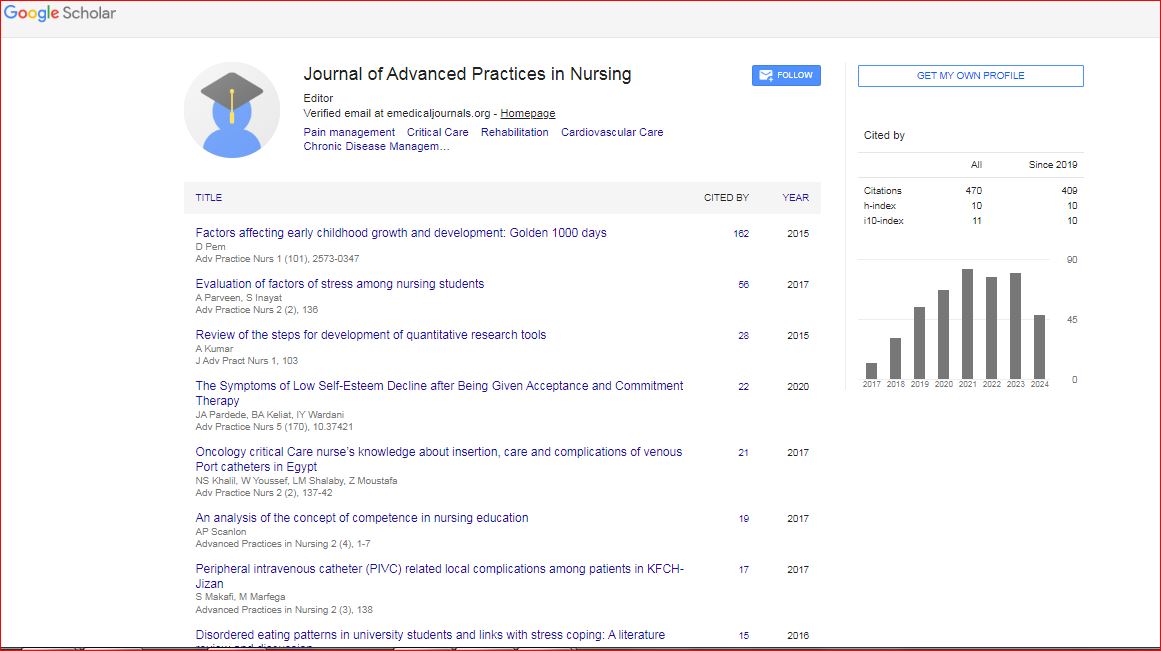
Journal of Advanced Practices in Nursing received 410 citations as per Google Scholar report