Opinion - (2025) Volume 16, Issue 6
Received: 01-Nov-2025, Manuscript No. assj-25-174908;
Editor assigned: 03-Nov-2025, Pre QC No. P-174908;
Reviewed: 17-Nov-2025, QC No. Q-174908;
Revised: 24-Nov-2025, Manuscript No. R-174908;
Published:
01-Dec-2025
, DOI: 10.37421/2151-6200.2025.16.696
Citation: Park, Min-Jae. "MemoryandLiterature: Shaping, Trans mitting, Challenging." Arts Social Sci J 16 (2025):696.
Copyright: © 2025 Park M. This is an open-access article distributed under the terms of the Creative Commons Attribution License, which permits unrestricted use, distribution and reproduction in any medium, provided the original author and source are credited
This article re-examines Freud's work on Leonardo da Vinci, delving into how memory functions not just as a repository of the past, but as an active, mimetic process shaped by political and cultural forces. It highlights the intricate connection between individual and collective memory formation, and how literary analysis can uncover the underlying mechanisms of historical representation and its impact on identity, pushing us to consider memory's active role in shaping our present. [1].
This article explores the intricate relationship between memory, narrative, and truth in our contemporary 'post-truth' landscape. It examines how literary and cultural narratives are constructed, contested, and re-shaped, influencing collective memory and our understanding of historical events. The authors argue that understanding these narrative processes is crucial for navigating misinformation and safeguarding factual accounts in a fragmented informational environment, emphasizing literature's role in this critical dialogue. [2].
This article explores how contemporary German literature engages with autobiographical memory, particularly focusing on how fictional narratives embody and process the memories of 'the other.' It delves into the ethical and aesthetic dimensions of representing lived experiences that are not one's own, highlighting literature's capacity to foster empathy and understanding through shared memory spaces, even when these memories are vicarious or imagined, allowing for a deeper connection across experiences. [3].
This article investigates how post-dictatorship novels in Chile grapple with themes of memory and justice, particularly focusing on the role of literature in shaping collective memory and confronting historical trauma. It examines narrative strategies employed by authors to excavate suppressed histories and articulate demands for accountability, showcasing literature's power as a site for re-negotiating national narratives and fostering reconciliation, bringing past injustices into public consciousness. [4].
This article explores the cognitive mechanisms of memory involved in the act of literary reading, drawing from cognitive poetics. It unpacks how different memory systems (e.g., episodic, semantic, working memory) interact as readers process narratives, construct meaning, and form emotional connections with literary texts. The authors argue that understanding these cognitive processes provides crucial insights into the enduring power and impact of literature on the human mind, shedding light on why stories resonate so deeply. [5].
This article investigates the interplay of archive, memory, and performance within contemporary Australian Aboriginal literature. It reveals how Indigenous authors utilize narrative forms to challenge colonial archives, reclaim historical memory, and transform traumatic pasts into living, performative acts of remembrance. The authors highlight the vital role of literature in cultural revitalization and in asserting Indigenous sovereignty over historical narratives, demonstrating literature's power to shape identity and justice. [6].
This article examines the intersection of digital memory and literary texts, proposing a new framework for understanding how the past is constructed and accessed in the digital age. It explores how digital archives, online platforms, and new media technologies influence literary production, reception, and the very concept of historical remembrance, shifting traditional notions of textual preservation and memory transmission, showing how technology reshapes our relationship with history. [7].
This article explores the concepts of postmemory and transgenerational trauma as manifested in contemporary European fiction. It delves into the ethical complexities of representing inherited memories of profound historical events, particularly for those who did not directly experience them. The authors analyze how literary narratives provide a crucial space for processing, understanding, and transmitting these difficult legacies across generations, shaping collective identity and moral responsibility, ensuring that past lessons endure. [8].
This article revisits Marcel Proust's enduring influence on literary studies, specifically examining the concept of 'affective memory' in the context of 21st-century literary imagination. It analyzes how contemporary authors engage with involuntary memory and sensory experiences to evoke complex emotional landscapes, demonstrating Proust's continued relevance for understanding the intricate relationship between feeling, remembrance, and narrative construction, proving that some insights are timeless. [9].
This article explores the relationship between urban memory and literary place-making in contemporary fiction. It examines how authors transform cityscapes into mnemonic landscapes, where architecture, public spaces, and everyday routines become repositories of individual and collective remembrance. The study highlights literature's capacity to articulate the complex layers of urban history and identity, revealing how cities are continually re-imagined through narrative, reflecting our ongoing engagement with the spaces we inhabit. [10].
The intricate relationship between memory and literature forms a compelling area of study, demonstrating how narratives are instrumental in shaping, preserving, and contesting our understanding of the past. Across various disciplines, these explorations consistently highlight literature's crucial role as a medium for individual and collective remembrance, profoundly influencing how societies engage with their histories, traumas, and identities. The scholarly discourse underscores that memory is not merely a passive repository of events, but an active, interpretative process, continuously reshaped by creative engagement with texts and cultural narratives. These insights reveal literature's deep impact on mnemonic landscapes globally.
Focusing on historical and collective remembrance, several articles illuminate literature's potent capacity to navigate complex societal narratives and confront profound traumas. For instance, a re-examination of Freud's work on Leonardo da Vinci shows memory as an active, mimetic process, inherently intertwined with political and cultural forces, critically influencing historical representation and identity formation [1]. Similarly, the contemporary "post-truth" landscape demands a close look at the relationship between memory, narrative, and truth, with literature emerging as a vital arena for safeguarding factual accounts against misinformation [2]. Post-dictatorship novels in Chile vividly illustrate how literature confronts historical trauma and demands justice, serving as crucial sites for re-negotiating national narratives and fostering reconciliation by excavating suppressed histories [4]. In a different cultural context, contemporary Australian Aboriginal literature demonstrates how Indigenous authors utilize narrative forms, archives, and performance to challenge colonial legacies, reclaim historical memory, and assert sovereignty, transforming traumatic pasts into living acts of remembrance vital for cultural revitalization [6]. Additionally, postmemory and transgenerational trauma are explored within contemporary European fiction, delving into the ethical complexities of representing inherited memories for those who did not directly experience them, ensuring past lessons endure and shape collective identity and moral responsibility [8]. These studies demonstrate literature's powerful role in shaping societal memory and addressing difficult pasts.
Beyond the collective, literature deeply engages with individual, autobiographical, and cognitive dimensions of memory. Contemporary German literature offers insights into autobiographical memory, specifically exploring how fictional narratives can embody and process the memories of "the other," fostering empathy and understanding through shared, vicarious experiences [3]. Furthermore, the cognitive mechanisms of memory during literary reading are critically examined through cognitive poetics. This approach unpacks how different memory systems, such as episodic, semantic, and working memory, interact dynamically as readers process narratives, construct meaning, and form emotional connections with literary texts. Understanding these intricate cognitive processes provides crucial insights into the enduring power and impact of literature on the human mind, shedding light on why stories resonate so deeply [5]. The enduring influence of Marcel Proust is also revisited, focusing on "affective memory" in the context of 21st-century literary imagination. This analysis reveals how contemporary authors draw upon involuntary memory and sensory experiences to evoke complex emotional landscapes, affirming Proust's continued relevance for understanding the intricate relationship between feeling, remembrance, and narrative construction, proving that some insights are truly timeless [9]. These perspectives underscore literature's unique ability to access, articulate, and shape the deeply personal and internal dimensions of memory, significantly enriching our comprehension of human consciousness.
The evolving landscape of memory also integrates digital advancements and the impact of physical environments. An examination of the intersection of digital memory and literary texts proposes a new paradigm for understanding how the past is constructed and accessed in the digital age. This area explores how digital archives, online platforms, and new media technologies profoundly influence literary production, reception, and the very concept of historical remembrance, shifting traditional notions of textual preservation and memory transmission, showing how technology reshapes our relationship with history [7]. Concurrently, the relationship between urban memory and literary place-making in contemporary fiction is investigated. Here, authors actively transform cityscapes into mnemonic landscapes, where architecture, public spaces, and daily routines become rich repositories of individual and collective remembrance. This study highlights literature's capacity to articulate the complex, layered history and identity embedded within urban environments, revealing how cities are continually re-imagined and re-interpreted through narrative, reflecting our ongoing engagement with the spaces we inhabit [10]. These articles demonstrate how both technological innovations and the built environment increasingly mediate and influence our engagement with the past.
Ultimately, these diverse studies collectively illuminate the dynamic, fluid, and often contested nature of memory itself, particularly when mediated through various literary forms. The research presented spans historical analyses, critical cultural evaluations, cognitive psychological inquiries, and profound ethical considerations, underscoring the inherently interdisciplinary nature of memory studies. It consistently reveals literature's unparalleled capacity to not only reflect existing memories but also to actively shape and transform them, thereby influencing political discourse, fostering personal empathy, deepening historical understanding, and ultimately contributing to the very fabric of individual and collective identity. The ongoing, vibrant dialogue between literary expression and mnemonic processes remains an exceptionally vital and continually evolving area of inquiry, especially as it adapts to new social, technological, and cultural shifts.
The provided articles comprehensively explore the multifaceted relationship between memory and literature across various contexts. They delve into how memory is not merely a passive record but an active, mimetic process shaped by political and cultural forces, influencing individual and collective identity. The texts examine memory's role in constructing and contesting narratives in the post-truth era, emphasizing literature's critical function in safeguarding factual accounts. Discussions extend to autobiographical memory in fiction, focusing on representing "the other's" experiences to foster empathy, and how literature confronts historical trauma and injustice in post-dictatorship settings, driving reconciliation. The cognitive aspects of literary reading, including how different memory systems interact to create meaning and emotional connections, are also considered. Furthermore, the collection addresses Indigenous literature's use of narrative to reclaim historical memory and challenge colonial archives, and the impact of digital technologies on memory construction and literary preservation. Concepts like postmemory and transgenerational trauma in European fiction highlight literature's role in transmitting difficult legacies. Proust's influence on understanding affective and involuntary memory's role in narrative is revisited, alongside the exploration of urban memory and literary place-making, showing how cityscapes become mnemonic landscapes. Collectively, these works underscore literature's profound capacity to shape, transmit, and challenge memories, influencing identity, history, and understanding across diverse cultural and temporal landscapes.
None
None
Indexed at, Google Scholar, Crossref
Indexed at, Google Scholar, Crossref
Indexed at, Google Scholar, Crossref
Indexed at, Google Scholar, Crossref
Indexed at, Google Scholar, Crossref
Indexed at, Google Scholar, Crossref
Indexed at, Google Scholar, Crossref
Indexed at, Google Scholar, Crossref
Indexed at, Google Scholar, Crossref
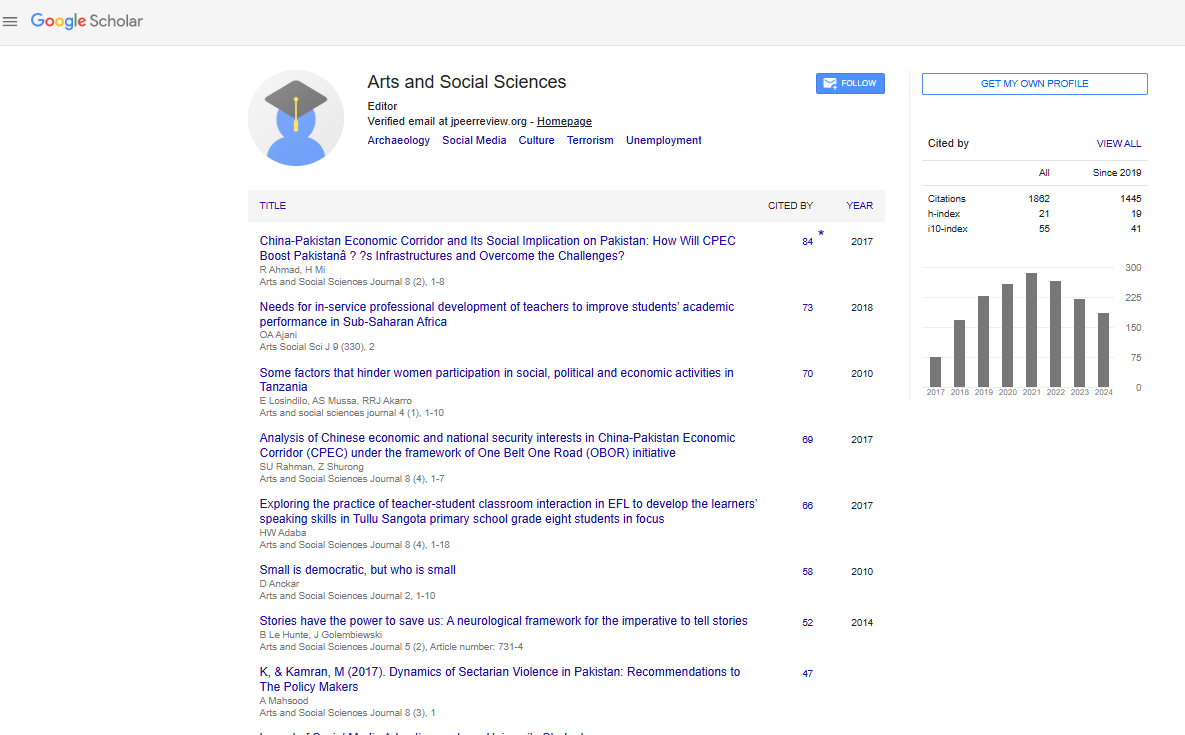
Arts and Social Sciences Journal received 1413 citations as per Google Scholar report