Commentary - (2025) Volume 14, Issue 6
Received: 03-Nov-2025, Manuscript No. mcce-26-190203;
Editor assigned: 05-Nov-2025, Pre QC No. P-190203;
Reviewed: 19-Nov-2025, QC No. Q-190203;
Revised: 24-Nov-2025, Manuscript No. R-190203;
Published:
29-Nov-2025
, DOI: 10.37421/2470-6965.2025.14.437
Citation: Dimitrova, Ivana. ”Ensuring Quality-Assured Antimalarial Medicines.” Malar Contr Elimination 14 (2025):437.
Copyright: © 2025 Dimitrova I. This is an open-access article distributed under the terms of the Creative Commons Attribution License, which permits unrestricted use, distribution and reproduction in any medium, provided the original author and source are credited.
Ensuring the availability and high quality of antimalarial medicines is a fundamental aspect of effective malaria control strategies. This necessitates the establishment and maintenance of robust regulatory systems, efficient supply chain management, and vigilant pharmacovigilance to actively prevent the infiltration of substandard and counterfeit drugs into patient access channels. Initiatives specifically focused on the prequalification of medicines and the comprehensive strengthening of national regulatory authorities are therefore critical components for achieving these goals.[1] The global effort to combat malaria is profoundly dependent on the consistent and uninterrupted availability of effective treatment options. A significant area of focus involves addressing vulnerabilities within the entire supply chain, from the initial procurement stages through to the complex processes of last-mile delivery. This comprehensive approach is essential to guarantee that quality-assured antimalarials reach the populations most in need, particularly those residing in remote and underserved geographical regions. Embracing innovations in logistics and distribution methodologies is therefore a key determinant of success.[2] The pervasive threat posed by substandard and falsified medicines presents a substantial impediment to malaria control initiatives. Such illicit products not only undermine the efficacy of prescribed treatments but also erode the crucial trust placed in medical interventions by patients and healthcare providers alike. Consequently, the implementation of robust post-market surveillance mechanisms, coupled with strengthened enforcement actions, becomes vital for the timely detection and subsequent removal of these dangerous pharmaceuticals from circulation.[3] For the successful execution of malaria control programs, it is imperative that national regulatory authorities (NRAs) are adequately empowered to rigorously ensure the quality of all medicinal products. This empowerment encompasses developing their capacity for efficient product registration, conducting thorough inspections, and implementing effective post-market surveillance. International collaboration and targeted capacity-building support are indispensable elements for strengthening these essential regulatory functions.[4] The World Health Organization's (WHO) Prequalification Programme plays an indispensable role in verifying and assuring the quality of various essential medicines, with a particular emphasis on antimalarials. Through a meticulous evaluation process that benchmarks medicines against established international standards, this program assists procurement agencies in making informed selections of safe and effective pharmaceutical products, thereby directly contributing to improved patient access.[5] Guaranteeing the quality of antimalarial medicines at the precise point of use represents a critical juncture in the prevention of treatment failures. Emerging technologies, such as advanced diagnostic tools and user-friendly mobile applications designed to authenticate the genuineness of medicines, are increasingly becoming indispensable resources for both healthcare providers and patients in their efforts to ensure treatment integrity.[6] Patient education and a heightened awareness among the general populace are integral components that significantly contribute to enhancing both the access to and the correct utilization of quality-assured antimalarial medicines. By empowering patients with the knowledge to identify potential issues with their medications and encouraging them to report such concerns, these efforts can substantially bolster existing pharmacovigilance systems and improve overall drug safety.[7] Robust pharmacovigilance systems are absolutely essential for the ongoing monitoring of the safety and real-world efficacy of antimalarial medicines once they have been introduced into clinical practice and are in widespread use. The establishment of effective reporting mechanisms and the diligent analysis of collected data are crucial for the early identification of potential problems, thereby ensuring that therapeutic interventions continue to be both effective and safe for patient populations.[8] Addressing the complex interplay of economic and regulatory barriers that hinder the production and widespread distribution of quality-assured antimalarial medicines, particularly within low-income settings, presents a formidable challenge. The implementation of strategic approaches that actively foster the development of local manufacturing capacities and streamline regulatory approval processes holds significant promise for improving both access to and the affordability of these vital medications.[9] Ultimately, the effective control and eventual elimination of malaria necessitate a sustained and unwavering commitment to ensuring that antimalarial medicines are not merely available but are also of consistently high quality. This goal can only be achieved through the adoption of integrated approaches that encompass strengthening regulatory frameworks, building resilience in supply chains, and maintaining constant vigilance against the pervasive threat of substandard pharmaceutical products.[10]
The cornerstone of effective malaria control relies heavily on ensuring that antimalarial medicines are consistently available and of high quality. This critical objective necessitates the implementation of comprehensive regulatory systems, efficient supply chain management practices, and proactive pharmacovigilance efforts to prevent the distribution of substandard and counterfeit drugs to patients. Key initiatives, such as the prequalification of medicines and the strengthening of national regulatory authorities, are vital for achieving this aim.[1] The ongoing battle against malaria is fundamentally linked to the reliable availability of effective treatments. Consequently, it is imperative to address existing vulnerabilities within the supply chain, encompassing all stages from procurement to final delivery to remote areas. This ensures that quality-assured antimalarials reach those who require them most, particularly in geographically isolated and underserved communities. Innovations in logistics and distribution are therefore paramount to achieving widespread access.[2] Substandard and falsified medicines represent a grave threat to the progress made in malaria control, as they compromise treatment efficacy and erode patient confidence. To counteract this danger, the establishment of robust post-market surveillance systems and strengthened enforcement mechanisms is crucial for the detection and removal of these dangerous products from circulation, thereby protecting public health.[3] For malaria control efforts to be successful, national regulatory authorities (NRAs) must be adequately equipped and empowered to guarantee the quality of medicines. This involves building their capacity for product registration, inspections, and post-market surveillance. International cooperation and support for capacity building are essential for enhancing these vital regulatory functions.[4] The World Health Organization's (WHO) Prequalification Programme serves a critical function in assuring the quality of medicines, including those used for malaria treatment. By evaluating medicines against rigorous international standards, the program aids procurement agencies in selecting safe and effective products, thereby improving access for patients globally.[5] Ensuring the quality of antimalarial medicines at the point of administration is a vital step in preventing treatment failures. The increasing importance of technologies such as diagnostic tools and mobile applications that can verify medicine authenticity cannot be overstated, as they provide essential support for healthcare providers and patients.[6] Patient education and awareness initiatives are indispensable for improving both access to and the correct use of quality-assured antimalarial medicines. By empowering patients to identify potential issues with their medications and to report them, pharmacovigilance efforts are significantly strengthened, leading to better patient outcomes.[7] Pharmacovigilance systems are fundamental for monitoring the ongoing safety and efficacy of antimalarial medicines once they are in use. Effective reporting mechanisms and thorough data analysis enable the early detection of potential problems, ensuring that interventions remain safe and effective for patient populations.[8] Overcoming the economic and regulatory hurdles to the production and distribution of quality-assured antimalarials in low-income countries is a complex challenge. Strategies aimed at fostering local manufacturing capabilities and streamlining regulatory processes can effectively improve access and affordability of these essential medicines.[9] Achieving effective malaria control and progressing towards elimination demands a sustained commitment to ensuring the consistent quality of antimalarial medicines alongside their availability. This requires integrated approaches that strengthen regulatory oversight, enhance supply chain resilience, and maintain vigilance against substandard pharmaceutical products.[10]
Effective malaria control hinges on the availability and quality of antimalarial medicines, necessitating robust regulatory systems, supply chain management, and pharmacovigilance to prevent substandard drugs. Addressing supply chain vulnerabilities and strengthening national regulatory authorities are crucial. Combating substandard and falsified medicines requires post-market surveillance and enforcement. The WHO Prequalification Programme plays a vital role in assuring medicine quality. Innovative technologies for authenticity verification and patient education are important for correct use. Pharmacovigilance systems are essential for monitoring safety and efficacy. Overcoming economic and regulatory barriers to production and distribution is key. Integrated approaches are needed for sustained commitment to quality-assured antimalarials.
None
None
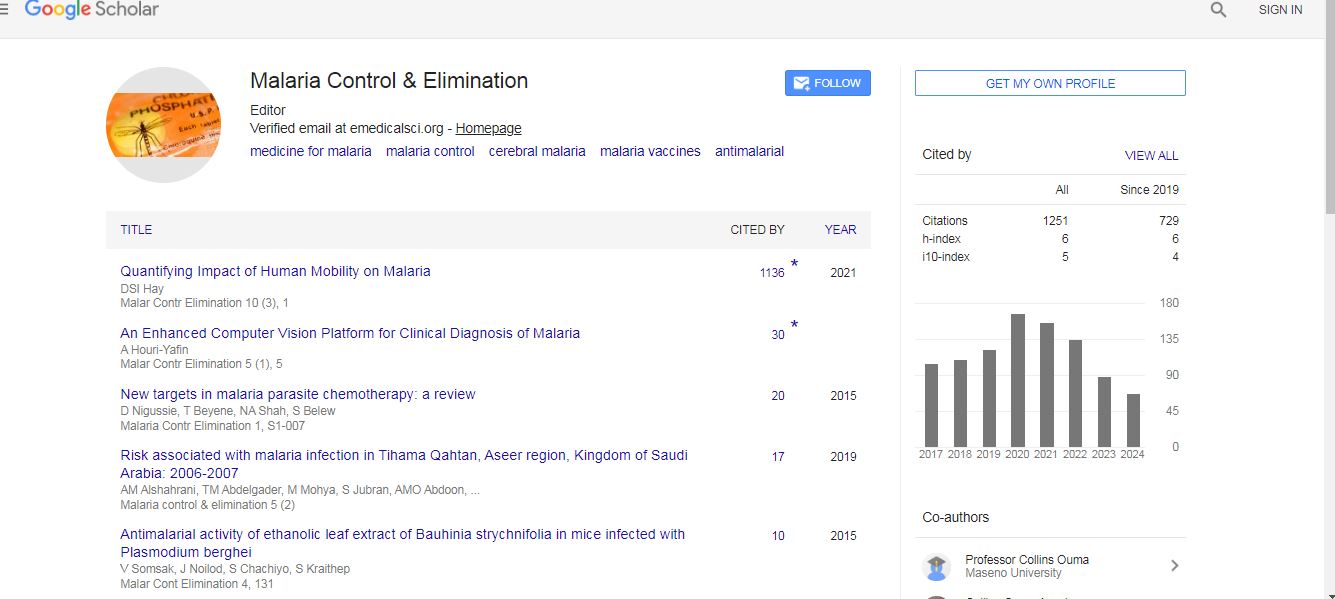
Malaria Control & Elimination received 1187 citations as per Google Scholar report