Perspective - (2025) Volume 14, Issue 3
Received: 01-May-2025, Manuscript No. mcce-26-190176;
Editor assigned: 05-May-2025, Pre QC No. P-190176;
Reviewed: 19-May-2025, QC No. Q-190176;
Revised: 22-May-2025, Manuscript No. R-190176;
Published:
29-May-2025
, DOI: 10.37421/2470-6965.2025.14.410
Citation: Muller, Thomas. ”Mass Drug Administration: Key To Malaria Elimination.” Malar Contr Elimination 14 (2025):410.
Copyright: © 2025 Muller T. This is an open-access article distributed under the terms of the Creative Commons Attribution License, which permits unrestricted use, distribution and reproduction in any medium, provided the original author and source are credited.
Mass Drug Administration (MDA) continues to be a vital strategy in the fight against malaria, particularly in regions with high transmission rates. This approach involves distributing antimalarial drugs to entire populations, aiming to clear existing infections and reduce the parasite reservoir, thereby interrupting transmission. While MDA has shown promise, its effectiveness is influenced by factors such as drug resistance, adherence, population coverage, and the underlying entomological inoculation rate. Ongoing research focuses on optimizing MDA strategies, including targeted MDA, intermittent preventive treatment for specific groups, and integrating MDA with other vector control interventions for a more comprehensive elimination effort.[1] The role of community engagement and healthcare worker training is paramount for the successful implementation of MDA programs. Without strong community buy-in and skilled healthcare providers administering the drugs correctly, coverage rates can suffer, diminishing the impact of MDA. This paper highlights the importance of local context and tailoring MDA strategies to specific communities to maximize adherence and efficacy.[2] Drug resistance remains a significant threat to the efficacy of MDA. This study investigates the emergence and spread of antimalarial drug resistance in areas where MDA has been implemented. It underscores the need for robust surveillance systems to monitor resistance patterns and adapt treatment strategies accordingly, potentially through the use of combination therapies or novel antimalarials.[3] Integrating MDA with vector control methods, such as insecticide-treated nets and indoor residual spraying, can create a synergistic effect, leading to more rapid and sustainable malaria elimination. This paper explores the evidence for such integrated approaches and discusses the operational challenges and benefits of combining these interventions.[4] The frequency and timing of MDA campaigns are critical for their success. This research examines different MDA regimens and their impact on reducing malaria burden and achieving elimination. It provides insights into optimizing the cyclical nature of MDA to maximize its impact on the parasite population.[5] Even after successful MDA campaigns, residual malaria transmission can persist. This study explores the challenges of eliminating the final remaining parasites, often found in specific geographical pockets or among certain demographic groups. It emphasizes the need for sustained surveillance and targeted interventions post-MDA to achieve complete elimination.[6] The economic impact of malaria elimination, facilitated by strategies like MDA, is significant. This paper analyzes the cost-effectiveness of MDA programs in reducing the disease burden and its associated economic consequences, highlighting the long-term benefits of investing in malaria control and elimination.[7] Geographic targeting of MDA can improve its efficiency and impact, especially in areas with heterogeneous malaria transmission. This research explores how to identify high-risk areas for more focused MDA interventions, thus optimizing resource allocation and maximizing disease reduction.[8] The development of novel antimalarial drugs is crucial to overcome resistance and enhance the effectiveness of MDA. This review discusses current drug development pipelines and their potential to support MDA strategies for malaria elimination.[9] Monitoring and evaluation (M&E) frameworks are essential for assessing the impact and sustainability of MDA programs. This article outlines best practices for M&E in MDA for malaria elimination, emphasizing data quality, timely reporting, and adaptive management.[10]
Mass Drug Administration (MDA) is a cornerstone of malaria control efforts, involving the widespread distribution of antimalarial drugs to eliminate infections and halt transmission in highly endemic areas. Its success is contingent upon overcoming challenges like drug resistance, ensuring adequate population coverage, and achieving high levels of adherence. Continuous research aims to refine MDA protocols, explore targeted approaches, and integrate them with other control measures for more effective elimination strategies.[1] Effective implementation of MDA hinges on robust community engagement and comprehensive training for healthcare workers. Without strong local support and skilled personnel to administer medications accurately, MDA programs risk suboptimal coverage and diminished impact. Tailoring strategies to suit specific community contexts is crucial for maximizing both adherence and efficacy.[2] Antimalarial drug resistance poses a persistent and substantial threat to the effectiveness of MDA. Ongoing studies are meticulously examining the emergence and propagation of resistance in areas where MDA is deployed. This highlights the imperative for sophisticated surveillance systems to track resistance patterns and adjust therapeutic regimens, potentially through combination therapies or the introduction of new antimalarial agents.[3] Combining MDA with established vector control methods, such as insecticide-treated nets and indoor residual spraying, can yield synergistic effects, accelerating the journey towards sustainable malaria elimination. This research delves into the evidence supporting these integrated interventions and evaluates the operational complexities and advantages of their combined application.[4] The temporal aspects of MDA campaigns, specifically their frequency and timing, are pivotal determinants of their success. This investigation scrutinizes various MDA regimens to ascertain their influence on reducing the malaria burden and achieving elimination goals, offering valuable insights for optimizing the cyclical administration of drugs to maximize their impact on parasite populations.[5] Even after the successful execution of MDA campaigns, the complete eradication of malaria transmission can be hindered by residual infections. This study addresses the difficulties associated with eliminating the final vestiges of the parasite, which may be concentrated in specific geographic locales or among particular demographic segments. It underscores the necessity for continuous surveillance and precisely targeted interventions following MDA to achieve full elimination.[6] The economic benefits of malaria elimination, significantly propelled by strategies like MDA, are substantial. This analysis quantifies the cost-effectiveness of MDA programs in mitigating disease burden and its related economic ramifications, thereby underscoring the long-term advantages of investing in comprehensive malaria control and elimination initiatives.[7] Targeting MDA geographically can substantially enhance its efficiency and overall impact, particularly in regions characterized by uneven malaria transmission. This research focuses on identifying high-risk zones to concentrate MDA efforts, thereby optimizing the allocation of resources and achieving greater reductions in disease incidence.[8] The development of novel antimalarial drugs is indispensable for combating resistance and bolstering the efficacy of MDA. This review critically examines the current landscape of drug development and assesses its potential contributions to advancing MDA strategies for malaria eradication.[9] Robust monitoring and evaluation (M&E) frameworks are fundamental for gauging the effectiveness and long-term sustainability of MDA programs. This article elucidates best practices for M&E within the context of MDA for malaria elimination, with a strong emphasis on data integrity, prompt reporting, and agile program adjustments.[10]
Mass Drug Administration (MDA) is a critical strategy for malaria elimination, involving mass distribution of antimalarial drugs to reduce parasite reservoirs and interrupt transmission. Its effectiveness is influenced by drug resistance, adherence, and population coverage. Community engagement and healthcare worker training are essential for successful implementation. Integrating MDA with vector control methods can enhance its impact. Optimizing MDA frequency, timing, and geographic targeting can improve efficiency. Addressing residual transmission and developing novel antimalarial drugs are crucial for complete elimination. Robust monitoring and evaluation frameworks are vital for assessing program impact and sustainability. MDA also offers significant economic benefits by reducing disease burden.
None
None
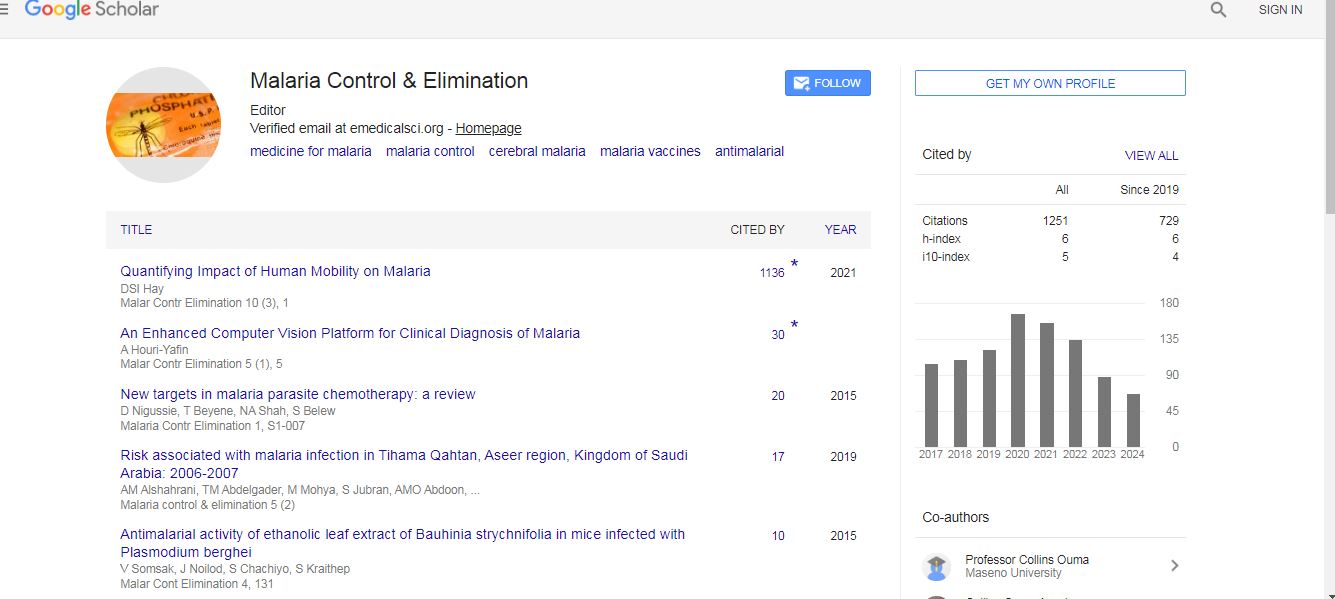
Malaria Control & Elimination received 1187 citations as per Google Scholar report