Brief Report - (2025) Volume 13, Issue 2
Received: 01-Apr-2025, Manuscript No. jcdd-25-175412;
Editor assigned: 03-Apr-2025, Pre QC No. P-175412;
Reviewed: 17-Apr-2025, QC No. Q-175412;
Revised: 22-Apr-2025, Manuscript No. R-175412;
Published:
29-Apr-2025
, DOI: 10.37421/2329-9517.2025.13.654
Citation: Connor, Liam O. ”Managing CAD: Personalized, Evolving,
AI-Driven.” J Cardiovasc Dis Diagn 13 (2025):654.
Copyright: © 2025 Connor O. Liam This is an open-access article distributed under the terms of the Creative Commons Attribution License, which permits unrestricted use,
distribution and reproduction in any medium, provided the original author and source are credited.
Managing chronic coronary syndromes, a common form of coronary artery disease, requires a thoughtful approach. The 2023 ESC guidelines offer clear direction, emphasizing integrated, patient-centered care. What this really means is that doctors should consider everything from lifestyle advice and medical treatments to potential revascularization procedures, always tailoring the plan to the individual's specific needs and risk profile. It's about optimizing symptoms, improving quality of life, and preventing serious events.[1] When it comes to diagnosing coronary artery disease, non-invasive imaging has seen some really exciting developments. Think beyond just the traditional tests; we're talking about advanced techniques that can spot issues earlier and more accurately, guiding treatment decisions more effectively. This overview gives a good sense of the methods available and how they're changing the game for patient assessment.[2] Seriously, lifestyle choices play a massive role in coronary artery disease. This review highlights how things like diet, exercise, and managing stress can actually change the course of the disease. It's not just about medication; empowering patients to make healthier choices is a powerful tool in both prevention and management, often leading to better outcomes and a higher quality of life.[3] Pharmacological treatments for atherosclerotic cardiovascular disease are constantly evolving. This article explores both the medicines we commonly use now and the exciting new therapies on the horizon. It's all about finding more effective ways to manage cholesterol, blood pressure, and inflammation to prevent heart attacks and strokes, ultimately improving patient prognosis significantly.[4] Understanding the genetic roots of coronary artery disease is a big deal for personalized medicine. This piece delves into how our genes influence our risk for CAD and how that knowledge can be used to tailor prevention and treatment strategies. It's about moving away from one-size-fits-all approaches and towards more individualized care based on a person's unique genetic makeup.[5] Inflammation is a key player in coronary artery disease, far more than just a symptom. This review breaks down the intricate mechanisms by which inflammation drives CAD, its implications for predicting future heart events, and crucially, how we can target it therapeutically. It's clear that managing inflammation is central to effective CAD treatment.[6] Here's the thing: coronary artery disease often presents differently in women compared to men. This paper explores these crucial sex differences, from the underlying biological mechanisms to how they manifest clinically. Recognizing these distinctions is vital for accurate diagnosis and effective treatment, ensuring women receive care tailored to their unique physiological profile.[7] Artificial intelligence is changing many fields, and coronary artery disease is no exception. This article looks at the potential of AI to revolutionize diagnosis, risk assessment, and treatment planning in CAD. While the promises are significant, there are also challenges and considerations to keep in mind as we integrate these powerful tools into clinical practice.[8] Deciding on the best revascularization strategy for patients with blockages in multiple coronary arteries is often complex. This paper explores what defines optimal revascularization, considering factors like patient characteristics, lesion complexity, and long-term outcomes. It's about finding the right balance between percutaneous intervention and surgical bypass to achieve the best possible results.[9] Biomarkers are becoming increasingly important in coronary artery disease. This article discusses the latest advancements in using biological indicators to assess risk, diagnose the condition, and predict patient prognosis. What this really means is better, more personalized care by identifying who is at higher risk and tailoring interventions accordingly, much earlier than before.[10]
Managing chronic coronary syndromes, a common form of coronary artery disease, requires a thoughtful approach. The 2023 ESC guidelines offer clear direction, emphasizing integrated, patient-centered care. What this really means is that doctors should consider everything from lifestyle advice and medical treatments to potential revascularization procedures, always tailoring the plan to the individual's specific needs and risk profile. It's about optimizing symptoms, improving quality of life, and preventing serious events [1]. Seriously, lifestyle choices play a massive role in coronary artery disease. This review highlights how things like diet, exercise, and managing stress can actually change the course of the disease. It's not just about medication; empowering patients to make healthier choices is a powerful tool in both prevention and management, often leading to better outcomes and a higher quality of life [3].
When it comes to diagnosing coronary artery disease, non-invasive imaging has seen some really exciting developments. Think beyond just the traditional tests; we're talking about advanced techniques that can spot issues earlier and more accurately, guiding treatment decisions more effectively. This overview gives a good sense of the methods available and how they're changing the game for patient assessment [2]. Biomarkers are also becoming increasingly important in coronary artery disease. This article discusses the latest advancements in using biological indicators to assess risk, diagnose the condition, and predict patient prognosis. What this really means is better, more personalized care by identifying who is at higher risk and tailoring interventions accordingly, much earlier than before [10].
Understanding the genetic roots of coronary artery disease is a big deal for personalized medicine. This piece delves into how our genes influence our risk for CAD and how that knowledge can be used to tailor prevention and treatment strategies. It's about moving away from one-size-fits-all approaches and towards more individualized care based on a person's unique genetic makeup [5]. Inflammation is a key player in coronary artery disease, far more than just a symptom. This review breaks down the intricate mechanisms by which inflammation drives CAD, its implications for predicting future heart events, and crucially, how we can target it therapeutically. It's clear that managing inflammation is central to effective CAD treatment [6]. Here's the thing: coronary artery disease often presents differently in women compared to men. This paper explores these crucial sex differences, from the underlying biological mechanisms to how they manifest clinically. Recognizing these distinctions is vital for accurate diagnosis and effective treatment, ensuring women receive care tailored to their unique physiological profile [7].
Pharmacological treatments for atherosclerotic cardiovascular disease are constantly evolving. This article explores both the medicines we commonly use now and the exciting new therapies on the horizon. It's all about finding more effective ways to manage cholesterol, blood pressure, and inflammation to prevent heart attacks and strokes, ultimately improving patient prognosis significantly [4]. Deciding on the best revascularization strategy for patients with blockages in multiple coronary arteries is often complex. This paper explores what defines optimal revascularization, considering factors like patient characteristics, lesion complexity, and long-term outcomes. It's about finding the right balance between percutaneous intervention and surgical bypass to achieve the best possible results [9].
Artificial intelligence is changing many fields, and coronary artery disease is no exception. This article looks at the potential of AI to revolutionize diagnosis, risk assessment, and treatment planning in CAD. While the promises are significant, there are also challenges and considerations to keep in mind as we integrate these powerful tools into clinical practice [8]. The ongoing integration of these diverse strategies, from foundational lifestyle changes to advanced technological applications, signifies a dynamic and patient-centric evolution in the field of CAD management.
Managing chronic coronary artery disease (CAD) requires a thoughtful, integrated, and patient-centered approach, guided by recent guidelines that combine lifestyle advice, medical treatments, and tailored revascularization procedures to optimize symptoms, enhance quality of life, and prevent serious events. Diagnosis benefits significantly from advances in non-invasive imaging, offering earlier and more accurate detection, complemented by increasingly important biomarkers for risk assessment and prognosis, allowing for personalized interventions. Key aspects of CAD also involve understanding its underlying mechanisms; this includes the massive role of lifestyle choices in disease modification, the genetic roots influencing individual risk, and the critical part inflammation plays in its progression and as a therapeutic target. Furthermore, recognizing crucial sex differences in how CAD presents is vital for accurate diagnosis and effective, tailored treatment for women. Therapeutic options are constantly evolving, spanning current and future pharmacological therapies aimed at managing cholesterol, blood pressure, and inflammation, alongside complex decisions regarding optimal revascularization strategies for patients with multivessel disease. The integration of Artificial Intelligence (AI) holds considerable potential for revolutionizing diagnosis, risk assessment, and treatment planning, despite ongoing challenges, pointing towards a future of highly individualized and effective CAD management.
Indexed at, Google Scholar, Crossref
Indexed at, Google Scholar, Crossref
Indexed at, Google Scholar, Crossref
Indexed at, Google Scholar, Crossref
Indexed at, Google Scholar, Crossref
Indexed at, Google Scholar, Crossref
Indexed at, Google Scholar, Crossref
Indexed at, Google Scholar, Crossref
Indexed at, Google Scholar, Crossref
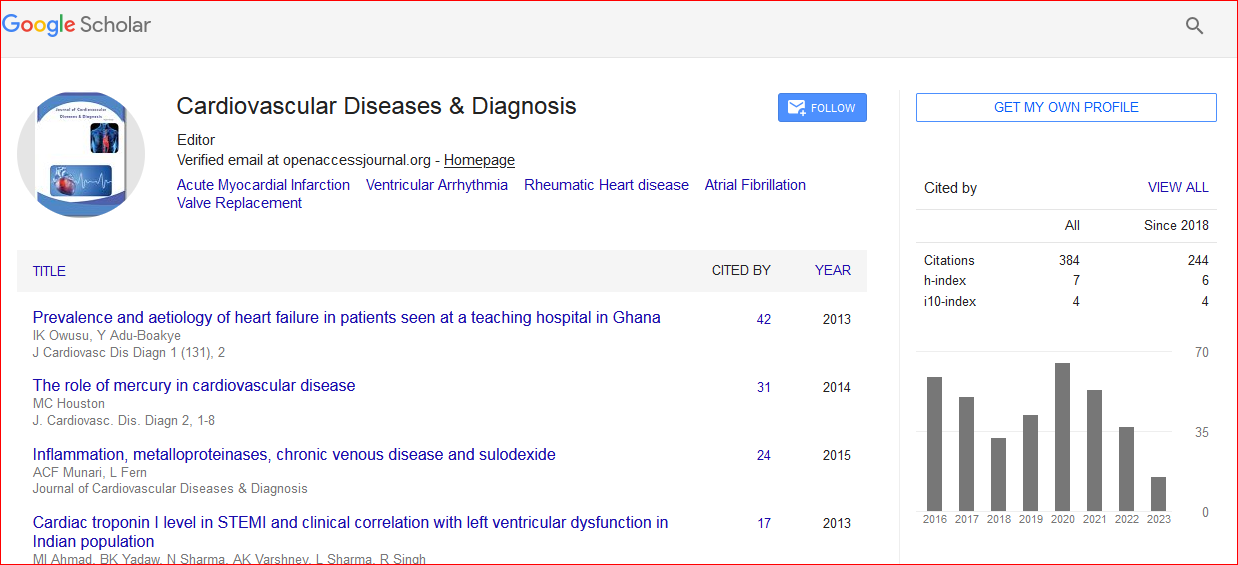
Cardiovascular Diseases & Diagnosis received 427 citations as per Google Scholar report