Commentary - (2025) Volume 11, Issue 5
Received: 02-Sep-2025, Manuscript No. ldt-25-178446;
Editor assigned: 04-Sep-2025, Pre QC No. P-178446;
Reviewed: 18-Sep-2025, QC No. Q-178446;
Revised: 23-Sep-2025, Manuscript No. R-178446;
Published:
30-Sep-2025
, DOI: 10.37421/2472-1018.2025.11.321
Citation: Mehta, Aarav. ”Managing Acute Exacerbations in Chronic Lung Diseases.” J Lung Dis Treat 11 (2025):321.
Copyright: © 2025 Mehta A. This is an open-access article distributed under the terms of the Creative Commons Attribution License, which permits unrestricted use, distribution and reproduction in any medium, provided the original author and source are credited.
The management of acute exacerbations in chronic lung diseases, such as COPD and asthma, necessitates a comprehensive and multi-faceted approach to mitigate their significant impact on patient health and healthcare systems [1].
For asthma exacerbations specifically, swift intervention is paramount, with a primary focus on relieving bronchoconstriction and reducing airway inflammation through pharmacological means [2].
Interstitial lung diseases (ILDs), including idiopathic pulmonary fibrosis (IPF), present unique challenges in identifying and managing acute exacerbations, which are often associated with substantial morbidity and mortality [3].
The judicious use of antibiotics during COPD exacerbations is a critical clinical decision, guided by factors such as the presence of purulent sputum and increased dyspnea, with current guidelines recommending their use in moderate to severe cases [4].
Non-invasive ventilation (NIV) has emerged as a valuable tool in managing acute respiratory failure during exacerbations of chronic lung diseases, offering benefits in gas exchange and work of breathing [5].
In the context of asthma exacerbations, the role of inhaled corticosteroids (ICS) is well-established, with high-dose therapy frequently initiated to effectively reduce airway inflammation and improve lung function [6].
Early recognition of exacerbations in patients with cystic fibrosis (CF) is vital for prompt intervention, aiming to prevent further lung damage and optimize outcomes through a combination of therapies [7].
Emerging technologies like telemedicine and remote monitoring are demonstrating increasing value in the management of chronic lung diseases, particularly in reducing hospitalizations due to exacerbations [8].
A fundamental aspect of effectively treating exacerbations in chronic lung diseases lies in understanding the intricate role of airway inflammation and exploring novel therapies that target specific inflammatory pathways [9].
Patient education and the promotion of self-management strategies are indispensable components in both the prevention and management of exacerbations across various chronic lung diseases, empowering patients to take an active role in their care [10].
Managing acute exacerbations in chronic lung diseases like COPD and asthma demands a multi-faceted approach. Key strategies involve timely recognition of exacerbation triggers, prompt administration of appropriate bronchodilators and corticosteroids, and consideration of antibiotics when bacterial infection is suspected. Oxygen therapy must be carefully titrated to avoid hypercapnia. Patient education on recognizing early warning signs and adherence to maintenance therapy is crucial for preventing future events. Non-invasive ventilation can be beneficial in selected patients with respiratory failure [1].
Asthma exacerbations require swift intervention, focusing on relieving bronchoconstriction and inflammation. Inhaled short-acting beta-agonists and systemic corticosteroids are cornerstones of treatment. The role of antibiotics in asthma exacerbations is generally limited to cases with evidence of bacterial coinfection. Close monitoring for response to therapy and identifying potential triggers are essential for successful management and preventing relapse [2].
Identifying and managing exacerbations in patients with interstitial lung diseases (ILDs) presents unique challenges. Acute exacerbations of ILD, often referred to as acute exacerbations of idiopathic pulmonary fibrosis (IPF), are associated with significant morbidity and mortality. Treatment strategies are largely supportive, and research into specific pharmacological interventions is ongoing. Understanding the potential triggers and early recognition are paramount [3].
The use of antibiotics during COPD exacerbations is a critical decision influenced by the presence of purulent sputum and increased dyspnea. Current guidelines suggest antibiotics for moderate to severe exacerbations, particularly in patients with specific phenotypic characteristics. The selection of antibiotic therapy should consider local resistance patterns and patient comorbidities. Careful patient selection is key to optimizing outcomes and minimizing antibiotic resistance [4].
Non-invasive ventilation (NIV) plays a significant role in the management of acute respiratory failure during exacerbations of chronic lung diseases. NIV can improve gas exchange, reduce the work of breathing, and decrease the need for invasive mechanical ventilation, thereby lowering the risk of complications. Patient selection and appropriate application are crucial for achieving optimal benefits from NIV [5].
The role of inhaled corticosteroids (ICS) in the management of asthma exacerbations is well-established. High-dose ICS therapy is often initiated during exacerbations to reduce airway inflammation and improve lung function. Understanding the appropriate dosing and duration of ICS treatment during exacerbations is critical for preventing further deterioration and promoting recovery [6].
Early recognition of exacerbations in patients with cystic fibrosis (CF) is crucial for timely intervention and preventing lung damage. Management typically involves optimizing airway clearance techniques, increasing doses of inhaled bronchodilators, and initiating antibiotics to treat or prevent bacterial infections. Close monitoring and individualized treatment plans are essential [7].
Telemedicine and remote monitoring are emerging as valuable tools in the management of chronic lung diseases, particularly in reducing hospitalizations for exacerbations. These technologies allow for early detection of worsening symptoms and timely adjustments to treatment, potentially improving patient outcomes and quality of life while reducing healthcare burdens [8].
Understanding the role of airway inflammation in exacerbations of chronic lung diseases is fundamental to effective treatment. Targeting specific inflammatory pathways with novel therapies holds promise for improving outcomes in patients who do not respond adequately to conventional treatments. Research continues to unravel the complex inflammatory mechanisms driving exacerbations [9].
Patient education and self-management strategies are critical components of preventing and managing exacerbations in chronic lung diseases. Empowering patients to recognize early signs of deterioration, understand their treatment plan, and use their inhaler devices correctly can significantly reduce the frequency and severity of exacerbations [10].
Acute exacerbations in chronic lung diseases such as COPD, asthma, ILDs, IPF, CF, and other respiratory conditions require prompt and tailored management. Key interventions include early trigger recognition, administration of bronchodilators and corticosteroids, and judicious use of antibiotics when bacterial infection is suspected. Oxygen therapy must be carefully managed, and non-invasive ventilation can be beneficial in cases of respiratory failure. Patient education and self-management are crucial for preventing future events and improving adherence to treatment. Emerging technologies like telemedicine are also playing a role in monitoring and managing these conditions, with ongoing research focusing on understanding and targeting airway inflammation for improved therapeutic outcomes.
None
None
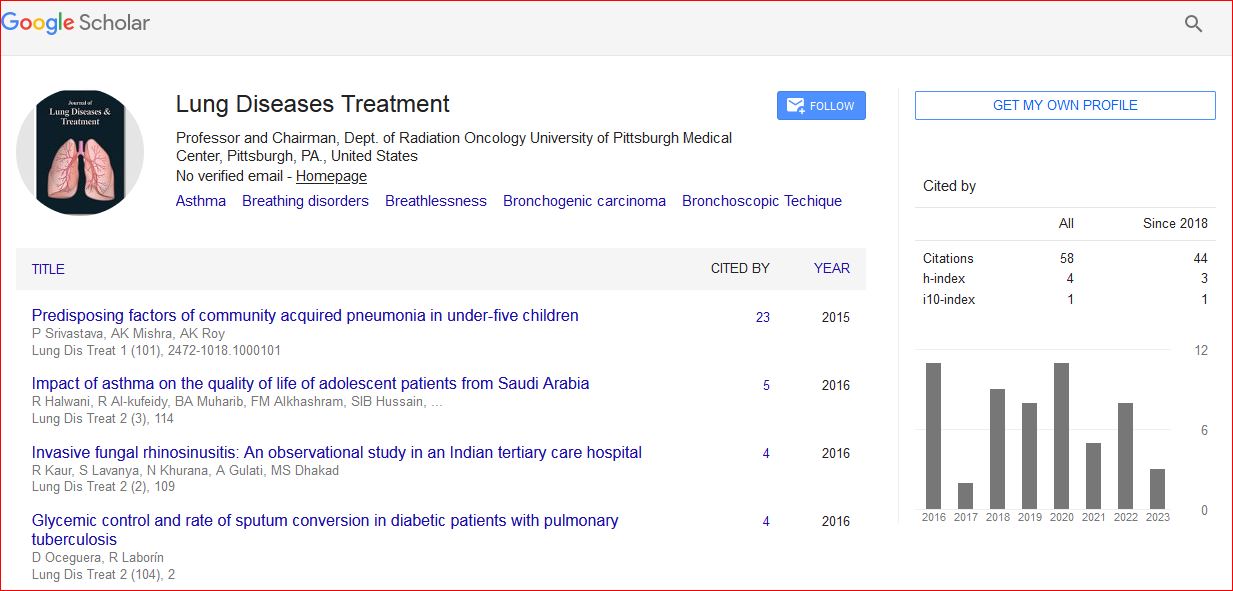
Journal of Lung Diseases & Treatment received 247 citations as per Google Scholar report