Short Communication - (2025) Volume 16, Issue 2
Received: 01-Mar-2025, Manuscript No. jhmi-26-178813;
, Pre QC No. P-178813;
Reviewed: 17-Mar-2025, QC No. Q-178813;
Revised: 24-Mar-2025, Manuscript No. R-178813;
Published:
31-Mar-2025
, DOI: 10.37421/2157-7420.2025.16.578
Citation: Bello, Aisha K.. ”Machine Learning Enhances Chronic Disease Early Detection.” J Health Med Informat 16 (2025):578.
Copyright: © 2025 Bello K. Aisha This is an open-access article distributed under the terms of the Creative Commons Attribution License, which permits unrestricted use, distribution and reproduction in any medium, provided the original author and source are credited.
Machine learning models are demonstrating significant promise in identifying individuals at high risk for developing chronic diseases. By meticulously analyzing complex datasets, these advanced computational tools can detect subtle patterns and intricate risk factors that traditional screening methods might overlook. This capability enables earlier interventions, ultimately leading to improved patient outcomes and a more proactive approach to healthcare. The crucial role of early detection in managing the progression of conditions such as diabetes, cardiovascular disease, and certain cancers cannot be overstated, as it contributes to reducing the overall healthcare burden and enhancing the quality of life for affected individuals [1].
The application of deep learning algorithms, a sophisticated subset of machine learning, is proving particularly powerful in the early detection of chronic diseases, especially when applied to medical imaging and electronic health records. These deep learning models possess the remarkable ability to learn intricate features from vast amounts of data, thereby yielding more accurate and sensitive predictions for diseases like diabetic retinopathy and breast cancer. The integration of these advanced techniques into existing clinical workflows has the potential to fundamentally revolutionize proactive healthcare strategies and disease management [2].
Predictive modeling, utilizing machine learning techniques applied to electronic health record (EHR) data, offers a robust method for identifying individuals who are at a high risk of developing type 2 diabetes. By systematically analyzing a wide array of information including demographic details, laboratory results, and a patient's medical history, these models can effectively flag individuals who may benefit from targeted interventions. Such interventions can encompass lifestyle modifications and regular screenings, ultimately serving to prevent or significantly delay the onset and progression of the disease [3].
Machine learning approaches are proving to be highly effective in predicting the risk of cardiovascular diseases. This is achieved through the integration of diverse data sources, which can include genetic predispositions, lifestyle choices, and various clinical indicators. These sophisticated models excel at identifying complex, non-linear interactions between multiple risk factors. The outcome is a more personalized and precise assessment of an individual's risk, paving the way for proactive management strategies aimed at mitigating the occurrence of potentially life-threatening cardiovascular events [4].
In the critical domain of cancer detection, machine learning algorithms are making significant strides by analyzing medical images such as mammograms and computed tomography (CT) scans. The primary objective is to identify the earliest signs of malignancy, often before they are discernible to the human eye. These models are capable of detecting subtle abnormalities that might be overlooked by even experienced radiologists, thereby substantially improving diagnostic accuracy and enabling the initiation of treatment at an earlier stage, which generally leads to better patient prognoses [5].
The integration of data collected from wearable sensors with machine learning techniques presents novel and exciting opportunities for the continuous monitoring and early detection of chronic diseases. By continuously analyzing key physiological signals, including heart rate, activity levels, and sleep patterns, these sophisticated systems can identify deviations from an individual's baseline. Such deviations can be indicative of emerging health issues, allowing for timely and targeted interventions before a condition significantly progresses [6].
Natural language processing (NLP) techniques are proving to be instrumental in the process of extracting valuable, often nuanced, information from unstructured clinical notes found within EHRs. This extracted information is crucial for enhancing the accuracy and scope of early disease detection efforts. NLP can effectively identify patient symptoms, potential risk factors, and relevant family history that may be documented in free-text narratives, thereby complementing structured data for a more comprehensive and insightful risk profiling of patients [7].
The development of explainable artificial intelligence (XAI) within the context of machine learning models designed for chronic disease detection is paramount for their successful clinical adoption. XAI is essential because it provides healthcare professionals with transparency into the model's decision-making processes. This transparency builds critical trust among clinicians, enabling them to readily understand the rationale behind specific risk predictions and to confidently integrate these tools into their practice [8].
Geospatial analysis, when effectively combined with machine learning methodologies, offers a powerful approach to identifying environmental risk factors that may contribute to the prevalence of chronic diseases within specific populations. By systematically mapping disease incidence alongside detailed environmental data, these integrated approaches can pinpoint geographical areas that are particularly susceptible and consequently require targeted public health interventions and resource allocation [9].
The implementation of machine learning for early chronic disease detection is not without its challenges, particularly concerning ethical considerations. Issues such as data privacy, the potential for algorithmic bias, and ensuring equitable access to these advanced technologies demand careful and continuous attention. Addressing these complex ethical concerns is absolutely critical for the responsible, effective, and just implementation of these powerful diagnostic and predictive tools within the healthcare landscape [10].
Machine learning models are significantly advancing the early identification of individuals at high risk for chronic diseases by analyzing complex datasets. These models excel at detecting subtle patterns and risk factors often missed by traditional methods, facilitating earlier interventions and better patient outcomes. Early detection is vital for managing chronic conditions like diabetes, cardiovascular disease, and certain cancers, thereby reducing healthcare burdens and improving quality of life [1].
Deep learning algorithms are offering a powerful approach to early chronic disease detection, particularly in the analysis of medical imaging and electronic health records. These algorithms can learn intricate features from large datasets, leading to more accurate and sensitive predictions for diseases such as diabetic retinopathy and breast cancer. Integrating deep learning into clinical workflows can revolutionize proactive healthcare strategies [2].
Predictive modeling using machine learning on electronic health record (EHR) data is effective in identifying individuals at high risk for type 2 diabetes. By analyzing demographic information, laboratory results, and medical history, these models can flag patients for targeted interventions, including lifestyle changes and regular screenings, to prevent or delay disease onset and progression [3].
Machine learning approaches are effective in predicting cardiovascular disease risk by integrating data from genetic, lifestyle, and clinical sources. These models identify complex interactions between risk factors, enabling more personalized risk assessments and proactive management strategies to mitigate cardiovascular events [4].
In cancer detection, machine learning algorithms analyze medical images like mammograms and CT scans to identify early signs of malignancy. These models can detect subtle abnormalities missed by human radiologists, improving diagnostic accuracy and allowing for earlier treatment initiation for better prognoses [5].
The integration of wearable sensor data with machine learning offers new possibilities for continuous monitoring and early detection of chronic diseases. Analyzing physiological signals such as heart rate, activity levels, and sleep patterns helps identify deviations indicative of emerging health issues, enabling timely interventions [6].
Natural language processing (NLP) techniques are essential for extracting valuable information from unstructured clinical notes in EHRs for early disease detection. NLP identifies symptoms, risk factors, and family history from free text, complementing structured data for more comprehensive risk profiling [7].
The development of explainable artificial intelligence (XAI) in machine learning models for chronic disease detection is crucial for clinical adoption. XAI provides transparency into the model's decision-making process, building trust among healthcare professionals and enabling them to understand risk prediction rationales [8].
Geospatial analysis combined with machine learning can identify environmental risk factors contributing to chronic diseases in specific populations. Mapping disease incidence with environmental data highlights areas needing targeted public health interventions [9].
Ethical considerations and challenges in using machine learning for early chronic disease detection, including data privacy, algorithmic bias, and equitable access, require careful attention. Addressing these issues is critical for the responsible and effective implementation of these tools in healthcare [10].
Machine learning and deep learning algorithms are significantly advancing the early detection of chronic diseases by analyzing complex datasets, medical images, and electronic health records. These technologies excel at identifying subtle patterns and risk factors missed by traditional methods, leading to earlier interventions and improved patient outcomes for conditions such as diabetes, cardiovascular disease, and cancer. Techniques like natural language processing enhance risk profiling by extracting information from clinical notes, while wearable sensors allow for continuous monitoring. Explainable AI is crucial for clinical trust and adoption, and geospatial analysis helps identify environmental risk factors. Addressing ethical concerns such as data privacy and algorithmic bias is paramount for the responsible implementation of these powerful tools.
None
None
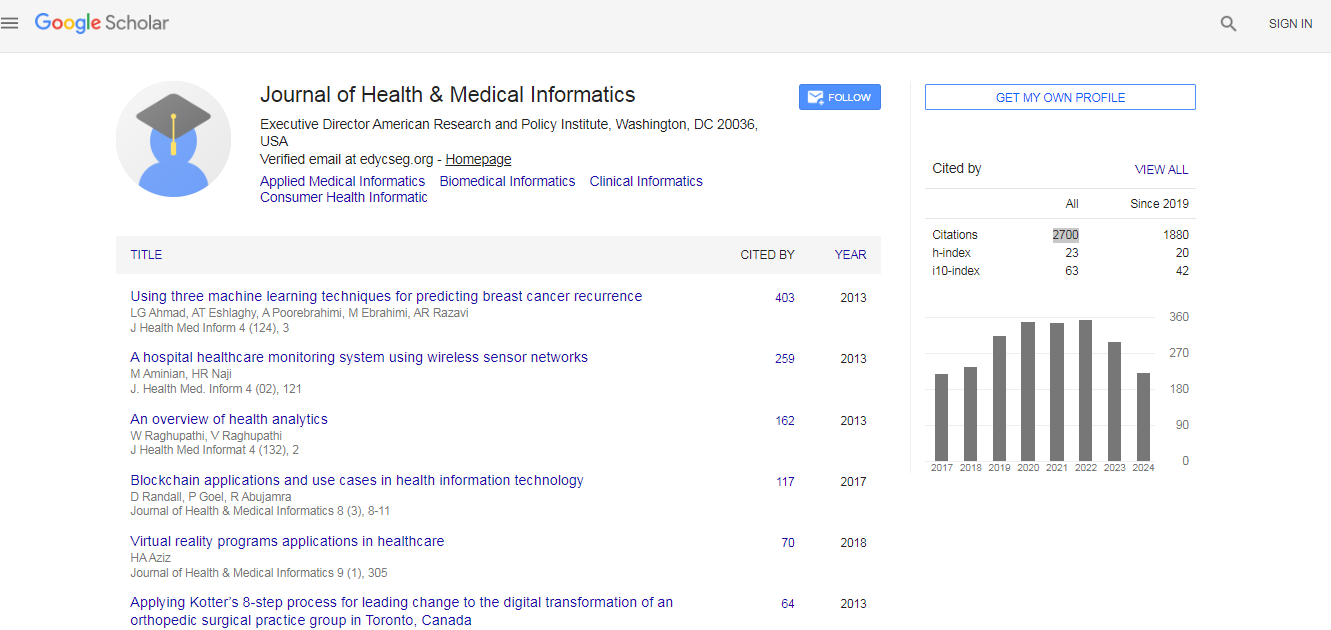
Journal of Health & Medical Informatics received 2700 citations as per Google Scholar report