Brief Report - (2025) Volume 11, Issue 5
Received: 02-Sep-2025, Manuscript No. ldt-25-178449;
Editor assigned: 04-Sep-2025, Pre QC No. P-178449;
Reviewed: 18-Sep-2025, QC No. Q-178449;
Revised: 23-Sep-2025, Manuscript No. R-178449;
Published:
30-Sep-2025
, DOI: 10.37421/2472-1018.2025.11.323
Citation: Wei, Li. ”Lung Transplantation: Advances in Utilization and Outcomes.” J Lung Dis Treat 11 (2025):323.
Copyright: © 2025 Wei L. This is an open-access article distributed under the terms of the Creative Commons Attribution License, which permits unrestricted use, distribution and reproduction in any medium, provided the original author and source are credited.
Recent advancements in lung transplantation are significantly transforming the landscape of this complex procedure, aiming to improve outcomes for recipients and expand the utility of available donor organs. A primary focus lies in optimizing donor lung utilization, recognizing that not all potential grafts are currently used to their full potential. This pursuit involves innovative strategies to assess and manage donor lungs before transplantation, thereby broadening the pool of viable organs for those in need. Ex vivo lung perfusion (EVLP) has emerged as a pivotal technique in this regard, allowing for the objective assessment and potential reconditioning of donor lungs that might otherwise be deemed unsuitable. This technology not only expands the donor pool but also demonstrably improves early graft function, which is crucial for successful transplantation and can potentially reduce the incidence of primary graft dysfunction immediately post-operatively. Concurrent with these developments in donor organ management, there has been a dedicated effort to refine immunosuppressive strategies. The traditional reliance on calcineurin inhibitors is being challenged by the exploration of novel agents and combination therapies. The goal is to strike a more effective balance between suppressing the recipient's immune response to the allograft and maintaining sufficient immune competence to fight off infections, a persistent threat in post-transplant care. Post-transplant care itself is undergoing significant evolution, emphasizing the early detection and proactive management of complications. Primary graft dysfunction (PGD), a severe and immediate post-operative complication, remains a critical area of focus. Advanced diagnostic tools and therapeutic interventions are being investigated to identify PGD earlier and implement timely treatments to improve immediate outcomes. Beyond immediate post-operative concerns, chronic lung allograft dysfunction (CLAD) continues to be the leading cause of late graft loss. Extensive research is dedicated to unraveling the complex pathophysiology of CLAD, aiming to develop more effective surveillance methods and targeted treatment strategies. This includes efforts to differentiate and manage distinct CLAD phenotypes, such as restrictive and obstructive forms. Surgical techniques are also advancing, with a growing adoption of minimally invasive approaches for lung transplantation. These evolving surgical methods hold the promise of reduced post-operative pain, shorter hospital stays, and a quicker recovery for patients, contributing to an improved overall patient experience and potentially faster return to quality of life. The role of the lung microbiome in the context of transplantation is an increasingly important area of investigation. Understanding how the microbial communities within the allograft influence immune responses and contribute to rejection or tolerance could unlock novel therapeutic avenues, particularly for preventing or treating CLAD. Personalized medicine is another burgeoning field, with researchers exploring genetic profiling of both recipients and donors. This approach aims to predict individual responses to immunosuppression and the risk of rejection, paving the way for highly tailored post-transplant management plans that optimize individual outcomes. Furthermore, advancements in cellular therapies, such as the infusion of regulatory T-cells, are being explored as a means to induce immune tolerance. This strategy could potentially reduce the long-term reliance on conventional immunosuppressive drugs, thereby mitigating their associated toxicities and side effects. Finally, the integration of artificial intelligence and machine learning into lung transplantation is showing considerable promise. These technologies are being utilized to analyze vast datasets, enabling better prediction of transplant outcomes, optimization of donor-recipient matching, and personalization of post-transplant monitoring for enhanced patient management.
The field of lung transplantation is witnessing a significant wave of innovation aimed at improving graft survival and recipient outcomes. Central to these advancements is the optimization of donor lung utilization, with strategies designed to maximize the number of viable organs available for transplantation. This includes a concerted effort to assess and potentially recondition marginal donor lungs before they are transplanted. Ex vivo lung perfusion (EVLP) stands out as a critical technology facilitating this optimization. By allowing for the assessment and reconditioning of donor lungs outside the body, EVLP significantly expands the donor pool and has been shown to enhance early graft function. This capability is instrumental in reducing the incidence of primary graft dysfunction, a major hurdle in the immediate post-operative period. In parallel, the development of novel immunosuppressive strategies is a key area of research. Moving beyond traditional calcineurin inhibitors, investigators are exploring new agents and combination regimens. The objective is to achieve effective immunosuppression while minimizing toxicity and preserving immune competence against opportunistic infections, a perpetual challenge for transplant recipients. Post-transplant care protocols are increasingly emphasizing early detection and management of critical complications. Primary graft dysfunction (PGD) is a primary concern, and research is focused on identifying robust biomarkers and advanced imaging techniques to enable earlier diagnosis and more effective therapeutic interventions, thereby improving immediate post-operative survival. Chronic lung allograft dysfunction (CLAD) remains the principal determinant of long-term graft failure. Current research is deeply invested in elucidating the intricate pathophysiology of CLAD to devise better surveillance methods and treatment strategies. This includes the identification and management of distinct CLAD phenotypes, such as restrictive and obstructive forms, offering a more nuanced approach to care. Surgical advancements are also contributing to improved patient recovery. The increasing adoption of minimally invasive surgical techniques in lung transplantation is associated with benefits such as reduced post-operative pain, shorter hospitalizations, and accelerated recovery times, enhancing the patient's overall post-operative journey. Emerging research is exploring the impact of the lung microbiome on allograft health and immune responses. Understanding the complex interactions between the microbiome and the host immune system could lead to novel strategies for preventing or treating CLAD, potentially by modulating microbial composition. Personalized medicine approaches are gaining traction, with a focus on recipient and donor genetic profiling. This strategy aims to predict individual responses to immunosuppressive therapies and the risk of allograft rejection, enabling the development of tailored post-transplant management plans that are specific to each patient's unique biological profile. Cellular therapies, particularly those involving regulatory T-cells, represent a promising frontier in inducing immune tolerance. By fostering tolerance, these therapies may reduce the long-term dependence on conventional immunosuppressants, thereby mitigating the associated systemic toxicities and improving the quality of life for transplant recipients. Finally, the integration of artificial intelligence and machine learning is revolutionizing data analysis in lung transplantation. These powerful tools can predict transplant outcomes, optimize donor-recipient matching, and personalize post-transplant monitoring, ultimately leading to more effective and efficient patient management strategies.
Recent advancements in lung transplantation focus on maximizing donor lung utilization through techniques like ex vivo lung perfusion (EVLP) and developing novel immunosuppressive strategies to minimize rejection and toxicity. Post-transplant care emphasizes early detection and management of complications such as primary graft dysfunction (PGD) and chronic lung allograft dysfunction (CLAD), utilizing personalized monitoring. Minimally invasive surgical techniques, microbiome research, personalized medicine based on genetic profiling, cellular therapies for tolerance induction, and the application of artificial intelligence are further shaping the future of lung transplantation, aiming for improved long-term graft survival and patient outcomes.
None
None
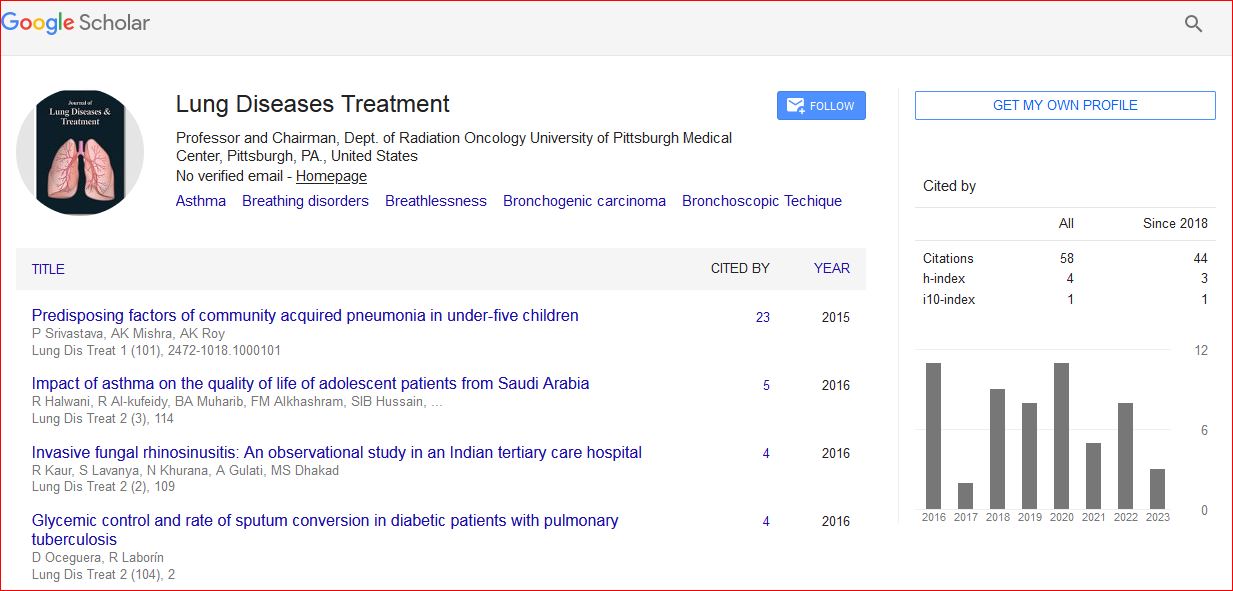
Journal of Lung Diseases & Treatment received 247 citations as per Google Scholar report